


FXOpen

Scalping attracts participants who want to engage with rapid price changes rather than multi-day trends. Scalping trading in cryptocurrencies relies on very short holding periods, tight execution, and clear rules around entries, exits, and risk exposure. It's based around liquidity, volatility, and disciplined decision-making rather than broad market narratives.
What does scalping mean in the crypto world? This article breaks down five commonly used cryptocurrency scalping strategies, explaining how traders structure and manage trades and operate within fast-moving market conditions.
Takeaways
- How may you use crypto scalping? Short-term crypto scalping takes the form of positions being opened and closed within seconds or minutes, where the focus is on small price movements and tight execution rather than longer trends.
- Scalping trading in the cryptocurrency market commonly relies on liquid markets, narrow spreads, predefined risk limits, and frequent decision-making across low timeframes.
- Common cryptocurrency scalping strategies include range trading, breakout setups, chart pattern entries, indicator-based approaches using RSI and Bollinger Bands, and bid-ask spread techniques.
- Time selection, transaction costs, and execution speed play a central role, as frequent trades can magnify both returns and downside exposure.
What Does Scalping Mean in Crypto?
As in any other financial market, in cryptocurrency trading, scalping refers to a type of trading where traders aim to take advantage of short-term market movements. This approach involves entering and exiting trades within minutes, or even seconds, aiming to capitalise on small fluctuations in price.
According to theory, scalpers typically use high leverage and execute many trades to make seemingly insignificant potential gains that add up rather than seeking larger, less frequent potential returns. Scalping is particularly popular in crypto trading, as digital assets are inherently volatile and experience extreme daily price changes.
Pros and Cons of Cryptocurrency Scalp Trading
Scalp trading in the cryptocurrency market has its advantages and disadvantages. Let’s examine some of the most notable pros and cons.
Pros:
- Frequent Trades: The volatility of crypto can present more scalping trades compared with other assets.
- Limited Exposure: Since scalping relies on quick entries and exits, trades spend less time in the market, which could reduce the impact of unexpected events such as economic announcements or regulatory changes.
- Quicker Results: Scalping allows traders to place smaller, more frequent trades, removing the need to wait for them to develop over a longer horizon.
Cons:
- Risk of Significant Losses: As mentioned, scalping requires discipline. Given the need for high leverage, poor risk management can wipe out a scalper’s account within a few trades if they aren’t strict with their strategy.
- Time-Consuming: Scalping requires constant monitoring of the market, which can be both time and energy-consuming. The ongoing need for quick decision-making may also be particularly draining for some traders.
- High Costs: The fees associated with frequent trading, like spreads and transaction costs, can eat into potential returns.
5 Cryptocurrency Scalping Strategies
Let’s dive into particular strategies.
Range Trading
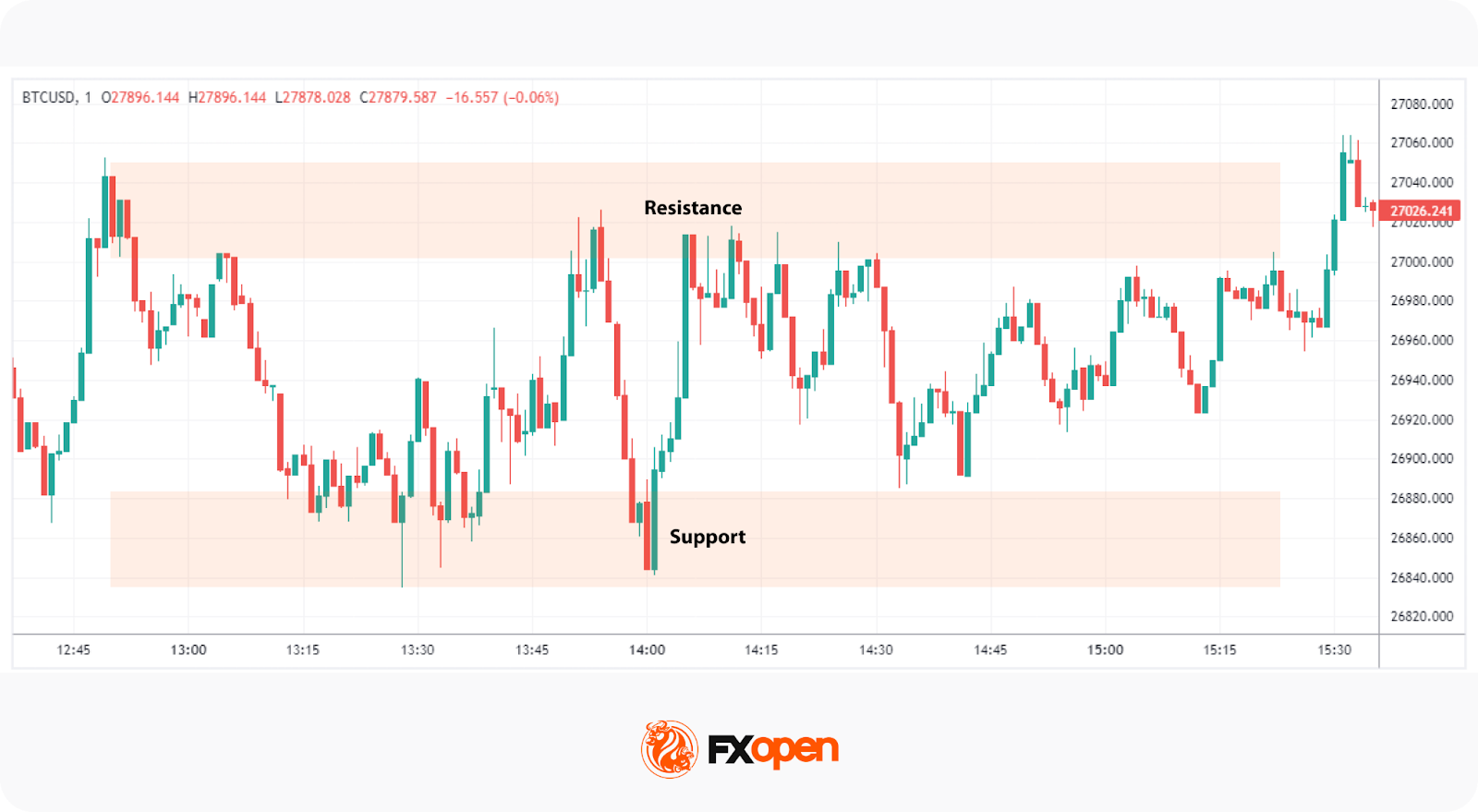
Range trading is a popular strategy among crypto scalers. It involves identifying a specific consolidation range that an asset is likely to fluctuate within. Scalpers aim to buy at the lower end of the range (support) and sell at the upper bound (resistance).
To get started with range trading, traders first need to identify a ranging market on a low timeframe, like the 1 or 5-minute charts. Then, support and resistance levels near the highs and lows of the range are identified. These levels then serve as entry and exit points, with a trader entering at support looking to exit at resistance and vice versa.
Some will look for reversal candlestick patterns, like hammers or shooting stars, at support or resistance, respectively, before entering with a market order. Others will simply set limit orders at their chosen entry point.
Stop losses might be placed beyond the range’s high or low, depending on the direction of trade. Scalpers usually use a 1:1 risk/reward ratio or don’t place stop-loss orders, but the latter is a risky approach.
Breakout Trading
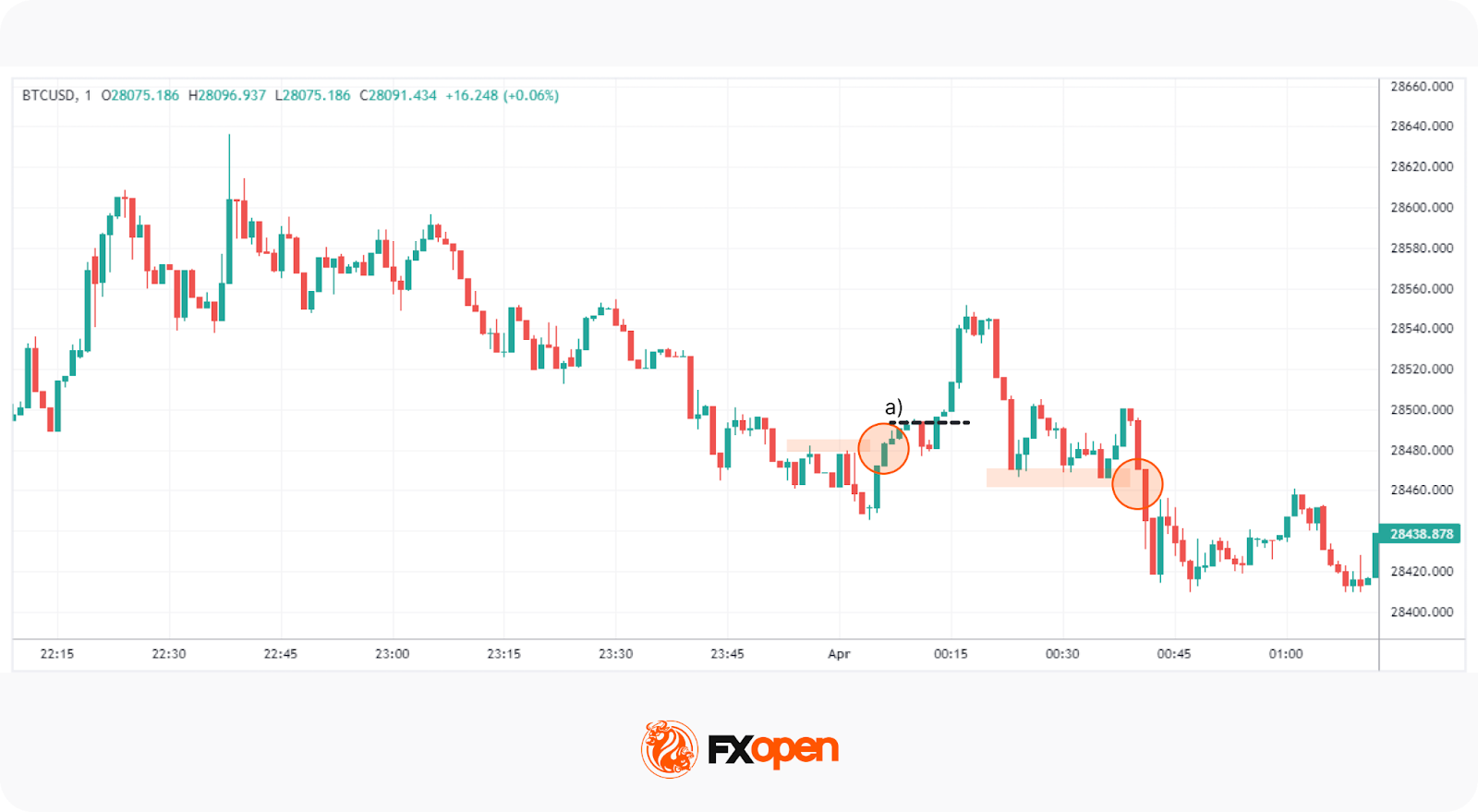
Breakouts occur when a level of support/resistance is broken through, often indicating the start or continuation of a trend. Traders use breakout trading in several ways.
To start, we need to identify a support or resistance level. A common way is to look for relatively equal highs or lows forming, like in the chart above. When the level is broken with a strong impulsive move, traders may enter on the close of the breakout candle. However, if the move isn’t particularly strong, like at a), they could wait for a pullback. Traders can also place a stop order to enter as the pullback itself breaks out, as marked by the dotted lines.
Some traders place take-profit orders at an opposing support or resistance level. However, some may prefer to attempt to ride the trend and trail their stop-loss levels above or below swing points as the move progresses. Similarly, stop losses might be placed above or below the nearest swing points.
Chart Patterns
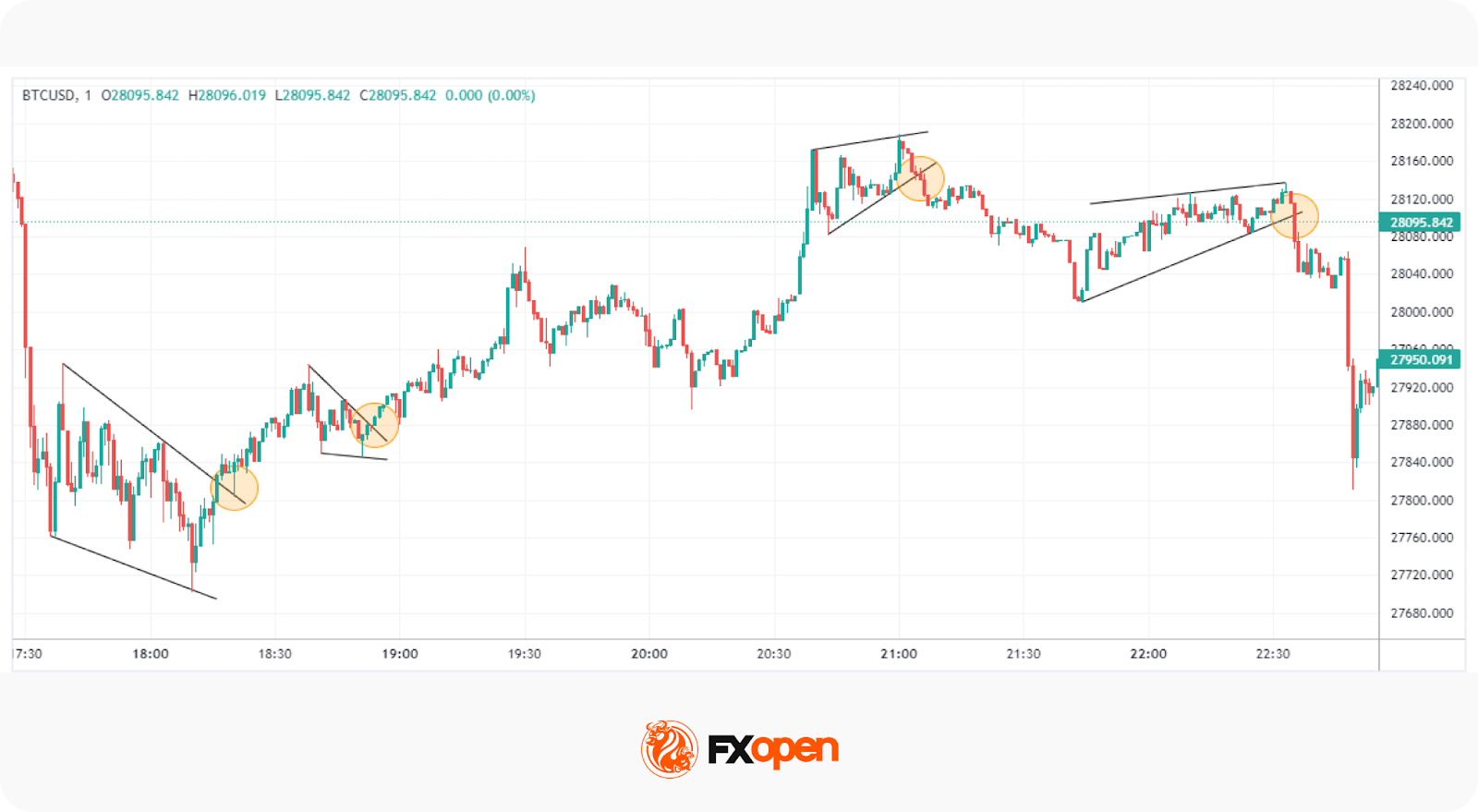
Chart patterns can be a powerful tool for scalping, helping traders to identify potential trend continuations and reversals. While there are many different chart patterns out there, some traders stick to just one or two to avoid confusion. We’ll use rising and falling wedges in this example, as they often lead to strong moves.
There are two ways to enter: either on the breakout or on the retest of the broken trendline. As you can see in the example, entering retests might be a more accurate method, but it’ll mean you miss out on some trades. Conversely, entering on the breakout is riskier, as it could just as easily be a false breakout.
A profit target and stop-loss levels will depend on the pattern you’re using. Given that wedges typically prompt a prolonged trend, you could look for significant areas of support/resistance. For a more conservative approach, you might place a take-profit level at the most extreme point of the pattern. Likewise, stop losses might be set at the most extreme opposing point. For example, you might set a profit target at the high of a bullish wedge and a stop loss beneath its low.
Using the Relative Strength Index and Bollinger Bands
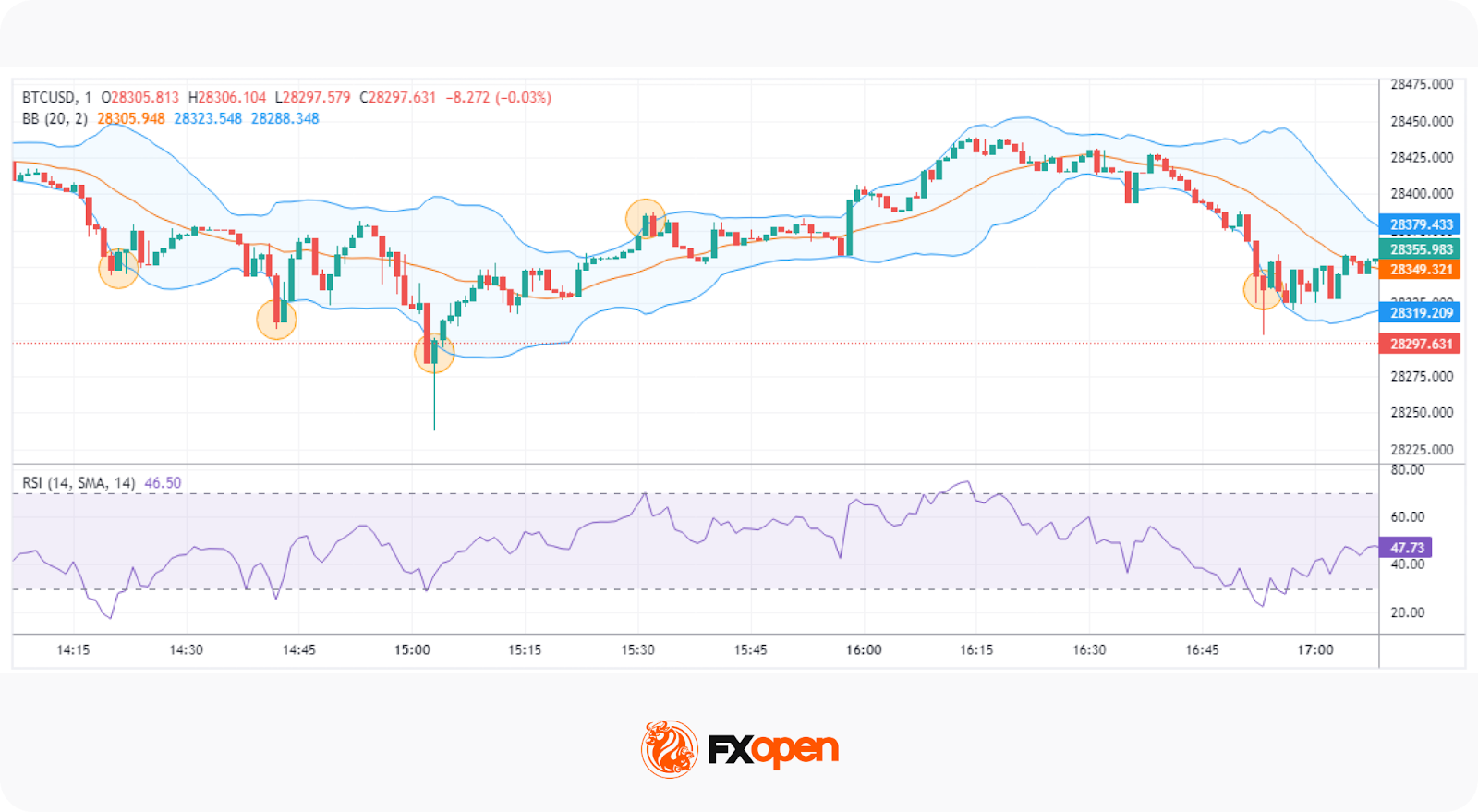
Some scalpers rely heavily on technical indicators to determine entries and exits. One popular combination is the relative strength index (RSI) and Bollinger Bands.
Relative Strength Index (RSI): The RSI measures the strength of price movements and can be used to identify overbought/oversold conditions and divergences. RSI can be particularly valuable for pinpointing short-term reversals.
Bollinger Bands: Bollinger Bands can identify periods of high or low volatility and potential price reversals with their standard deviations. Scalpers often look to short when price reaches the upper band and go long when it touches the lower band.
When RSI crosses 70, indicating overbought conditions, or below 30, showing the asset is oversold, traders can look to confirm a reversal entry with Bollinger Bands. If an asset is overbought and crosses above the upper band, a short position can be considered. If the asset is oversold and price breaches the lower band, a long position could be entered.
As for exit conditions, some scalpers may prefer to place a take-profit order at the midpoint of the Bollinger Bands or the opposing band. Others may close their trades when RSI crosses above or below 50, depending on the direction of trade. In terms of stop losses, they might be placed above or below a nearby area of support or resistance. Alternatively, traders choose a fixed distance for each trade.
At FXOpen, we offer both of these indicators in the TickTrader platform. There, you’ll also discover a whole host of additional indicators and tools ready to help you navigate the markets.
Bid-Ask Spread
The bid-ask spread refers to the gap between the maximum price a buyer can offer (bid) and the minimum price a seller can accept (ask) for a specific asset. Scalpers may take advantage of the bid-ask spread.
When spreads are wide, traders place buy orders and sell orders simultaneously. They buy at the bid price and sell at the ask price, capturing the spread. This strategy is common for less liquid cryptocurrencies where spreads are naturally wider.
How May You Create a Scalping Crypto Strategy?
Now, it’s time to create your own scalping trading strategy for crypto. While your strategy will ultimately be unique to you and your preferences, you may try these steps to begin developing a system.
- Choose a Timeframe: Select a short timeframe that suits your trading style, such as 1-, 3-, or 5-minute, to base your trades on. Try to balance choosing one that allows you to take advantage of short-term movements while giving you enough time to think through your decisions.
- Identify Support and Resistance Levels: Use trendlines and horizontal levels to pinpoint potential entry and exit points. You may also look for psychological or dynamic levels if desired. Set a rule that you’ll only enter and exit at these levels to avoid impulsive decision-making.
- Employ Indicators: Use indicators to confirm your entries and exits. You can set specific criteria to filter out trades, like only trading a resistance level when RSI is overbought.
- Develop a Risk Management Plan: Risk management is almost as important as your strategy itself. Traders use stop-loss orders, limit orders, and proper position sizing to manage trades. Also, they might set predetermined loss limits and rules for avoiding emotional decision-making.
- Test and Refine: Continuously backtest and optimise your strategy using past price action, and make adjustments as needed to improve its performance. Some traders keep a trading journal to record their trades and analyse their decision-making process.
Final Thoughts
Of course, these steps aren’t exclusive to the crypto market. While scalping crypto may be preferable for some traders, you can also apply similar strategies to the forex, commodity, and stock markets – but you need to adjust them to suit these markets.
You’ll also need to account for differences in liquidity, trading hours, and fee structures, as these factors can materially change execution and risk exposure. Regardless of the market, scalping remains heavily dependent on consistency, cost control, and clearly defined rules rather than broad directional views.
Once you feel ready to actually implement your strategy, you can consider opening an FXOpen account to gain access to hundreds of assets in our TickTrader trading platform.
FAQ
Is It Easy to Use Cryptocurrency Scalping?
Despite its short time horizon, cryptocurrency scalping involves a demanding workflow. Traders operate on low timeframes where execution speed, platform stability, and transaction costs materially affect outcomes.
Decision-making is compressed, leaving little room for hesitation or interpretation. Market noise can distort signals, particularly during periods of low liquidity or sudden volatility spikes. As a result, scalping is used by participants with defined rules, consistent availability, and the ability to manage repeated exposure without drifting from their framework.
Which Crypto Is Most Popular for Scalping?
There isn’t one single crypto that’s most popular for scalping. Traders usually choose assets with high liquidity, strong intraday volatility, and consistent trading volume, as these conditions allow for quick entries and exits. In practice, the most popular crypto for scalping is simply the one that’s most active and volatile at the moment.
What Is the Most Popular Scalping Strategy for Crypto?
There isn’t one universally “most popular” scalping strategy in crypto, but most approaches focus on capturing very small price movements on the 1-minute chart. Traders typically use this timeframe to spot short-term momentum, quick breakouts, or brief pullbacks during active market conditions.
*Important: At FXOpen UK, Cryptocurrency trading via CFDs is only available to our Professional clients. They are not available for trading by Retail clients. To find out more information about how this may affect you, please get in touch with our team.
This article represents the opinion of the Companies operating under the FXOpen brand only. It is not to be construed as an offer, solicitation, or recommendation with respect to products and services provided by the Companies operating under the FXOpen brand, nor is it to be considered financial advice.
Stay ahead of the market!
Subscribe now to our mailing list and receive the latest market news and insights delivered directly to your inbox.


Latest articles


Market Analysis: AUD/USD And NZD/USD Turn Bullish, Is Rally Set to Extend?
AUD/USD started a fresh increase above 0.6970 and 0.7000. NZD/USD is also rising and might aim for more gains above 0.5850.
Important Takeaways for AUD USD and NZD USD Analysis Today
· The Aussie Dollar started

FOMC Minutes in Focus: USD/JPY and USD/CAD Pull Back from Highs
The US dollar has shifted into a corrective phase following its previous rally, while market participants adopt a wait-and-see approach ahead of the release of the Federal Reserve’s meeting minutes. The weakening of the dollar has already led to