


DAX Uptrend at Risk from Fundamentals
FXOpen
March proved to be one of the weakest months for the German index in recent years, though conditions stabilised by mid-April. At present, the DAX (Germany 40 mini on FXOpen) is showing a solid recovery, trading around 24,650. The rebound has been largely driven by gains in Rheinmetall and Infineon, highlighting investor preference for defence and technology stocks amid the current geopolitical backdrop.
The index remains highly sensitive to developments around the Strait of Hormuz. Ongoing reports of blockades and resumptions in shipping continue to fuel uncertainty in energy markets, directly affecting costs for German industry. At the same time, ECB policy remains a limiting factor: the central bank has kept rates at 2.0%, and despite inflation concerns, markets are not pricing in easing before the summer.
Technical picture
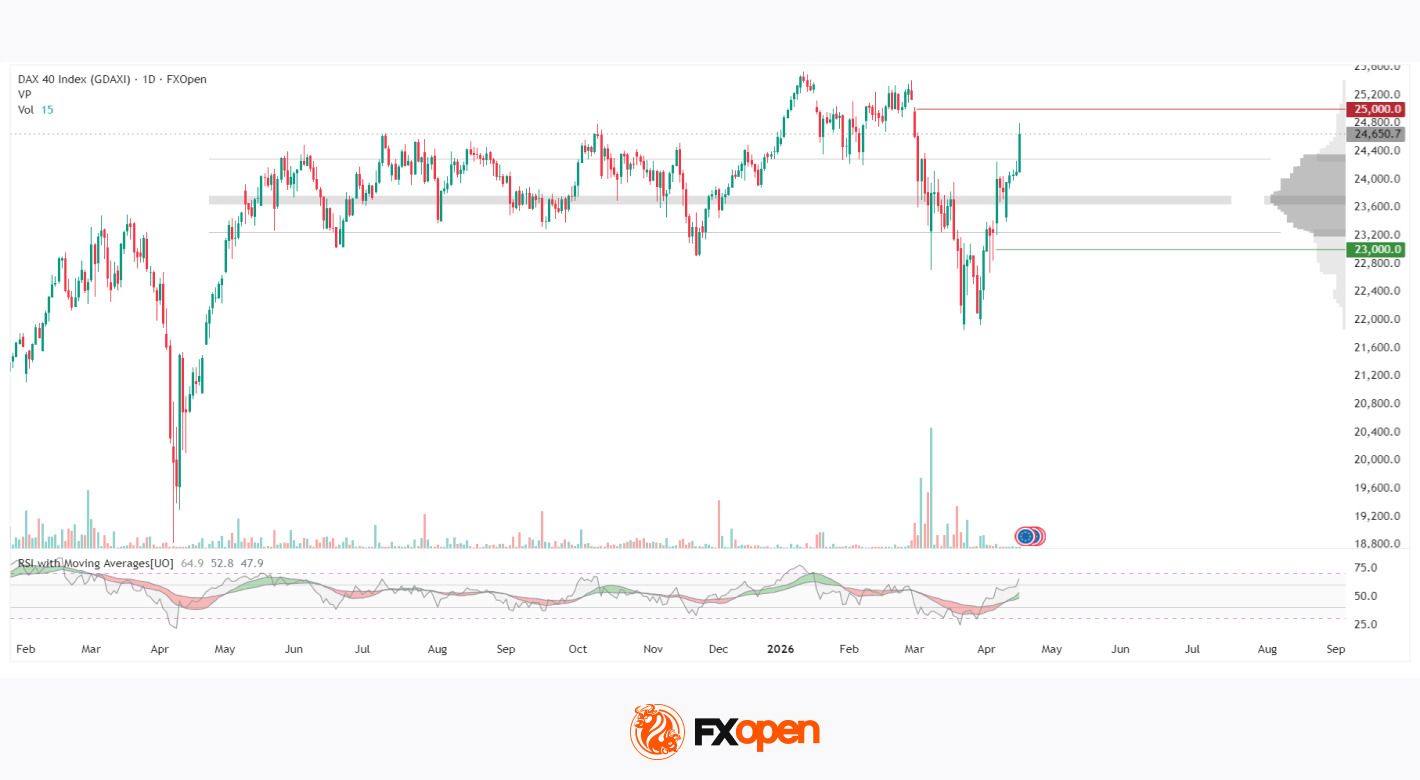
After reaching highs near 25,500 in January 2026, the index appears to have entered a sharp correction phase. A gap on 2 March may have signalled a shift in sentiment, prompting traders to unwind long positions. On 9 March, an extreme spike in vertical volume was recorded as the market attempted to break below 23,000. The index later tested strong support at 22,000, where heavy buying appears to have emerged and a base may have begun forming.
Following the rebound, price has consolidated above the POC zone of 23,500–23,800, which may have since transitioned into support. Volume levels have normalised after the March volatility, suggesting that panic selling could have subsided. The RSI indicator points to improving momentum, rising to 64.9 and holding above its moving averages, which may indicate renewed bullish strength. The next key resistance for buyers is seen at 25,000.
Summary
Holding above the POC zone may have restored a bullish structure, potentially returning control to buyers. The 23,000 level is now shaping up as a strong support area, while RSI with MA signals suggest recovering demand. However, despite the current rebound, the broader fundamental backdrop remains mixed, with geopolitical risks and ECB policy expectations continuing to influence the index’s trajectory.
Trade global index CFDs with zero commission and tight spreads (additional fees may apply). Open your FXOpen account now or learn more about trading index CFDs with FXOpen.
This article represents the opinion of the Companies operating under the FXOpen brand only. It is not to be construed as an offer, solicitation, or recommendation with respect to products and services provided by the Companies operating under the FXOpen brand, nor is it to be considered financial advice.
Stay ahead of the market!
Subscribe now to our mailing list and receive the latest market news and insights delivered directly to your inbox.


Latest articles

CAD/JPY: The Yen's Most Historic Move in 30 Years Meets a Fragile Support
Two central banks are heading in genuinely opposite directions this week, and the tension is unmistakable. The Bank of Canada held rates steady at 2.25% on September 2, with a mildly hawkish tilt as policymakers acknowledged a broadening economic

USD/JPY and USD/CAD Await Key Fed Decision
The US dollar is consolidating against the yen and Canadian dollar ahead of the key event of the week — the Federal Reserve meeting. The Fed is widely expected to raise its policy rate by 25 basis points to a range

UnitedHealth: Fundamentals Are Healing, Now the Chart Must Agree
UnitedHealth finds itself in a genuinely split narrative right now, trading near $388, down about 15.9% from its 52-week high, even as the fundamental picture keeps improving. Q2 earnings beat expectations, with revenue of $112.03 billion, and the