


GBP/USD: Sterling Under Pressure Despite Strong GDP Data
FXOpen

Fundamental Background
UK GDP grew by 0.6% in the first quarter of 2026, notably above the revised 0.2% reading recorded in the fourth quarter of 2025. The main contribution came from the services sector, which expanded by 0.8%. Nevertheless, strong macroeconomic data failed to support sterling: CPI inflation accelerated to 3.3% year-on-year in March, up from 3.0% in February, mainly due to higher motor fuel prices linked to the Middle East conflict.
At its meeting on 30 April, the Bank of England kept the base rate unchanged at 3.75% in an 8–1 vote, while several MPC members signalled the possibility of further tightening should inflationary pressure persist. According to the International Monetary Fund, UK GDP growth in 2026 is expected to reach only 0.8%, representing the largest downgrade among G7 economies.
Technical Picture
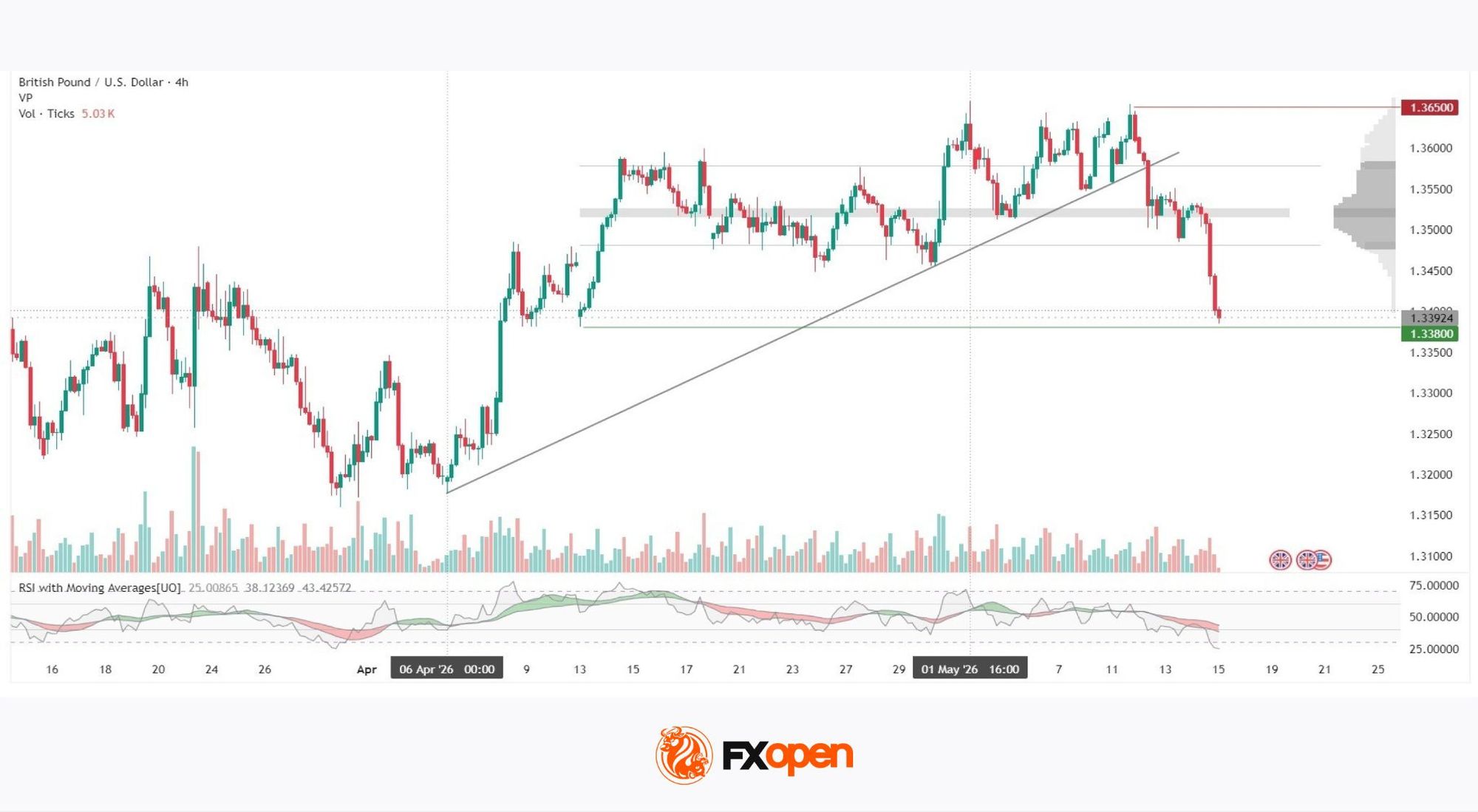
From 6 April to 1 May, GBP/USD appears to have developed an upward trend supported by a rising trendline. As the pair approached the peak, price action seems to have become increasingly compressed, potentially forming a reversal structure with a dense profile concentration in the 1.3480–1.3580 range amid rising selling pressure. After breaking below the trendline and moving outside the profile range, the pair may have accelerated lower.
GBP/USD is currently trading below the horizontal volume zone, which could indicate continued seller dominance. The lower boundary of the profile, followed by the POC area around 1.3515–1.3520, may act as a potential reference zone for buyers. If the pair manages to regain the upper boundary of the profile at 1.3580, the next resistance area could be located near 1.3650 around the recent trend highs.
Support around 1.3380 corresponds to prior price extremes that preceded the April rally and may act as an important structural support area, which the pair appears to be approaching. This could potentially limit further downside within the current move.
The RSI + MAs indicator shows readings of 26, 38 and 43. The moving averages appear to remain tilted lower, which may reflect ongoing downside pressure. However, the RSI has entered oversold territory, which could be taken into consideration as a potential signal of exhaustion.
Key Takeaways
Strong first-quarter GDP data has not eased concerns over inflation and monetary policy uncertainty, and this fundamental conflict is likely to determine the pair’s future direction. From a technical perspective, the main RSI + MAs reading has entered oversold territory, although there are still no clear signs of a reversal.
Trade over 50 forex markets 24 hours a day with FXOpen. Take advantage of low commissions, deep liquidity, and spreads from 0.0 pips (additional fees may apply). Open your FXOpen account now or learn more about trading forex with FXOpen.
This article represents the opinion of the Companies operating under the FXOpen brand only. It is not to be construed as an offer, solicitation, or recommendation with respect to products and services provided by the Companies operating under the FXOpen brand, nor is it to be considered financial advice.
Stay ahead of the market!
Subscribe now to our mailing list and receive the latest market news and insights delivered directly to your inbox.


Latest articles

CAD/JPY: The Yen's Most Historic Move in 30 Years Meets a Fragile Support
Two central banks are heading in genuinely opposite directions this week, and the tension is unmistakable. The Bank of Canada held rates steady at 2.25% on September 2, with a mildly hawkish tilt as policymakers acknowledged a broadening economic

USD/JPY and USD/CAD Await Key Fed Decision
The US dollar is consolidating against the yen and Canadian dollar ahead of the key event of the week — the Federal Reserve meeting. The Fed is widely expected to raise its policy rate by 25 basis points to a range

UnitedHealth: Fundamentals Are Healing, Now the Chart Must Agree
UnitedHealth finds itself in a genuinely split narrative right now, trading near $388, down about 15.9% from its 52-week high, even as the fundamental picture keeps improving. Q2 earnings beat expectations, with revenue of $112.03 billion, and the