


FXOpen

Geopolitical tensions in the Middle East had remained the primary macro driver for the gold market over recent weeks; however, on 8 April the situation shifted sharply as the United States and Iran agreed to a temporary two-week ceasefire, including the reopening of the Strait of Hormuz and a pause in military strikes. The easing of acute tensions triggered a sharp decline in oil prices and a return of risk appetite across global markets, weighing on demand for safe-haven assets. As a result, gold retreated from intraday highs near 4,850.
That said, the durability of the agreement remains uncertain. Reports of localised strikes in the region continue to keep market participants on edge, preventing a full dismissal of Iranian-related risks. Additional influence comes from macroeconomic data—particularly US inflation—whose interpretation in the context of Federal Reserve rate expectations continues to shape dollar dynamics. Structural support from central banks persists, with China continuing to increase its gold reserves, while Malaysia and South Korea have resumed purchases after an extended pause.
Technical Outlook
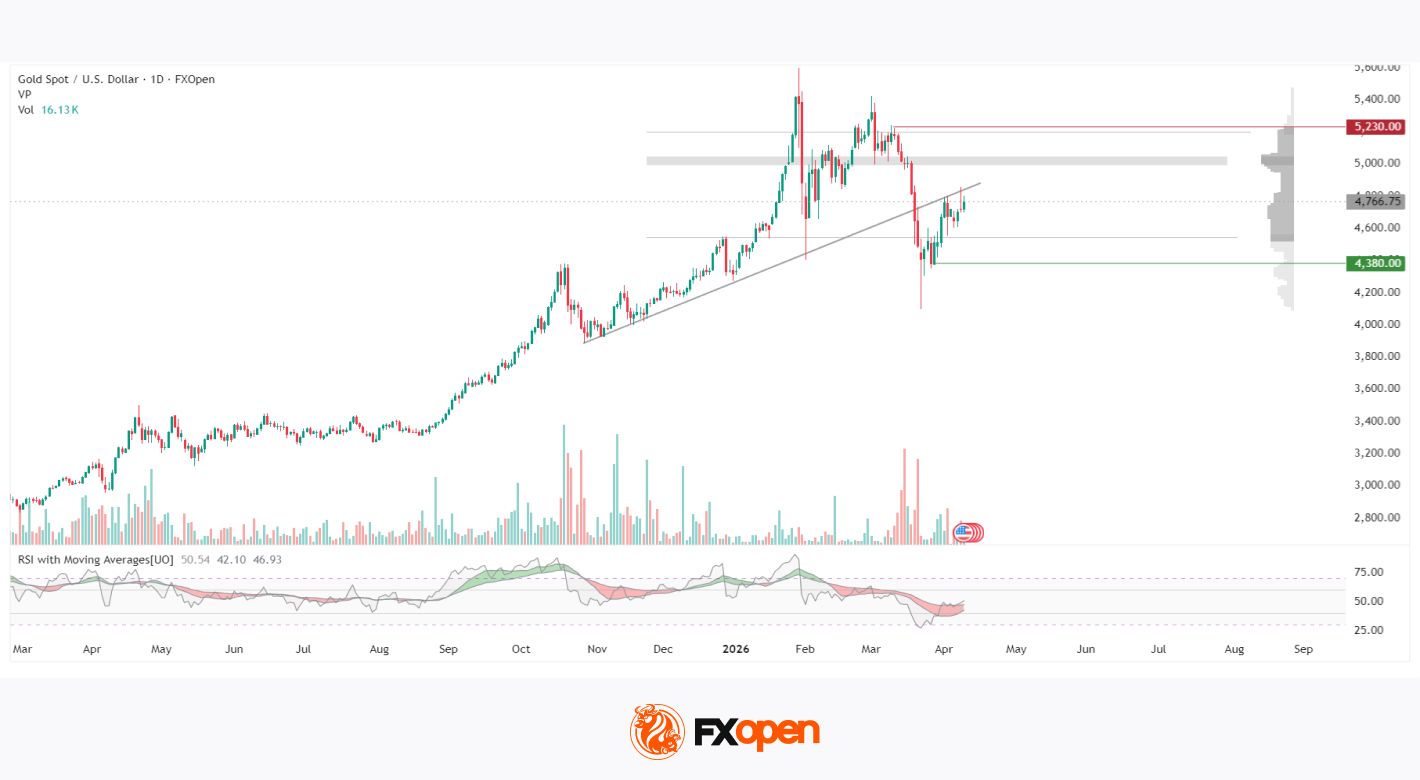
On the daily chart of XAU/USD, a clear two-phase structure is evident. An uptrend that began in March 2024 drove prices to a record high in the 5,595–5,600 range by late January 2026, followed by a sharp and impulsive decline. Notably, the peak in vertical volume occurred not at the price high, but during the subsequent sell-off in March 2026, indicating a climactic phase of selling rather than buying.
The low of that move was recorded near 4,100, from which price rebounded to current levels around 4,766. The horizontal volume profile reveals a dense cluster in the 4,990–5,050 zone, marking the point of control (POC) where trading activity has been most concentrated. This area acts as a natural resistance to further upside. The next significant level above lies at 5,230.
The ascending trend line originating from autumn 2025 was broken to the downside in March 2026 and no longer serves as support for buyers. It may now act as an additional resistance near the 5,000 level.
The lower boundary of the current range is located around 4,380. The RSI and moving averages stand at 50.54 / 42.10 / 46.93, with the RSI hovering near the neutral 50 level and remaining below both upward-sloping moving averages, signalling a lack of confirmed directional momentum.
Summary
Following the completion of an active corrective phase, gold has stabilised below the POC zone, while the RSI remains near neutral levels without a clear directional bias. The current trading range—4,380 on the downside and 5,230 on the upside—continues to define the market structure, as geopolitical developments and Federal Reserve rhetoric shape short-term price dynamics.
Start trading commodity CFDs with tight spreads (additional fees may apply). Open your trading account now or learn more about trading commodity CFDs with FXOpen.
This article represents the opinion of the Companies operating under the FXOpen brand only. It is not to be construed as an offer, solicitation, or recommendation with respect to products and services provided by the Companies operating under the FXOpen brand, nor is it to be considered financial advice.
Stay ahead of the market!
Subscribe now to our mailing list and receive the latest market news and insights delivered directly to your inbox.


Latest articles


Commodity Currencies on the Rise: Market Focus Shifts to US and Canadian Data
Commodity-linked currencies continue to strengthen, while the US dollar remains under pressure amid easing geopolitical tensions and a shift in investor preference towards riskier assets. Reports of a temporary ceasefire between the US and Iran have helped stabilise sentiment and

European Currencies Strengthen: Dollar Under Pressure Following Ceasefire News
European currencies posted solid gains, while the US dollar came under pressure amid easing geopolitical tensions following reports of a two-week ceasefire agreement between the United States and Iran. Reduced demand for so-called safe-haven assets acted as the primary driver,