


Nasdaq-100: Price Concentrates Within the Market Profile Zone
FXOpen
Last week was one of the worst for US technology stocks since the beginning of 2026, with the index losing around 4.6% under the influence of two opposing factors. Firstly, the market continued to reassess the pace of returns on AI infrastructure investment — concerns that spending is outpacing actual returns triggered a sell-off in semiconductor stocks, with the Philadelphia Semiconductor Index falling nearly 8% over the week. Secondly, the US-Iran conflict surrounding the Strait of Hormuz escalated over the weekend: Tehran claimed responsibility for attacks on commercial vessels, while the US responded with air strikes. By Monday morning, tensions had eased somewhat as both sides announced a temporary halt to hostilities and agreed to hold talks in Doha on Tuesday. Against this backdrop, Nasdaq-100 futures gained around 1.1%.
Technical Picture
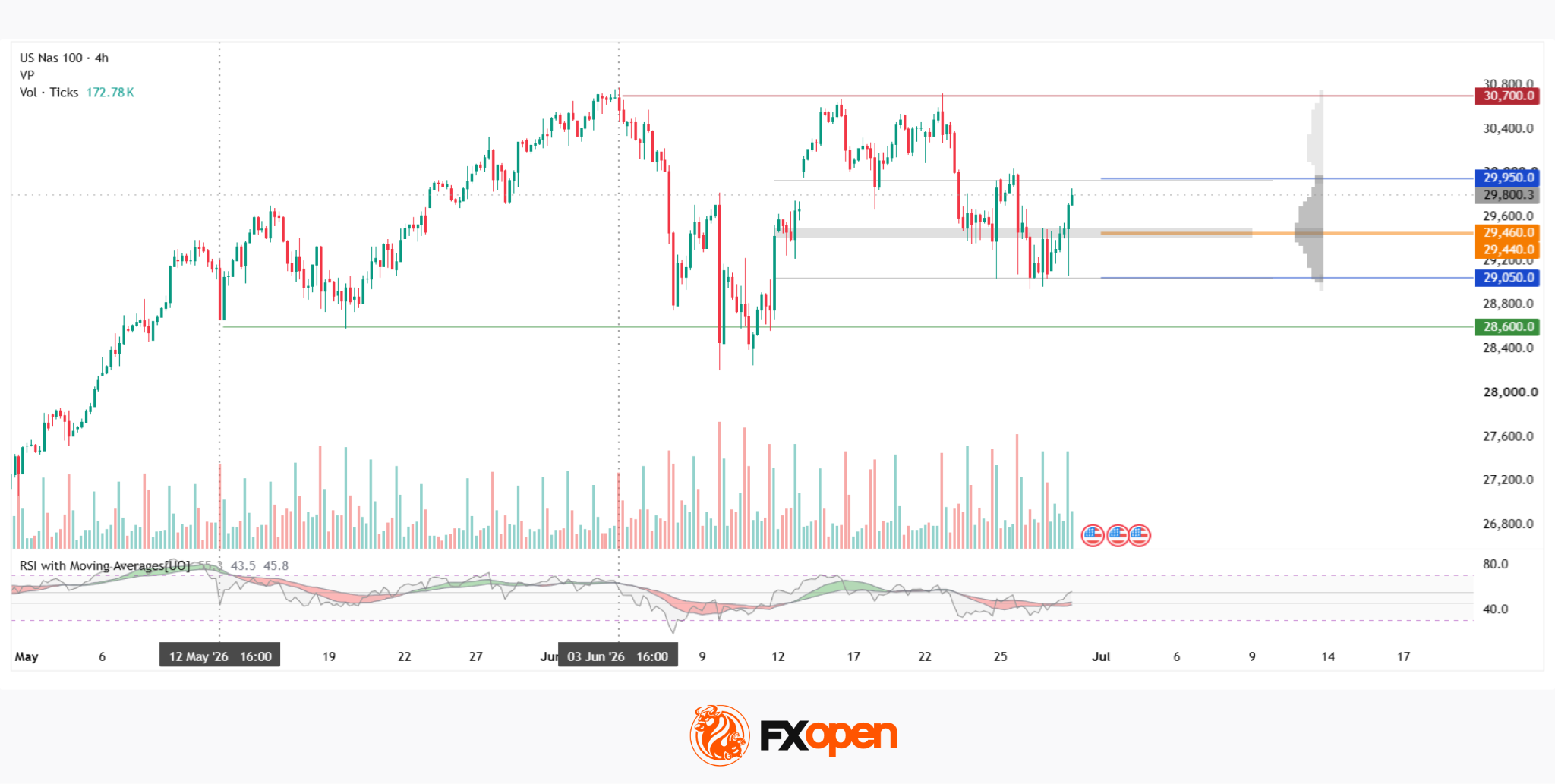
On the four-hour chart, the Nasdaq-100 (NDXm on FXOpen) has been trading within a sideways range since May, bounded by support near 28,600 and resistance around 30,700 — a range that formed following the June peak. After reaching that peak, the index experienced a sharp decline on 9 June, accompanied by exceptionally high trading volume. As a result of buyers defending the local lows, the price has since concentrated near the centre of the current range.
At present, the price is holding above the POC zone at 29,440–29,460, which may be viewed by market participants as the key point of attraction within the range. The price is approaching intermediate resistance at the upper boundary of the profile at 29,950, above which lies the red resistance level. RSI + MAs shows readings of 55, 43 and 45 — the oscillator remains above both moving averages, although the moving averages have yet to confirm a potential reversal and remain near the lower boundary of the neutral zone.
Key Takeaways
News of a pause in the US-Iran conflict supported the Nasdaq-100 at the market open, although concerns surrounding AI-related spending remain unresolved and were the primary driver of price action throughout June. The POC zone continues to serve as the key reference point for the balance between supply and demand: this is where the largest concentration of horizontal volume is located, and holding above this area could indicate that the market is preparing to continue its move towards the upper part of the range.
Trade global index CFDs with zero commission and tight spreads (additional fees may apply). Open your FXOpen account now or learn more about trading index CFDs with FXOpen.
This article represents the opinion of the Companies operating under the FXOpen brand only. It is not to be construed as an offer, solicitation, or recommendation with respect to products and services provided by the Companies operating under the FXOpen brand, nor is it to be considered financial advice.
Stay ahead of the market!
Subscribe now to our mailing list and receive the latest market news and insights delivered directly to your inbox.


Latest articles
CAD/JPY: The Yen's Most Historic Move in 30 Years Meets a Fragile Support
Two central banks are heading in genuinely opposite directions this week, and the tension is unmistakable. The Bank of Canada held rates steady at 2.25% on September 2, with a mildly hawkish tilt as policymakers acknowledged a broadening economic

USD/JPY and USD/CAD Await Key Fed Decision
The US dollar is consolidating against the yen and Canadian dollar ahead of the key event of the week — the Federal Reserve meeting. The Fed is widely expected to raise its policy rate by 25 basis points to a range

UnitedHealth: Fundamentals Are Healing, Now the Chart Must Agree
UnitedHealth finds itself in a genuinely split narrative right now, trading near $388, down about 15.9% from its 52-week high, even as the fundamental picture keeps improving. Q2 earnings beat expectations, with revenue of $112.03 billion, and the