


EUR/USD Analysis: Who Is in Control?
FXOpen

Two central banks, two hawkish tones — but only one dollar just took a hit. The ECB delivered a 25bp hike in June, its first since 2023, lifting the deposit rate to 2.25% as Middle East-driven energy costs pushed headline inflation to 3.2% in May before easing to 2.8% in June, with growth downgraded to 0.8% amid weaker confidence.
The Fed, under new Chair Kevin Warsh, held rates at 3.50%-3.75% for a fourth straight meeting, with a hawkish dot-plot shift initially fueling hike expectations. However, the June employment report—released on July 3rd—showed nonfarm payrolls rising by just 57K against 110K expected, the weakest reading in four months, while the unemployment rate dipped to 4.2% only due to a labor force participation rate falling to 61.5%, its lowest level in five years.
The result: both central banks' communications currently lean hawkish, but with the Fed's data now sending mixed signals. Which side ultimately prevails could well set the tone for EUR/USD's trend into year-end.
EUR/USD Technical Analysis
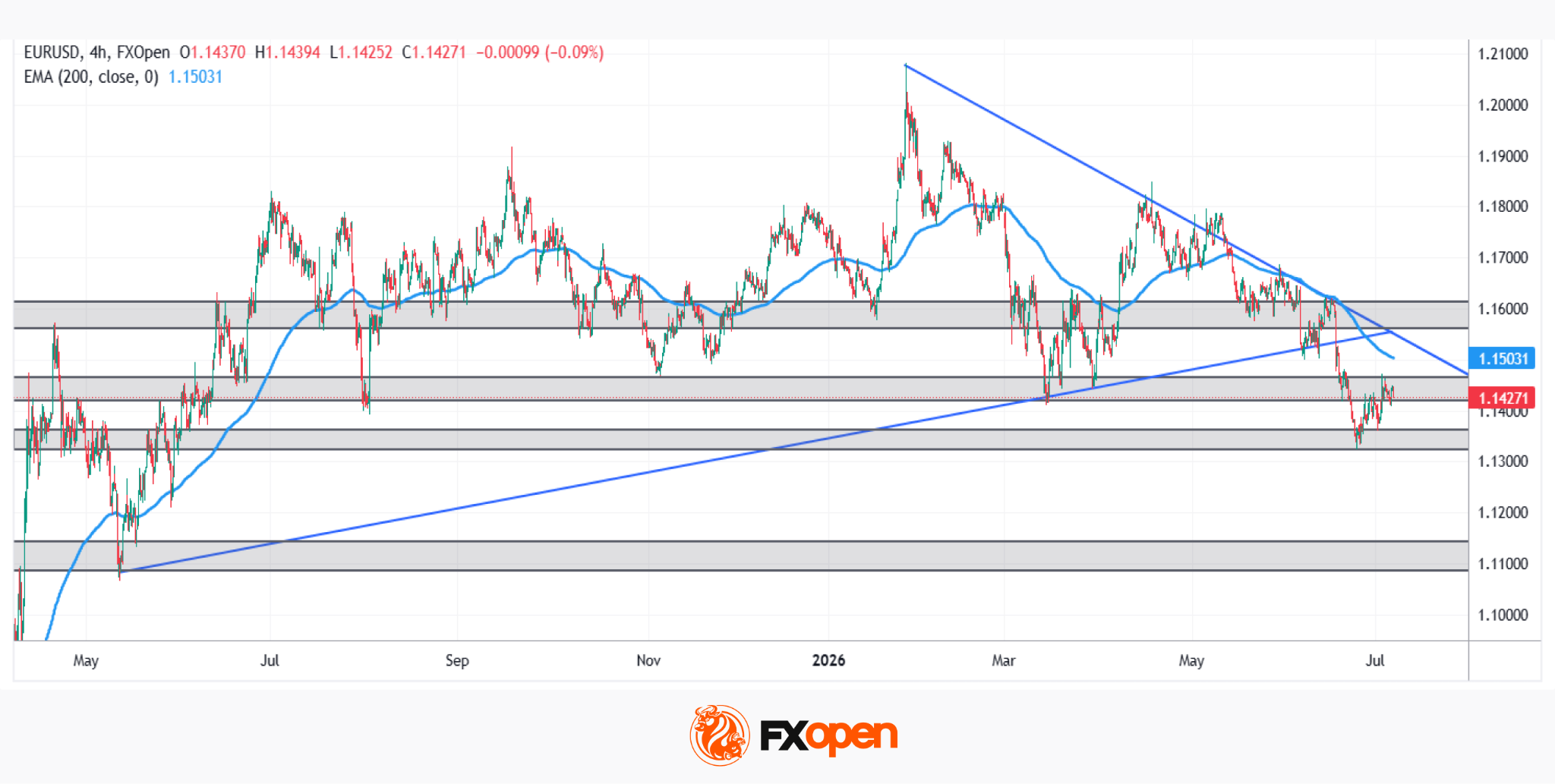
EUR/USD has spent roughly the past year confined within a broad consolidation range, as the chart illustrates, with price repeatedly oscillating between well-defined boundaries and no decisive breakout sustained in either direction.
Bullish Scenario
After briefly breaking below the range's base support, price snapped back quickly, reclaiming the range almost as fast as it left it. For renewed bullish momentum to take hold, EUR/USD first needs to hold above the 1.1420-1.1460 support zone. The next, more decisive test lies with the descending trendline originating from January's highs, which has been respected consistently throughout the year. This same area also converges with the 200-period EMA and the long-term ascending trendline broken to the downside in June. This confluence makes 1.1500-1.1550 the pivotal zone: a clean break above it would open the door for the euro to regain sustained strength against the dollar.
Bearish Scenario
The alternative reading is that price is currently only retesting the previously broken key support at 1.1420-1.1460. A decisive break below the low formed near 1.1320-1.1350 would confirm renewed downside momentum, clearing the path to resume the broader medium-term downtrend, where the next significant support comes into play around 1.1100-1.1150.
Either scenario will likely require confluence between technical structure and fundamentals, with central bank rhetoric and action remaining the key driver. ECB or Fed — which one becomes the catalyst for EUR/USD's next major trend?
Trade over 50 forex markets 24 hours a day with FXOpen. Take advantage of low commissions, deep liquidity, and spreads from 0.0 pips (additional fees may apply). Open your FXOpen account now or learn more about trading forex with FXOpen.
This article represents the opinion of the Companies operating under the FXOpen brand only. It is not to be construed as an offer, solicitation, or recommendation with respect to products and services provided by the Companies operating under the FXOpen brand, nor is it to be considered financial advice.
Stay ahead of the market!
Subscribe now to our mailing list and receive the latest market news and insights delivered directly to your inbox.


Latest articles

CAD/JPY: The Yen's Most Historic Move in 30 Years Meets a Fragile Support
Two central banks are heading in genuinely opposite directions this week, and the tension is unmistakable. The Bank of Canada held rates steady at 2.25% on September 2, with a mildly hawkish tilt as policymakers acknowledged a broadening economic

USD/JPY and USD/CAD Await Key Fed Decision
The US dollar is consolidating against the yen and Canadian dollar ahead of the key event of the week — the Federal Reserve meeting. The Fed is widely expected to raise its policy rate by 25 basis points to a range

UnitedHealth: Fundamentals Are Healing, Now the Chart Must Agree
UnitedHealth finds itself in a genuinely split narrative right now, trading near $388, down about 15.9% from its 52-week high, even as the fundamental picture keeps improving. Q2 earnings beat expectations, with revenue of $112.03 billion, and the