


USD/JPY Analysis: BoJ Tightens the Grip — Will the Yen Reverse Course?
FXOpen

On June 16, the Bank of Japan raised its policy rate to 1.0% (7-1 vote) and confirmed a gradual taper of government bond purchases, settling at a "cruising" pace of ¥2 trillion monthly from April 2027. The message is clear: normalisation continues, as inflation risks remain skewed to the upside of the 2% target.
For the yen, the medium-term picture remains constructive, though not without friction — one dissenter warned that Middle East tensions threaten output and jobs more than prices. The BoJ has also built itself a safety net, ready to intervene should yields spike unexpectedly.
Technical Analysis
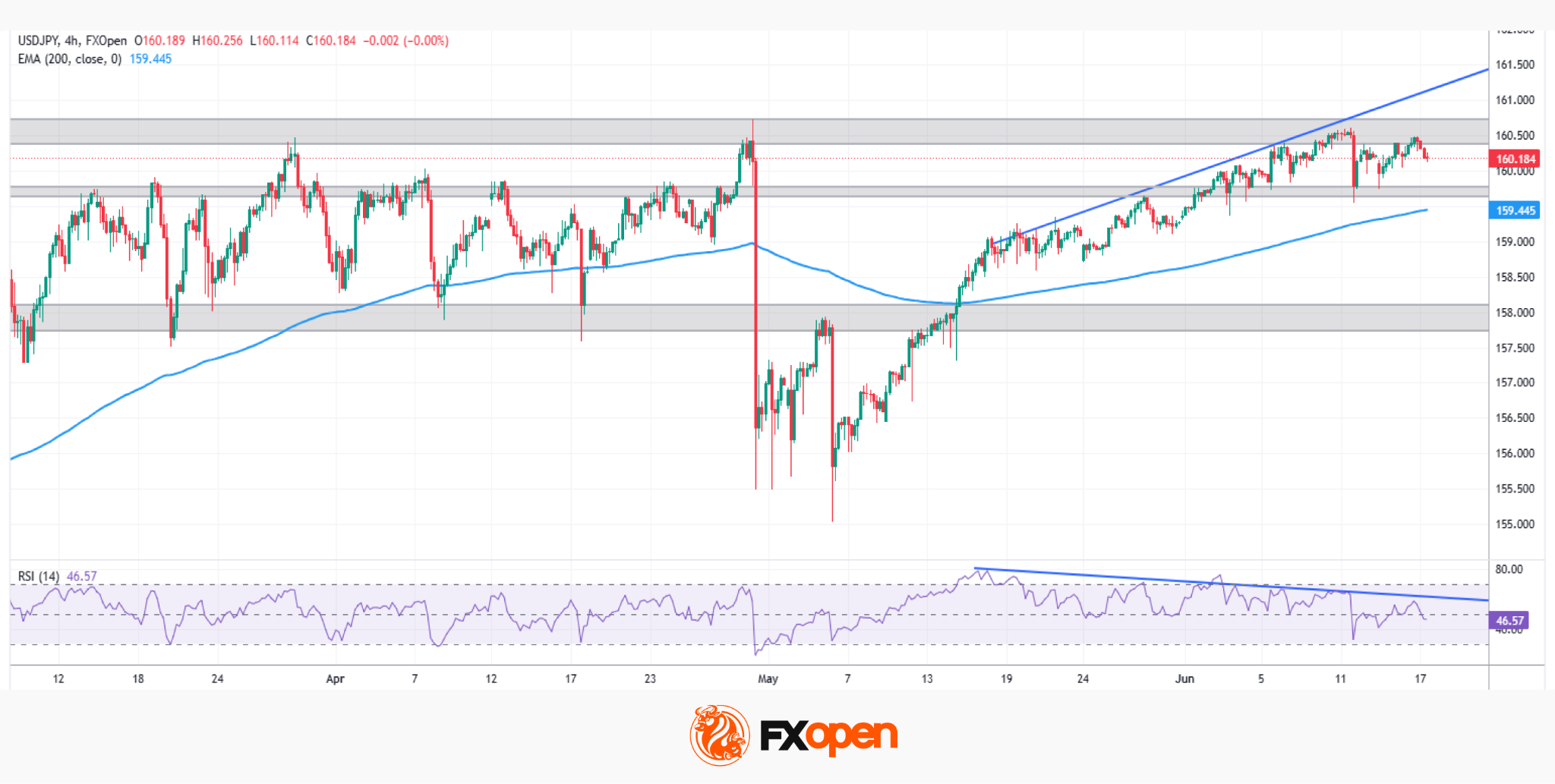
The rate hike didn’t boost the yen. Still, USD/JPY continues to struggle against the formidable resistance at 160.00, a level that carries weight both psychologically and technically. This zone has already rejected multiple advances throughout 2026, and price now approaches it once again — setting the stage for a decisive test.
Bullish scenario: a confirmed break above 160.00-161.00 would need to be followed by a retest on the 4H chart, with a subsequent break of the highs that triggered the initial move — only then would the breakout gain real confirmation, opening the path toward 162.00 and a retest of the 2024 highs. Without this follow-through, the pair may continue to struggle beneath this psychological ceiling, capped by repeated rejection.
Bearish scenario: early confirmation of a reversal would come from a break of the first key support at 159.60-159.80, where the 200-period EMA on the 4H chart is already being tested, much as it has held in the past. A more decisive support could be at 157.80-158.00; a break below this level could trigger a sharper decline. Reinforcing the bearish case is a notable RSI divergence since 18 May, with lower highs on the oscillator against higher highs on price — a classic signal of fading bullish momentum.
The line in the sand is drawn at 160.00-161.00: whoever crosses it first, dollar or yen, will likely set the tone for the months ahead.
Trade over 50 forex markets 24 hours a day with FXOpen. Take advantage of low commissions, deep liquidity, and spreads from 0.0 pips (additional fees may apply). Open your FXOpen account now or learn more about trading forex with FXOpen.
This article represents the opinion of the Companies operating under the FXOpen brand only. It is not to be construed as an offer, solicitation, or recommendation with respect to products and services provided by the Companies operating under the FXOpen brand, nor is it to be considered financial advice.
Stay ahead of the market!
Subscribe now to our mailing list and receive the latest market news and insights delivered directly to your inbox.


Latest articles

CAD/JPY: The Yen's Most Historic Move in 30 Years Meets a Fragile Support
Two central banks are heading in genuinely opposite directions this week, and the tension is unmistakable. The Bank of Canada held rates steady at 2.25% on September 2, with a mildly hawkish tilt as policymakers acknowledged a broadening economic

USD/JPY and USD/CAD Await Key Fed Decision
The US dollar is consolidating against the yen and Canadian dollar ahead of the key event of the week — the Federal Reserve meeting. The Fed is widely expected to raise its policy rate by 25 basis points to a range

UnitedHealth: Fundamentals Are Healing, Now the Chart Must Agree
UnitedHealth finds itself in a genuinely split narrative right now, trading near $388, down about 15.9% from its 52-week high, even as the fundamental picture keeps improving. Q2 earnings beat expectations, with revenue of $112.03 billion, and the