


Alibaba (BABA) Shares Drop Approximately 10% Over the Week
FXOpen
Last Wednesday, the closing price of Alibaba (BABA) shares was $152.28, while the closing price yesterday was $135.59, marking a 2026 low.
The roughly 10% decline was driven by a combination of bearish factors, including:
→ Unexpected resignation of Lin Junyang (Justin Lin) – Lin led Alibaba’s AI project Qwen, a key LLM platform. According to Reuters, this is the third notable departure from Qwen in 2026, and Lin has not provided a reason.
→ Overall bearish trend in tech stocks – High capital expenditures combined with uncertainty over profitability have weighed on the sector. Alibaba previously committed at least CNY 380 billion (around $52 billion) for AI and cloud infrastructure investments over three years.
→ Pressure from US regulators – Reports indicate that Alibaba was added to a list of companies cooperating with China’s military, potentially complicating business. Although the listing was later removed from the US Federal Register, the attempt itself increases the risk of new sanctions from the administration.
→ Geopolitical tensions – With the threat of the Middle East conflict escalating into a wider war, financial markets see increased demand for safe-haven assets. Chinese tech companies are particularly exposed to these pressures.
Despite these challenges, technical analysis offers hope for the bulls.
Technical Analysis of Alibaba (BABA) Shares
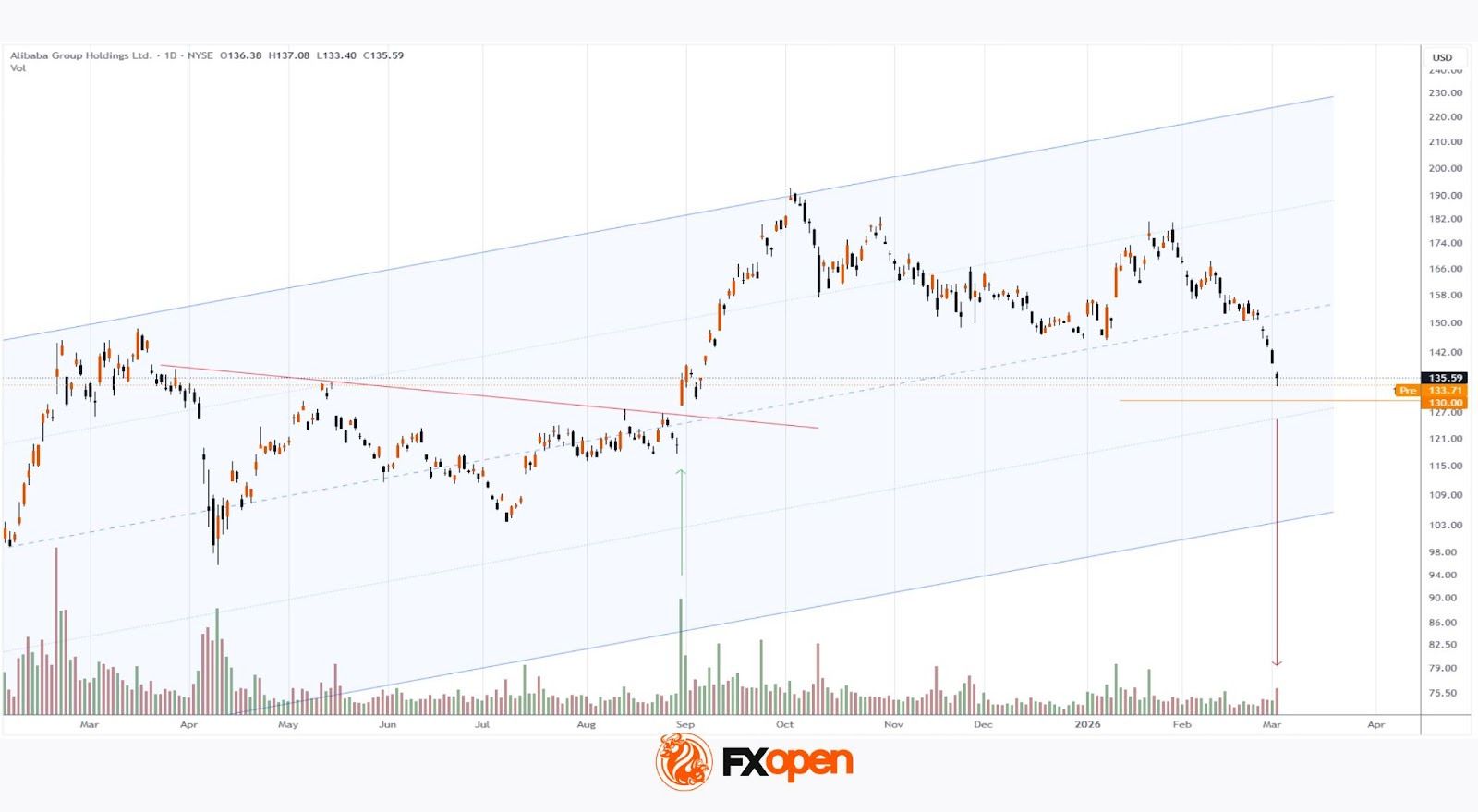
Take a look at the most recent BABA candlestick – the closing price is well above the low, while trading volume has surged to the highest level since late January. This can be interpreted as a sign of demand preventing further price declines.
Looking at history confirms this observation. In late August, BABA shares broke through the descending trendline and, on extremely high volumes, began a run towards multi-month highs.
At that time, demand clearly dominated – bulls may gain confidence near the $130 mark and prevent a deeper drop in the stock.
Buy and sell stocks of the world's biggest publicly-listed companies with CFDs on FXOpen’s trading platform. Open your FXOpen account now or learn more about trading share CFDs with FXOpen.
This article represents the opinion of the Companies operating under the FXOpen brand only. It is not to be construed as an offer, solicitation, or recommendation with respect to products and services provided by the Companies operating under the FXOpen brand, nor is it to be considered financial advice.
Stay ahead of the market!
Subscribe now to our mailing list and receive the latest market news and insights delivered directly to your inbox.


Latest articles

CAD/JPY: The Yen's Most Historic Move in 30 Years Meets a Fragile Support
Two central banks are heading in genuinely opposite directions this week, and the tension is unmistakable. The Bank of Canada held rates steady at 2.25% on September 2, with a mildly hawkish tilt as policymakers acknowledged a broadening economic

USD/JPY and USD/CAD Await Key Fed Decision
The US dollar is consolidating against the yen and Canadian dollar ahead of the key event of the week — the Federal Reserve meeting. The Fed is widely expected to raise its policy rate by 25 basis points to a range

UnitedHealth: Fundamentals Are Healing, Now the Chart Must Agree
UnitedHealth finds itself in a genuinely split narrative right now, trading near $388, down about 15.9% from its 52-week high, even as the fundamental picture keeps improving. Q2 earnings beat expectations, with revenue of $112.03 billion, and the