


FXOpen
This week, the media highlighted that the share price of NIO Inc. (NIO), the Chinese smart electric vehicle manufacturer, fell after management announced a $1 billion share offering to raise capital. The funds are intended to finance projects such as the development of EV charging infrastructure.
Indeed, on 10 September, a wide bearish gap appeared on the chart, but by 11 September (yesterday) the bulls had almost entirely recovered the decline. This indicates bullish strength, possibly supported by a solid fundamental backdrop, driven by:
→ the expansion of NIO’s model range (which now includes the budget ONVO brand as well as the premium Firefly series);
→ higher delivery volumes – in the latest reporting quarter the company delivered 72,056 vehicles, up 25.6% compared to the previous period.
The NIO Inc. (NIO) price chart points to further bullish signals.
Technical Analysis of NIO Stock
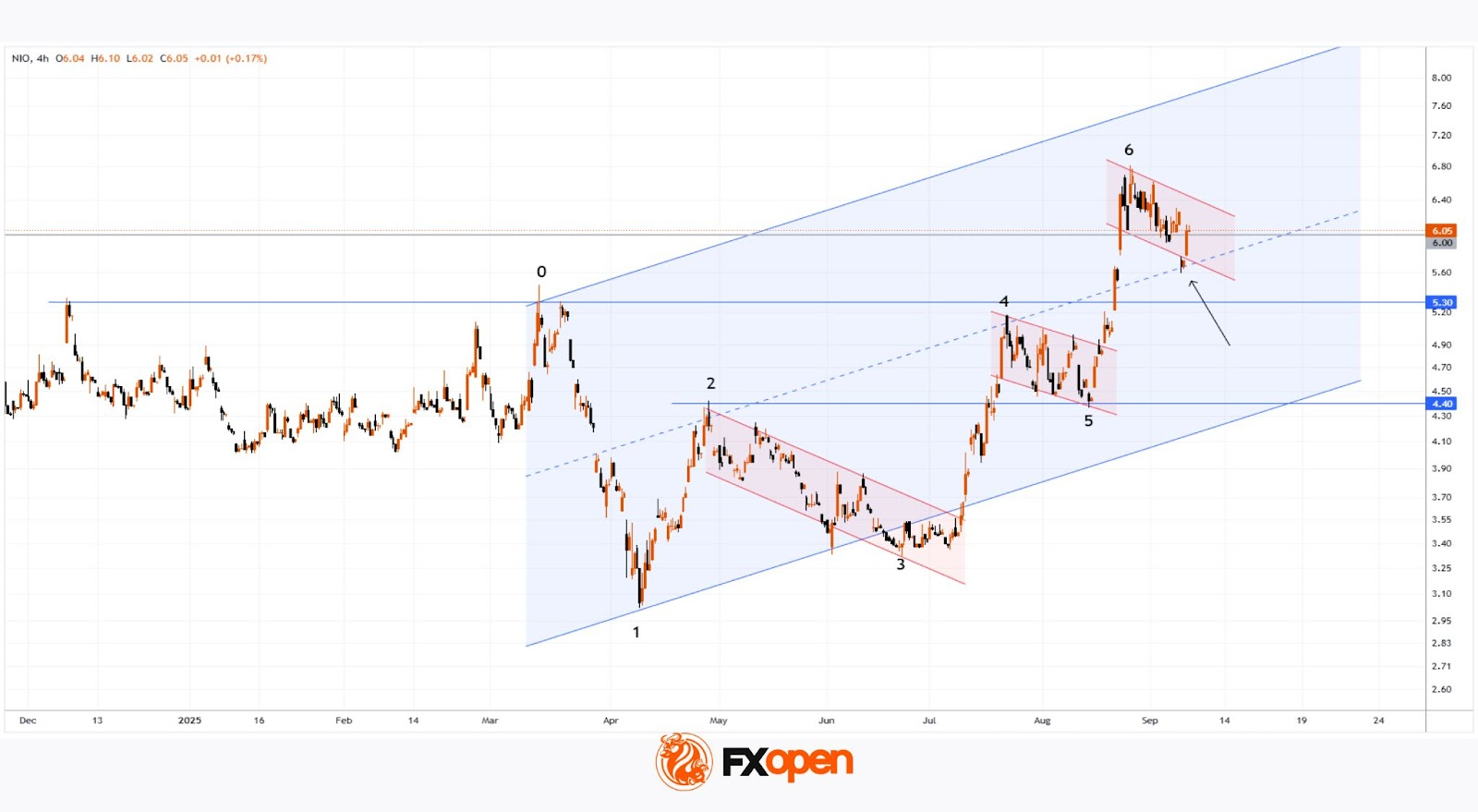
Price movements are forming an ascending channel (shown in blue), with the following features:
→ The bulls managed to recover from the sharp decline 0→1, after which we observe the 1→6 sequence, typical of a bullish market, as each subsequent low and high is higher than the previous one.
→ Upward impulses are steep, while the subsequent pullbacks (which can be interpreted as a bullish flag pattern, shown in red) look like healthy corrections.
→ Key resistance levels are turning into support. This was the case with $4.40 and $5.30. The black arrow shows that the channel’s median line also acts as support – which led to the price moving above the psychological $6 level.
From a bearish perspective, resistance may be provided by the upper boundary of the current correction zone. However, the third bullish flag could be broken (as were the previous two), which would open the way for NIO’s share price to reach the upper boundary of the blue channel.
Buy and sell stocks of the world's biggest publicly-listed companies with CFDs on FXOpen’s trading platform. Open your FXOpen account now or learn more about trading share CFDs with FXOpen.
This article represents the opinion of the Companies operating under the FXOpen brand only. It is not to be construed as an offer, solicitation, or recommendation with respect to products and services provided by the Companies operating under the FXOpen brand, nor is it to be considered financial advice.
Stay ahead of the market!
Subscribe now to our mailing list and receive the latest market news and insights delivered directly to your inbox.


Latest articles

Market Insights with Gary Thomson: USD, CAD, and Commodities in Focus
In this video, we’ll explore the key economic events and market trends, shaping the financial landscape. Get ready for insights into financial markets to help you navigate the week ahead. Let’s dive in!
In this episode of Market
USD/CHF Exchange Rate Rebounds from Multi-Year Low
The resilience of the Swiss economy and inflation remaining below 1% have made the Swiss franc an attractive safe-haven asset amid an extremely tense geopolitical backdrop and elevated gold prices. As the USD/CHF chart shows, the US dollar fell

Palantir Technologies (PLTR) Shares Show Strong Growth at the Beginning of March
Shares of Palantir Technologies (PLTR), a company specialising in big data analytics software, have become one of the stock market’s standout performers at the start of this spring.
While the closing price on the last trading day of February