


FXOpen

Yesterday, Oracle (ORCL) shares dropped by 5% following reports that investment firm Blue Owl Capital had withdrawn from financing a $10bn data centre project in Michigan.
The collapse of the deal raises questions over Oracle’s ability to meet its commitments under large-scale contracts (including a $300bn agreement with OpenAI) without further straining its balance sheet.
According to media reports, the company’s total debt has climbed to $111bn. The recent share price decline reflects growing concerns that Oracle’s “credit bubble” may struggle to withstand the AI arms race, making it increasingly difficult for the company to secure funding for its ambitious construction projects.
As a result:
→ ORCL shares fell below $180 for the first time since mid-June;
→ the chances of returning to the previously established ascending channel now look slim.
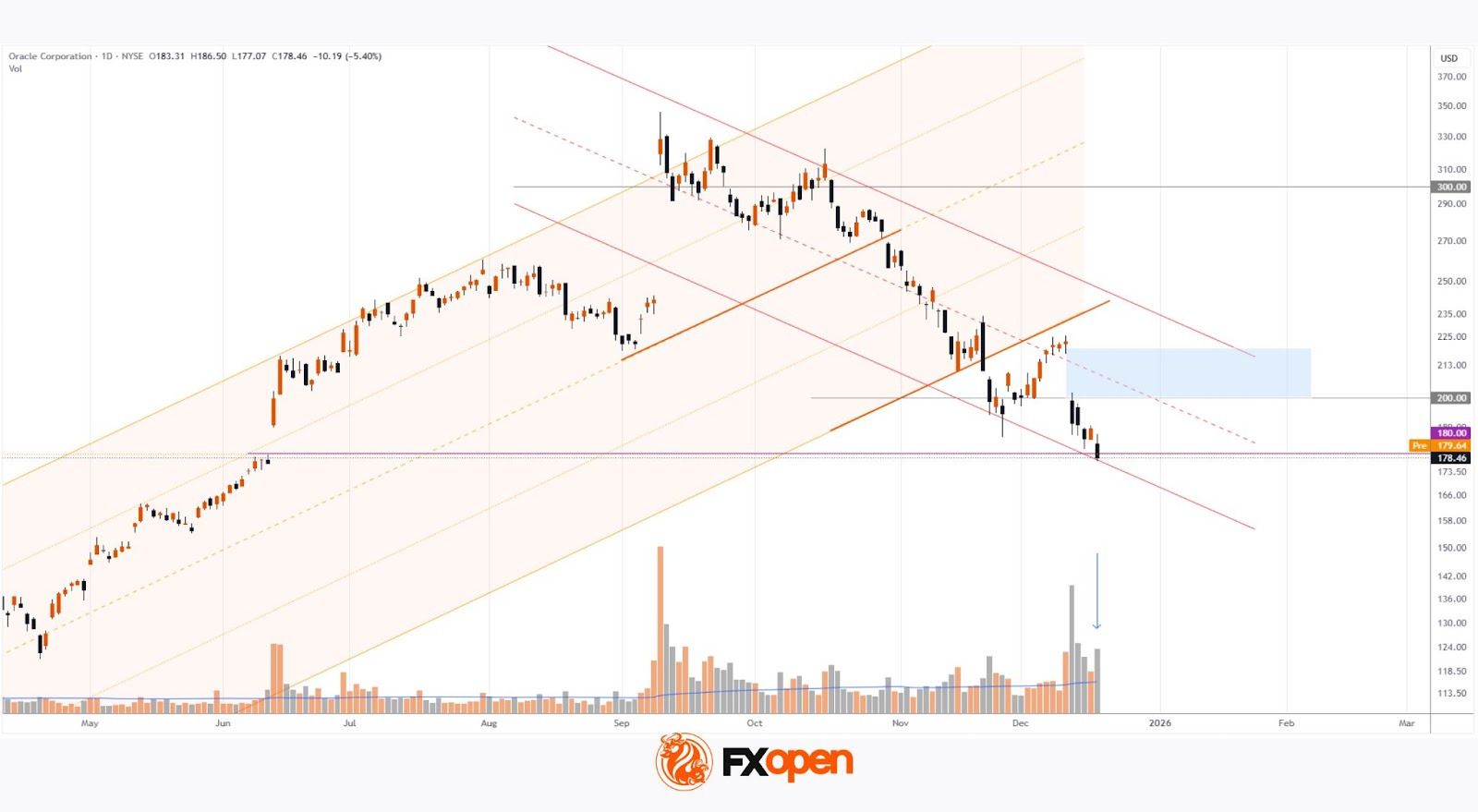
However, technical analysis of the ORCL chart highlights four factors that could support a rebound:
1 → The price has filled the bullish gap formed in mid-June;
2 → The share price has fallen by around 50% from its all-time high set in early September, which may attract risk-tolerant buyers looking to pick up a stock that has halved in value;
3 → The price is trading close to the lower boundary of the descending channel that frames the current decline;
4 → Yesterday’s surge in trading volumes may signal panic selling, which often precedes a rebound.
A fifth factor could be an oversold signal from your chosen oscillator.
That said, even if ORCL shares begin to recover, the upside may be capped by a key resistance zone (marked in blue), which formed after a bearish gap above the psychological $200 level following the quarterly earnings release.
Buy and sell stocks of the world's biggest publicly-listed companies with CFDs on FXOpen’s trading platform. Open your FXOpen account now or learn more about trading share CFDs with FXOpen.
This article represents the opinion of the Companies operating under the FXOpen brand only. It is not to be construed as an offer, solicitation, or recommendation with respect to products and services provided by the Companies operating under the FXOpen brand, nor is it to be considered financial advice.
Stay ahead of the market!
Subscribe now to our mailing list and receive the latest market news and insights delivered directly to your inbox.


Latest articles

FOMC Minutes in Focus: USD/JPY and USD/CAD Pull Back from Highs
The US dollar has shifted into a corrective phase following its previous rally, while market participants adopt a wait-and-see approach ahead of the release of the Federal Reserve’s meeting minutes. The weakening of the dollar has already led to
NVDA Shares Approach Key Resistance
Nvidia’s chip production is concentrated with Taiwanese contractor TSMC, increasing the company’s exposure to geopolitical risks and US export policy. Restrictions on shipments to China, including decisions related to H20-series chips, have led to significant financial adjustments, which

EUR/USD and GBP/USD at Range Boundaries Ahead of Geopolitical Decisions
European currencies are entering a consolidation phase following an attempted recovery, while market participants adopt a wait-and-see approach amid uncertainty surrounding the geopolitical landscape. Current price action reflects a balance between a softer US dollar and a lack of sustained