FXOpen

Following the close of the main trading session on 29 January, Tesla (TSLA) released an earnings report that fell short of analysts' expectations. The company reported:
→ Earnings per share (EPS) of $0.66, below the expected $0.74.
→ Revenue of $25.7 billion, missing the forecasted $27.3 billion.
Despite this, Tesla’s stock chart shows that the candle on 30 January closed around the key psychological level of $400, approximately 2% higher than the previous day’s close.
Investor concerns over weak quarterly results may have been offset by Elon Musk’s optimistic outlook, as he suggested Tesla’s business would return to growth in 2025, driven by:
→ New, more affordable electric vehicle models.
→ Progress in autonomous driving technology.
According to Business Insider, Musk stated that:
→ Tesla will begin testing a paid autonomous vehicle service in Austin, Texas, by June 2025.
→ The Full Self-Driving (FSD) software will undergo human-free testing in multiple states, including California, within a year.
→ Tesla is on track to become “the most valuable company” in the world, with strengthened production lines making 2026 an “epic” year.
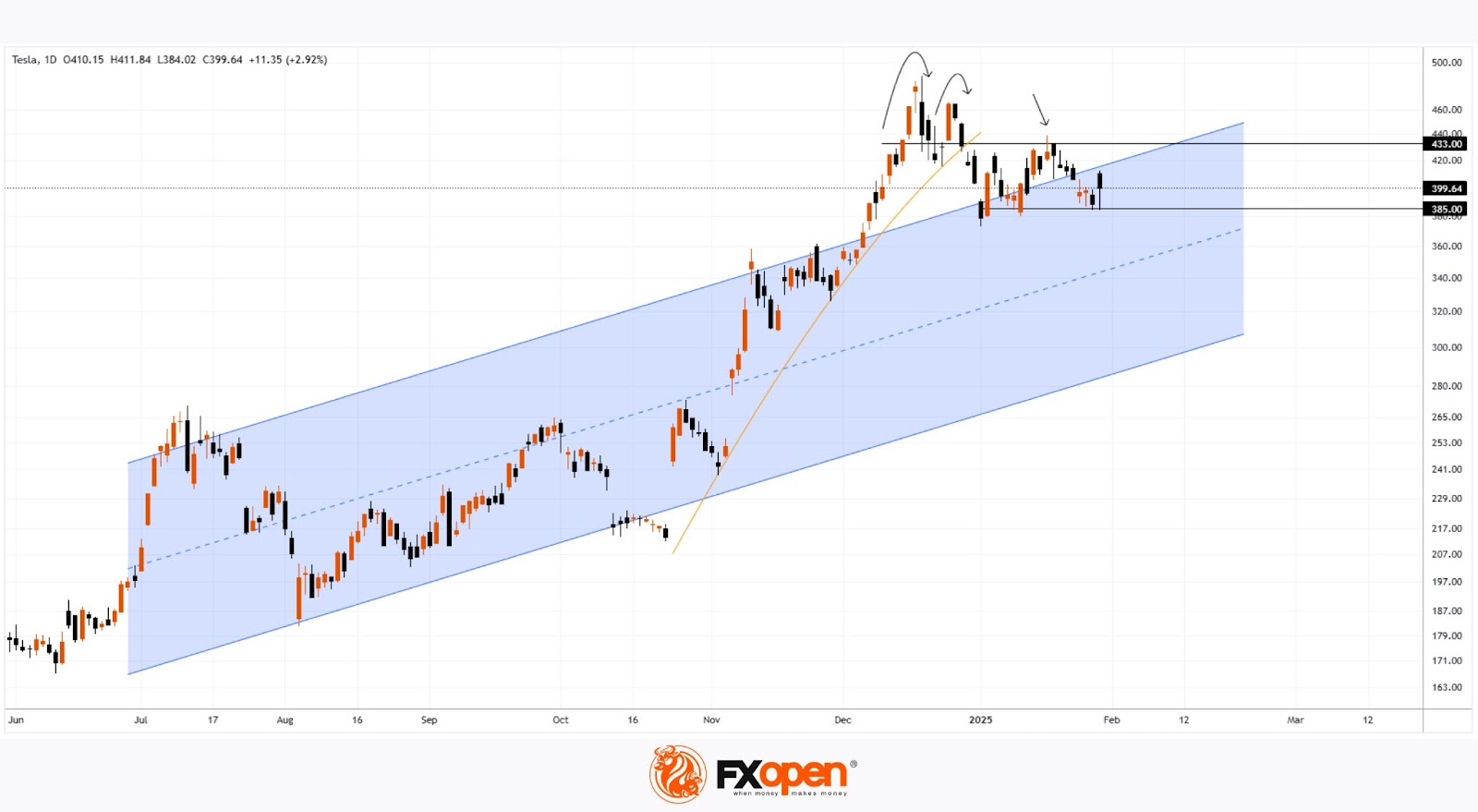
The technical analysis of Tesla (TSLA) stock shows that the bullish momentum (marked by the orange curve), which was supported by the market’s reaction to Trump’s victory, has already weakened as the price has broken below this trendline. Meanwhile:
→ The $433 level has acted as strong resistance, turning the price down three times (marked by black arrows), indicating bearish confidence that TSLA is overbought above this point.
→ The 2025 low around $385 serves as key support, preventing a deeper decline into the long-term rising channel (shown in blue).
TSLA’s price may fluctuate within this range until a fundamental catalyst shifts market sentiment.
Analysts, however, remain sceptical about TSLA’s outlook. According to TipRanks:
→ Only 12 out of 33 analysts recommend buying TSLA shares.
→ The 12-month price target averages $335, below current levels.
Buy and sell stocks of the world's biggest publicly-listed companies with CFDs on FXOpen’s trading platform. Open your FXOpen account now or learn more about trading share CFDs with FXOpen.
This article represents the opinion of the Companies operating under the FXOpen brand only. It is not to be construed as an offer, solicitation, or recommendation with respect to products and services provided by the Companies operating under the FXOpen brand, nor is it to be considered financial advice.
Stay ahead of the market!
Subscribe now to our mailing list and receive the latest market news and insights delivered directly to your inbox.


Latest articles

Market Analysis: AUD/USD and NZD/USD Test Support, Break or Bounce Next?
AUD/USD is attempting a fresh increase from 0.6630. NZD/USD is consolidating and could aim for a move above 0.5800 in the short term.
Important Takeaways for AUD/USD and NZD/USD Analysis Today
· The Aussie Dollar

USD/JPY Slides Towards Key Support
A Bank of Japan monetary policy meeting is due this week, and expectations around the decision are supporting the yen today. Traders increasingly believe that the central bank may raise its policy rate by 25 basis points to 0.75%