


FXOpen

On 14 May, Alibaba released its first-quarter performance report:
→ Earnings per share: actual = $1.404, expected = $1.421;
→ Gross income: actual = $30.716 billion, expected = $30.502 billion.
The fact that earnings per share were slightly below expectations did not disappoint investors much, as on 16 May, Alibaba's share price (BABA) reached a yearly high, exceeding $86, forming a wide bullish candlestick with a close near the top (a sign of strong demand).
Positive sentiments were also driven by:
→ Another Chinese company, JD.com, released a report that exceeded expectations;
→ US regulators published information that well-known investor Michael Burry invested in Alibaba shares. David Tepper, head of the hedge fund Appaloosa Management, also holds a bullish outlook;
→ According to a note published on X (Twitter) by Citron Research analysts, Alibaba's share price could rise to $100.
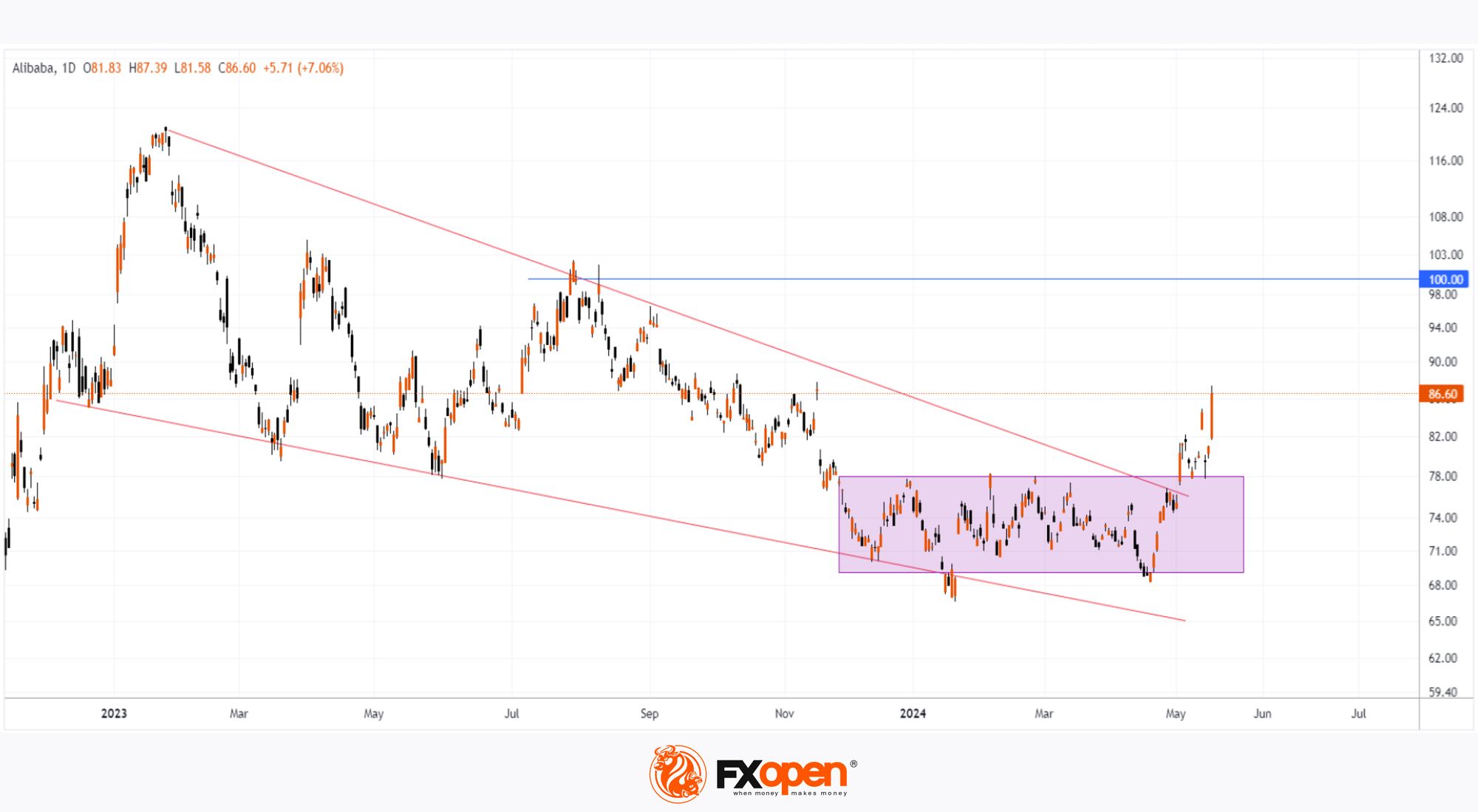
According to the technical analysis of the BABA share chart:
→ The price broke upwards from a narrowing triangle (shown in red lines) – this is a bullish sign;
→ In April, the price did not reach the lower boundary of the triangle at its lowest point – this confirms strong demand;
→ The purple rectangle can be seen as the range in which large hedge funds accumulated BABA shares;
→ Extending the height of the rectangle upwards from its upper boundary, we get a resistance level of $87, which is where the current quotation is located.
It is also worth noting that the psychological level of $100 per BABA share acted as resistance last summer.
Given the above, it is reasonable to assume that BABA's share price could form a significant rally in the long-term with short-term corrections.
According to TipRanks, the average forecasted price for BABA shares in 12 months is $105.13.
Buy and sell stocks of the world's biggest publicly-listed companies with CFDs on FXOpen’s trading platform. Open your FXOpen account now or learn more about trading share CFDs with FXOpen.
This article represents the opinion of the Companies operating under the FXOpen brand only. It is not to be construed as an offer, solicitation, or recommendation with respect to products and services provided by the Companies operating under the FXOpen brand, nor is it to be considered financial advice.
Stay ahead of the market!
Subscribe now to our mailing list and receive the latest market news and insights delivered directly to your inbox.


Latest articles

Consolidation Ahead of NFP: Commodity Currencies Search for Direction
Commodity-linked currencies have entered a consolidation phase following recent directional moves, as market participants adopt a wait-and-see approach ahead of key US labour market data. Current price action reflects a balance between ongoing demand for the US dollar and attempts

The Real Driver Behind the Dollar Rally: Market Insights with Gary Thomson
The US dollar has been firm, but the drivers behind the move may be more complex than they first appear.
While geopolitical tension and shifts in risk sentiment play a role, current price behaviour seems increasingly influenced by inflation expectations

EUR/USD and USD/CHF Pull Back: Market Reacts to Fundamentals
European currencies have shown a recovery in recent trading sessions after their recent decline, displaying early signs of a reversal. The US dollar is weakening amid expectations surrounding upcoming US macroeconomic data, while market participants are reassessing their short-term positions