FXOpen
The British pound extended downward movement against the US dollar on Monday, taking the price to less than 1.5705. The bearish momentum that started from July 15 still prevails thereby carving the fresh lows for 2014.
Technical Analysis
The British pound started new week at 1.5721. The price surged to 1.5736 but is restricted by an immediate resistance that lies around 1.5735 – 1.5770 zone, as demonstrated by the 23.6% fib level and the descending trend line in the following chart. The said level has been restricting the pair since November 28. So the pair may find some sellers around 1.5770. Success in breaking this resistance will allow the pair to rally towards 1.5822, the 50-Day SMA, thereby exposing its way to 1.5915, the 38.2% fib level. The major resistance that can be noted in GBP/USD lies around 1.6145, the confluence of 61.8% fib level and 100-Day SMA.
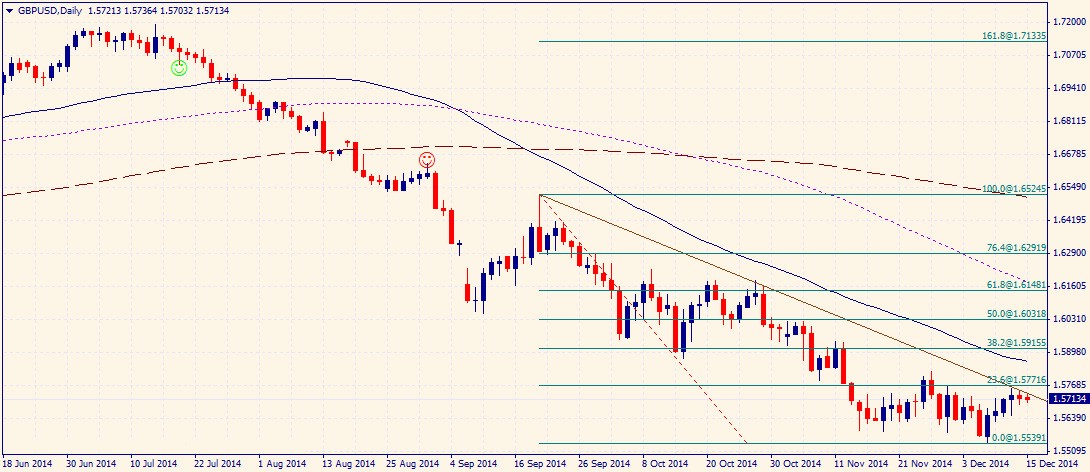
On the downside, 1.5590 is the major level that has been supporting the pair since 15th November. The next support can be seen around 1.5541, the swing low of December 12. The long-term bias is bearish because of lower lows and lower highs on the daily chart. The bias will remain bearish as far as the level 1.6145 is intact.
US Industrial Production
The US industrial Production remained at 0.6% this November, above than that of -0.1% in the month before, says the average forecast of different economists. Generally speaking, a high figure is anticipated as positive for the US dollar and vice versa. Thus a better than expected figure may further accelerate the bearish momentum in the price of GBP/USD.
US Capacity Utilization
Economists are expecting US capacity utilization to increase to 79.3% this November, from 78.9% in the month before. Indicating the overall growth of US economy, a high reading is bullish positive for the US dollar. Thus a better than expected outcome may spur a selling pressure in the price of GBP/USD.
Trade Idea
Considering the overall technical and fundamental analysis, buying the pair is preferred if the price leaves a bullish engulfing or bullish pin bar on the daily chart.
Trade over 50 forex markets 24 hours a day with FXOpen. Take advantage of low commissions, deep liquidity, and spreads from 0.0 pips (additional fees may apply). Open your FXOpen account now or learn more about trading forex with FXOpen.
This article represents the opinion of the Companies operating under the FXOpen brand only. It is not to be construed as an offer, solicitation, or recommendation with respect to products and services provided by the Companies operating under the FXOpen brand, nor is it to be considered financial advice.
Stay ahead of the market!
Subscribe now to our mailing list and receive the latest market news and insights delivered directly to your inbox.


Latest articles

XTI/USD Chart Analysis: WTI Oil Price Fluctuates Near $100
For the third Monday in a row, trading in the oil market has opened with a bullish gap, although this time it is not as wide as the gap seen, for example, on 9 March. The reason for the volatility

Gold Price Falls to a Monthly Low
As the XAU/USD chart shows, gold prices today dropped below the 3 March low, reaching levels last seen in the third week of February.
Why Is Gold Declining Despite the War?
Geopolitical turmoil typically supports demand for gold as