


AUD/CAD: Pair Remains Range-Bound Amid Interest Rate Divergence
FXOpen

The key macroeconomic factor for AUD/CAD remains the divergence in monetary policy between the two central banks. After three consecutive rate hikes since the beginning of the year, the Reserve Bank of Australia left its cash rate unchanged at 4.35%, citing persistent inflationary pressure and signs of slowing economic growth. The RBA stressed that inflation remains above its target range and that it is in no rush to begin easing policy. By contrast, the Bank of Canada has now kept its policy rate unchanged at 2.25% for a fifth consecutive meeting. Economic activity remains subdued, inflation has risen mainly due to higher energy prices, while core inflation has eased to 2.1%. The 210-basis-point interest rate differential formally supports the Australian dollar, although the RBA's more restrictive policy cycle continues to weigh on domestic demand and limits further gains in AUD.
Technical Picture
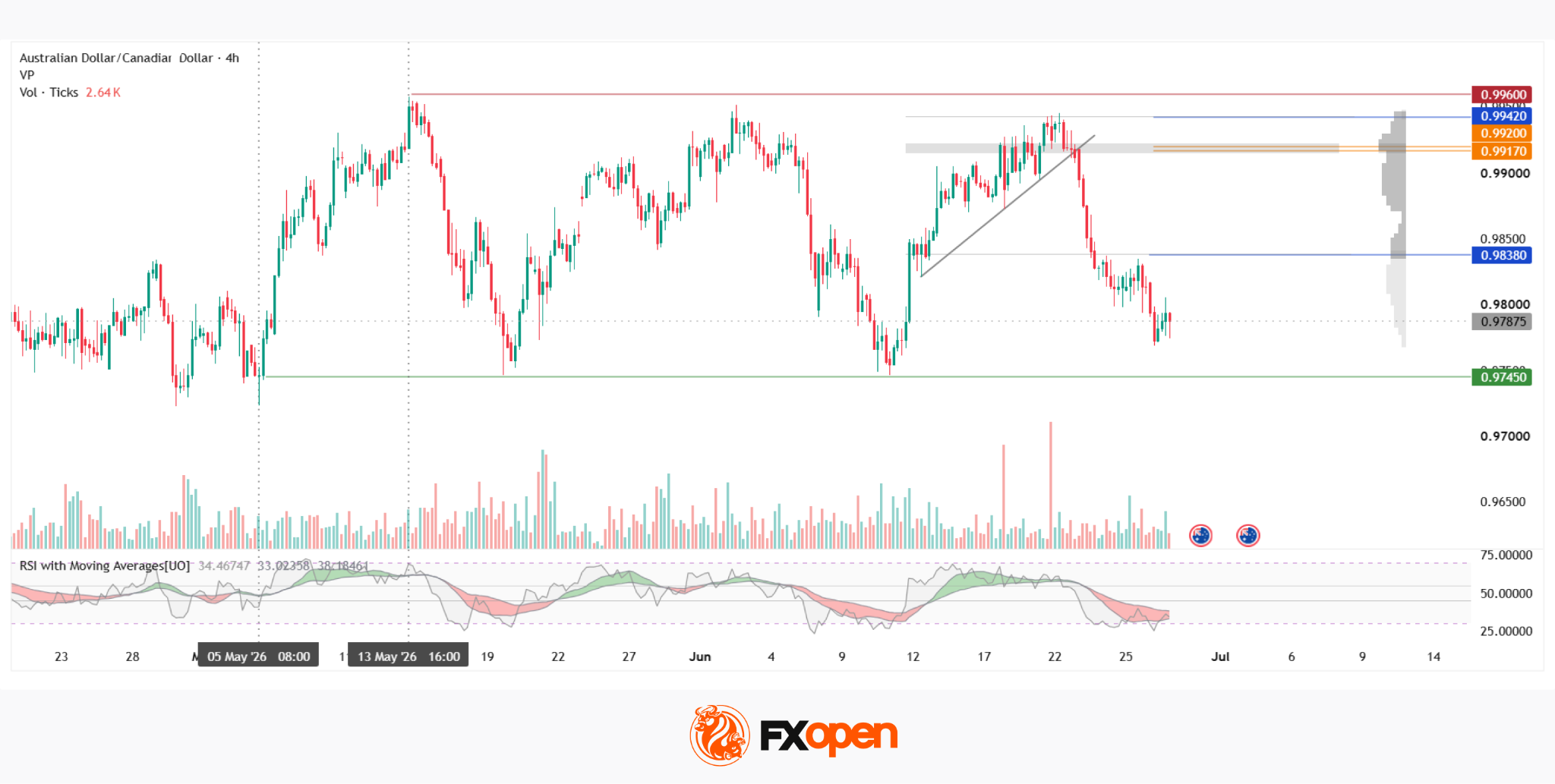
On the four-hour chart, AUD/CAD continues to trade within a broad sideways range, bounded by green support near 0.9745 and red resistance around 0.9960. During the first half of June, a local bullish trend developed within the range; however, in the latter part of the month, the price broke below the trendline and fell beneath the lower boundary of the current market profile at 0.9838. The POC zone is concentrated between 0.9917 and 0.9920 and could act as resistance should the market reverse higher.
Given the close proximity of the POC zone, the upper boundary of the profile at 0.9942, and the resistance level itself, this cluster may attract increased selling interest. Current horizontal volume remains moderate, suggesting the absence of a clear market bias. RSI + MAs shows readings of 34, 33, 38. The RSI has already entered oversold territory, while the moving averages, although coloured red, remain broadly horizontal.
Key Takeaways
The pair continues to trade within its established range, lacking a catalyst for a decisive breakout. The RSI has moved out of oversold territory, while the moving averages, although still red, have lost their directional bias. Further price action will largely depend on how the market reassesses expectations for the RBA's policy path amid signs of slowing growth in the Australian economy.
Trade over 50 forex markets 24 hours a day with FXOpen. Take advantage of low commissions, deep liquidity, and spreads from 0.0 pips (additional fees may apply). Open your FXOpen account now or learn more about trading forex with FXOpen.
This article represents the opinion of the Companies operating under the FXOpen brand only. It is not to be construed as an offer, solicitation, or recommendation with respect to products and services provided by the Companies operating under the FXOpen brand, nor is it to be considered financial advice.
Stay ahead of the market!
Subscribe now to our mailing list and receive the latest market news and insights delivered directly to your inbox.


Latest articles

Brent Crude Oil Analysis: Stabilisation or Simply a Pause?
Over the past few weeks, financial markets have been more focused than ever on developments surrounding the Strait of Hormuz — a critical waterway at the centre of ongoing US-Iran negotiations. The back-and-forth of diplomatic headlines has injected significant volatility into

Gold Analysis: Could XAU/USD Bounce From the Crucial $4,000 Level?
The year 2026 has so far been an unforgiving one for gold. XAU/USD is down approximately 7% since the start of the year, and roughly 28% from the late-January peak — a significant correction, though a physiologically natural one following

US Dollar Strengthens Amid Equity Market Weakness and Hawkish Fed Rhetoric
The US dollar continues to hold firm near multi-year highs as sentiment across equity markets deteriorates and investors increasingly expect the Federal Reserve to maintain a restrictive monetary policy stance for longer. The US economy remains resilient, while inflation risks