


Dow Jones (DJIA): Consolidation Beyond the Trend
FXOpen

Federal Reserve Chair Kevin Warsh testified before Congress on 14–15 July, reaffirming the Fed's commitment to bringing inflation back to target while providing no clear guidance on the future path of interest rates. Meanwhile, June inflation data came in softer than expected, with annual consumer price growth slowing to 3.5% from 4.2% in May, temporarily supporting risk appetite. At the same time, the earnings season got underway, with Goldman Sachs reporting better-than-expected results on 14 July, providing additional support for the Dow Jones Industrial Average index (Wall Street 30 on FXOpen).
Technical Picture
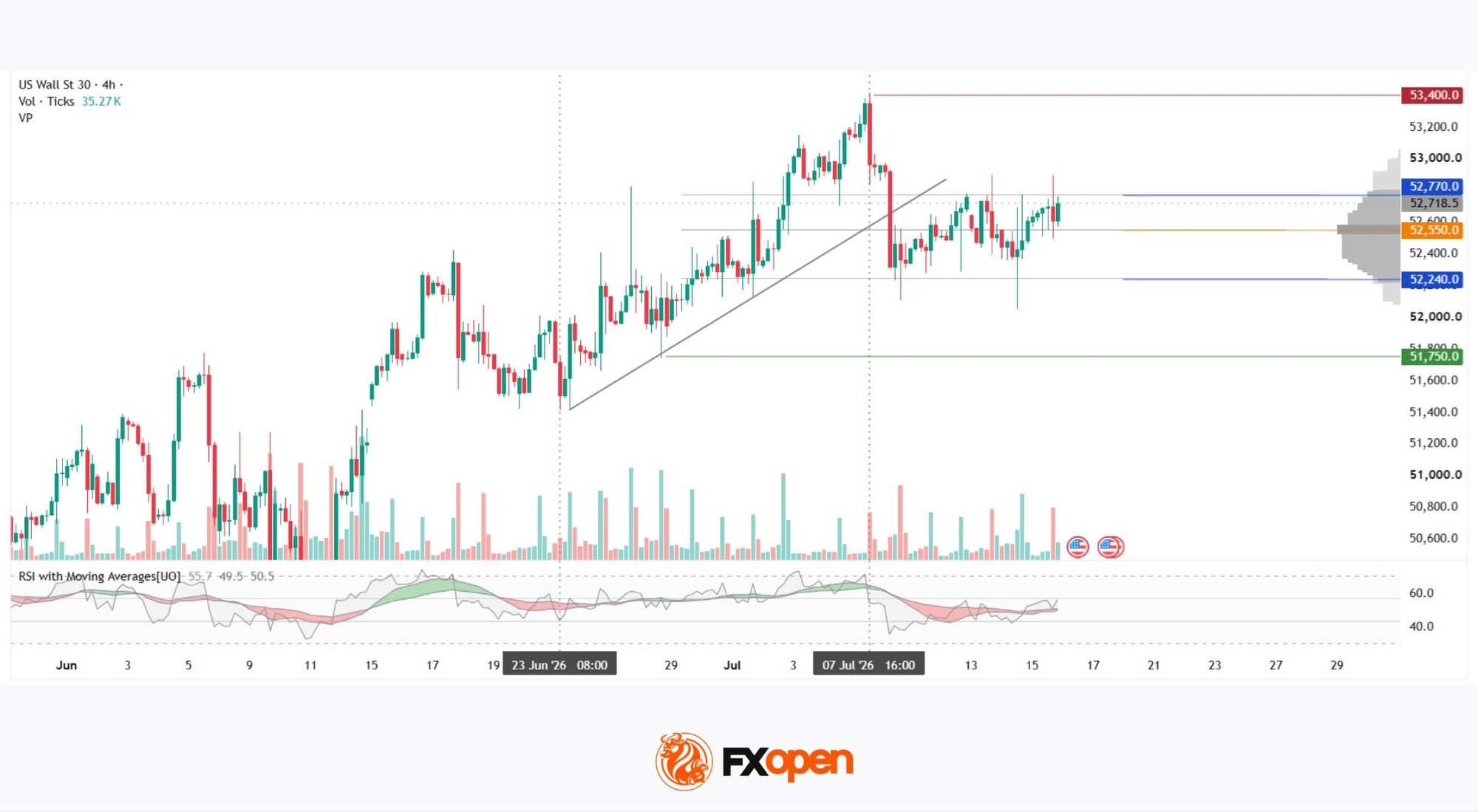
The Dow Jones Index (WS30m on FXOpen) advanced along an ascending trendline from its 23 June low, reaching the 53,400 area on 7 July, marked by the red resistance level. A sharp decline then followed, breaking below the trendline, with prices subsequently consolidating within the range of the large bearish breakout candle. Since then, the index has been trading within the current market profile, compressed between the profile's upper boundary at 52,770 and the Point of Control (POC) at 52,550, awaiting a catalyst to break out of the current range.
If the bearish scenario unfolds and the price falls below both the trendline and the lower boundary of the market profile at 52,240, market participants might focus on the 51,750 area, where the index could potentially find support during a further decline. The RSI + MAs indicator currently shows readings of 55, 49, and 50 respectively, with all three remaining in neutral territory and providing no clear directional signal.
Summary
With the RSI lacking momentum and price remaining confined to a narrow range between the POC and the upper boundary of the market profile, the market appears to be in a pause following the failed trend breakout. A potential catalyst for a decisive move could come from the US June Retail Sales report, due later today, 16 July, while the Federal Reserve's policy meeting on 29 July may provide the next major directional trigger.
Trade global index CFDs with zero commission and tight spreads (additional fees may apply). Open your FXOpen account now or learn more about trading index CFDs with FXOpen.
This article represents the opinion of the Companies operating under the FXOpen brand only. It is not to be construed as an offer, solicitation, or recommendation with respect to products and services provided by the Companies operating under the FXOpen brand, nor is it to be considered financial advice.
Stay ahead of the market!
Subscribe now to our mailing list and receive the latest market news and insights delivered directly to your inbox.


Latest articles

CAD/JPY: The Yen's Most Historic Move in 30 Years Meets a Fragile Support
Two central banks are heading in genuinely opposite directions this week, and the tension is unmistakable. The Bank of Canada held rates steady at 2.25% on September 2, with a mildly hawkish tilt as policymakers acknowledged a broadening economic

USD/JPY and USD/CAD Await Key Fed Decision
The US dollar is consolidating against the yen and Canadian dollar ahead of the key event of the week — the Federal Reserve meeting. The Fed is widely expected to raise its policy rate by 25 basis points to a range

UnitedHealth: Fundamentals Are Healing, Now the Chart Must Agree
UnitedHealth finds itself in a genuinely split narrative right now, trading near $388, down about 15.9% from its 52-week high, even as the fundamental picture keeps improving. Q2 earnings beat expectations, with revenue of $112.03 billion, and the