


EUR/JPY: Yen Recovers April Losses as the Market Searches for a New Equilibrium
FXOpen

Fundamental backdrop
In late April 2026, Japan’s Ministry of Finance moved from verbal warnings to direct action, carrying out a currency intervention worth roughly ¥5.5 trillion ($35 billion) — the first since July 2024. The move was triggered by the yen weakening beyond the psychologically significant level of 160 against the dollar.
Additional context comes from the divergence in monetary policy between the ECB and the Bank of Japan: the European regulator continues to leave the door open to tighter policy amid rising inflation expectations, while Tokyo maintains a cautious normalisation path without providing clear guidance on the timing of its next move.
Technical picture
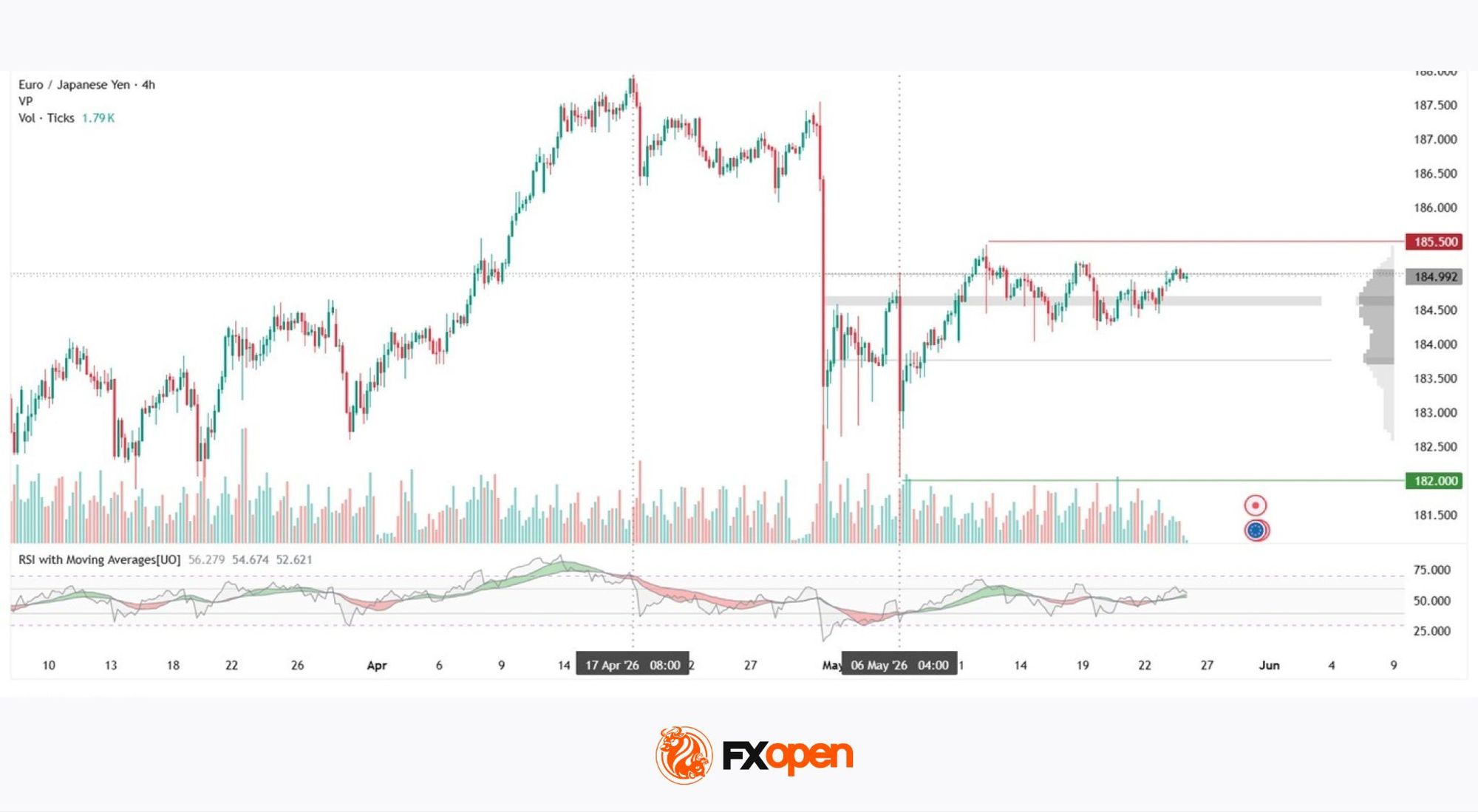
After reaching a local peak near 188 in mid-April, the EUR/JPY pair experienced two impulsive declines. The first occurred on 30 April, when the candlestick recorded an abnormal spike in vertical volume — a direct consequence of the Japanese Ministry of Finance intervention, which saw the yen strengthen by roughly 3% during the session. A second bout of sharp selling pressure followed in early May.
As a result, a horizontal profile formed with boundaries at 183.800–185.000, while the point of control is concentrated within the 184.50–184.70 range.
The price is now testing the upper boundary of the profile — an area where sellers have already shown activity on two separate occasions. The 182 region has held since February and could once again come into focus if pressure resumes: both May sell-offs reversed precisely from this zone, failing to break lower. Meanwhile, the 185.500 area could act as resistance should the current advance continue.
RSI + MA readings stand at 57 / 55 / 53 respectively — all three lines remain in neutral territory, with no clear signs of momentum.
Key takeaways
The current situation is shaped by the clash between interest-rate differentials and the willingness of the Japanese authorities to intervene again if necessary. For now, with RSI offering no directional impulse, the point of control and the profile boundaries remain the key reference levels for assessing the current trading range.
Trade over 50 forex markets 24 hours a day with FXOpen. Take advantage of low commissions, deep liquidity, and spreads from 0.0 pips (additional fees may apply). Open your FXOpen account now or learn more about trading forex with FXOpen.
This article represents the opinion of the Companies operating under the FXOpen brand only. It is not to be construed as an offer, solicitation, or recommendation with respect to products and services provided by the Companies operating under the FXOpen brand, nor is it to be considered financial advice.
Stay ahead of the market!
Subscribe now to our mailing list and receive the latest market news and insights delivered directly to your inbox.


Latest articles

CAD/JPY: The Yen's Most Historic Move in 30 Years Meets a Fragile Support
Two central banks are heading in genuinely opposite directions this week, and the tension is unmistakable. The Bank of Canada held rates steady at 2.25% on September 2, with a mildly hawkish tilt as policymakers acknowledged a broadening economic

USD/JPY and USD/CAD Await Key Fed Decision
The US dollar is consolidating against the yen and Canadian dollar ahead of the key event of the week — the Federal Reserve meeting. The Fed is widely expected to raise its policy rate by 25 basis points to a range

UnitedHealth: Fundamentals Are Healing, Now the Chart Must Agree
UnitedHealth finds itself in a genuinely split narrative right now, trading near $388, down about 15.9% from its 52-week high, even as the fundamental picture keeps improving. Q2 earnings beat expectations, with revenue of $112.03 billion, and the