


EUR/USD — At the Crossroads of Monetary Expectations
FXOpen

Fundamental Background
The fundamental backdrop for EUR/USD in early May is shaped by diverging monetary policy expectations on both sides of the Atlantic. At its 30 April meeting, the ECB left interest rates unchanged; however, Governing Council members Joachim Nagel and Peter Kazimir signalled the possibility of a rate hike as early as June amid persistent inflationary pressure. Meanwhile, the Federal Reserve has maintained rates within the 3.50–3.75% range without giving clear indications of imminent easing, while US inflation stood at 3.3% year-on-year in March.
Tensions in the Strait of Hormuz continue to keep oil prices near four-year highs, increasing inflation risks for the import-dependent eurozone. An additional pressure factor is the possibility of Washington raising tariffs on European cars to 25%.
Technical Picture
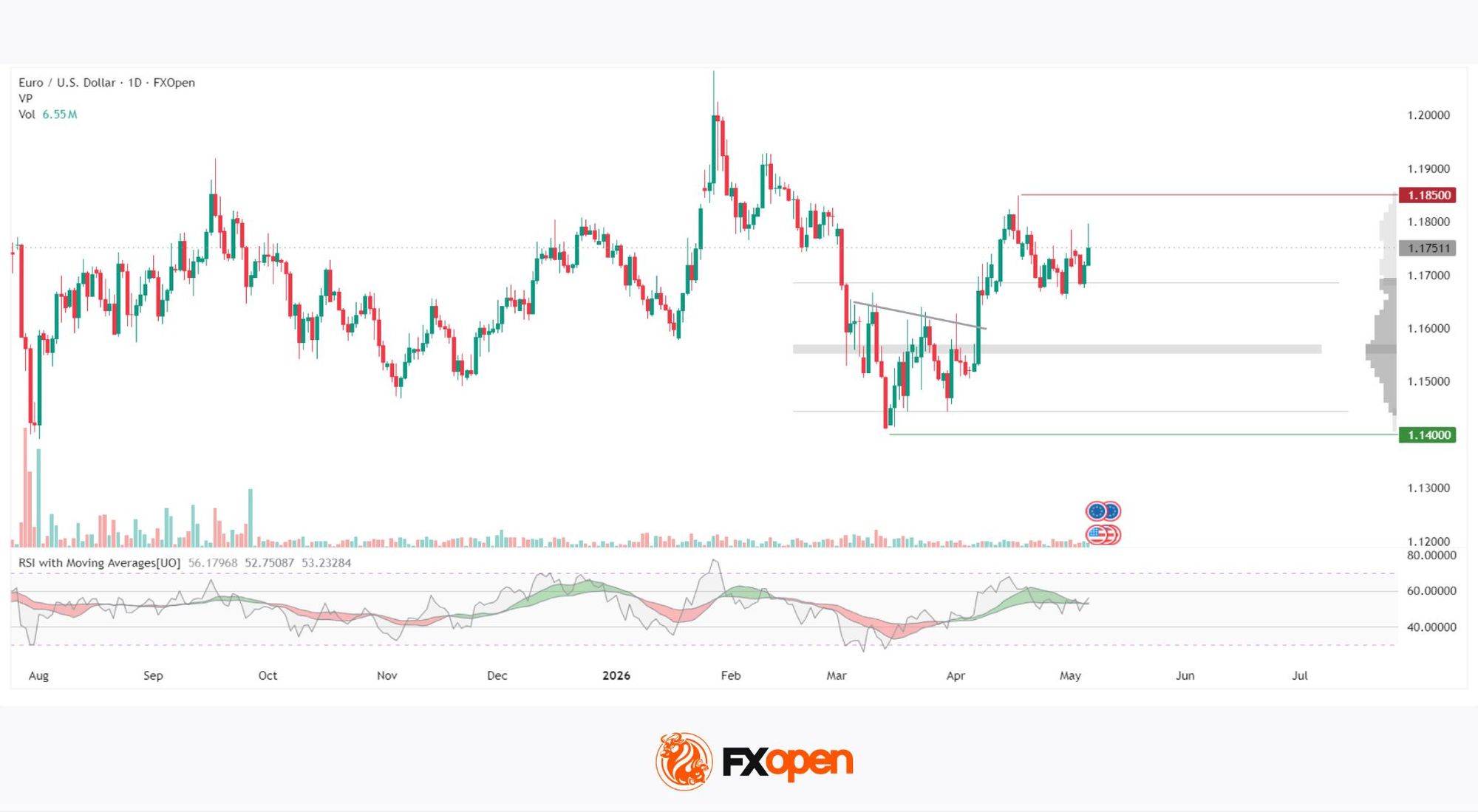
On the daily chart, EUR/USD appears to have formed and completed an inverted head-and-shoulders pattern in March. The neckline of the formation is positioned above the point of control (POC) of the horizontal volume profile, and the breakout above this neckline may have triggered a rally towards the 1.1850 area. The profile spans the 1.1440–1.1690 range, while the POC zone at 1.1550–1.1570 — representing the highest concentration of horizontal volume during the analysed period — may act as the main support area for the current market structure.
Following the pullback from 1.1850, the pair continues to trade above the upper boundary of the profile. The 1.1850 level could be the nearest significant resistance, while 1.1400 may serve as a deeper support level for the entire profile zone. The RSI + MAs indicator shows readings of 56, 52 and 53: RSI remains above both moving averages, indicating a moderate advantage for buyers without clear signs of strong momentum.
Key Takeaways
The fundamental backdrop remains mixed: expectations of tighter ECB policy may continue to support the euro, while energy-related risks and weak eurozone growth could be limiting bullish momentum. From a technical perspective, the key factor may be whether price can hold above the POC zone and the 1.1690 level — a condition that could help sustain the bullish trend.
Trade over 50 forex markets 24 hours a day with FXOpen. Take advantage of low commissions, deep liquidity, and spreads from 0.0 pips (additional fees may apply). Open your FXOpen account now or learn more about trading forex with FXOpen.
This article represents the opinion of the Companies operating under the FXOpen brand only. It is not to be construed as an offer, solicitation, or recommendation with respect to products and services provided by the Companies operating under the FXOpen brand, nor is it to be considered financial advice.
Stay ahead of the market!
Subscribe now to our mailing list and receive the latest market news and insights delivered directly to your inbox.


Latest articles

CAD/JPY: The Yen's Most Historic Move in 30 Years Meets a Fragile Support
Two central banks are heading in genuinely opposite directions this week, and the tension is unmistakable. The Bank of Canada held rates steady at 2.25% on September 2, with a mildly hawkish tilt as policymakers acknowledged a broadening economic

USD/JPY and USD/CAD Await Key Fed Decision
The US dollar is consolidating against the yen and Canadian dollar ahead of the key event of the week — the Federal Reserve meeting. The Fed is widely expected to raise its policy rate by 25 basis points to a range

UnitedHealth: Fundamentals Are Healing, Now the Chart Must Agree
UnitedHealth finds itself in a genuinely split narrative right now, trading near $388, down about 15.9% from its 52-week high, even as the fundamental picture keeps improving. Q2 earnings beat expectations, with revenue of $112.03 billion, and the