


Netflix 2026: Reversal on the Deal, Pullback on Earnings
FXOpen

Fundamental Background
At the end of February, Netflix withdrew from the bid for Warner Bros. Discovery assets after WBD’s board deemed Paramount Skydance’s $31-per-share offer more attractive. Netflix chose not to raise its own bid of $27.75 per share and received compensation of $2.8 billion. The market reacted positively to the company’s exit from the months-long M&A battle, as the threat of adding more than $40 billion in debt to the balance sheet was removed.
The second key event was the company’s Q1 2026 earnings report, released on 16 April. Revenue reached $12.25 billion (+16% year-on-year), while earnings per share came in at $1.23, exceeding consensus forecasts. However, guidance for Q2 fell short of analysts’ expectations for both revenue and EPS, while company founder Reed Hastings announced plans to step down from the board in June. Together, these factors triggered a sharp negative market reaction in April.
Technical Picture
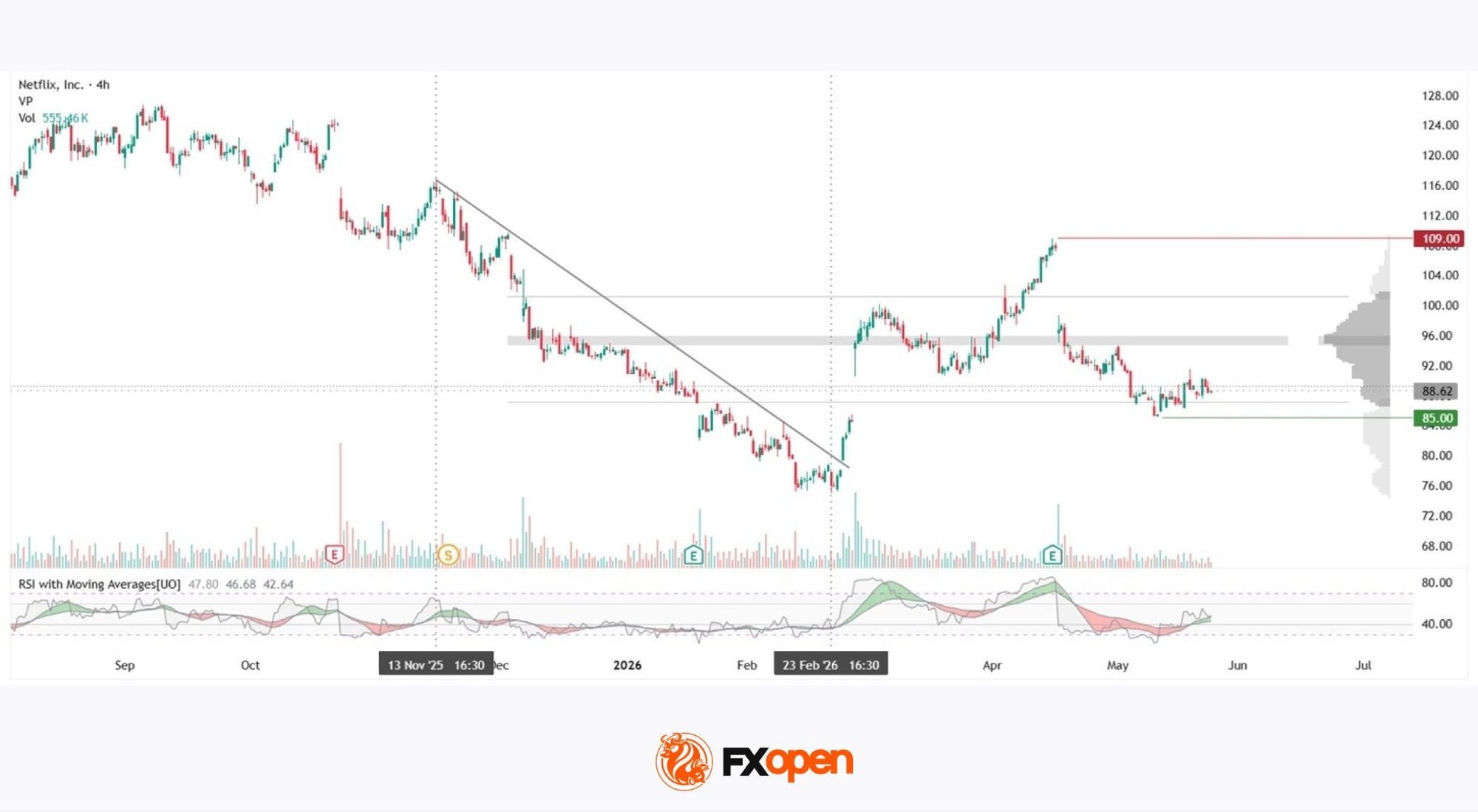
The long-term downtrend in Netflix shares began in July 2025, when the stock was trading near historic highs around $134. The period from 13 November 2025 to 23 February 2026 marked the final phase of this trend, during which the price declined towards $75.
The gap on 27 February 2026 — a direct consequence of the company’s withdrawal from the WBD deal — broke the descending trendline and was accompanied by an abnormal surge in vertical trading volume. The subsequent rally pushed the stock towards $109, which may now act as a resistance zone on any renewed advance. The gap on 17 April reversed the move lower, also on elevated volume, returning the price to the range of the current volume profile.
At present, the shares are trading slightly above the lower boundary of the profile, while the Point of Control (POC) zone lies around $94.50–$96.00 and may serve as a reference point in the event of a recovery. The $85.00 area could become the nearest significant support below the profile. RSI with moving averages currently shows readings of 47 / 46 / 42 — all three lines remain below the 50 mark and have yet to form any impulsive structure.
Key Takeaways
Netflix’s technical structure reflects two polar opposite events within the same year: the breakout of the long-term downtrend following a corporate event, and the subsequent correction after disappointing guidance. The stock’s next direction will largely depend on whether the market can hold above the lower boundary of the profile and how convincing the company’s operational progress proves to be in Q2.
Buy and sell stocks of the world's biggest publicly-listed companies with CFDs on FXOpen’s trading platform. Open your FXOpen account now or learn more about trading share CFDs with FXOpen.
This article represents the opinion of the Companies operating under the FXOpen brand only. It is not to be construed as an offer, solicitation, or recommendation with respect to products and services provided by the Companies operating under the FXOpen brand, nor is it to be considered financial advice.
Stay ahead of the market!
Subscribe now to our mailing list and receive the latest market news and insights delivered directly to your inbox.


Latest articles

CAD/JPY: The Yen's Most Historic Move in 30 Years Meets a Fragile Support
Two central banks are heading in genuinely opposite directions this week, and the tension is unmistakable. The Bank of Canada held rates steady at 2.25% on September 2, with a mildly hawkish tilt as policymakers acknowledged a broadening economic

USD/JPY and USD/CAD Await Key Fed Decision
The US dollar is consolidating against the yen and Canadian dollar ahead of the key event of the week — the Federal Reserve meeting. The Fed is widely expected to raise its policy rate by 25 basis points to a range

UnitedHealth: Fundamentals Are Healing, Now the Chart Must Agree
UnitedHealth finds itself in a genuinely split narrative right now, trading near $388, down about 15.9% from its 52-week high, even as the fundamental picture keeps improving. Q2 earnings beat expectations, with revenue of $112.03 billion, and the