


NZD/USD: Two-Bar Bearish Reversal Pattern Signals Strong Downside Risk
FXOpen
The New Zealand Dollar (NZD) fell broadely against the US Dollar (USD) yesterday, halting the 6-day long winning streak and leaving a classic two-bar bearish reversal setup on the daily chart which is considered a good indication for steep losses in the near future. The sentiment however remains bullish due to Higher High (HH) and Higher Low (HL) in the recent wave.
Tehcnical Analysis
As of this writing, the pair is being traded near 0.8658. A hurdle may be noted around 0.8743, the intraday high of yesterday ahead of 0.8779 that is the swing high of the previous wave. A break above 0.8779 will spurr a renewed buying interest, opening doors for the fresh all-time high above 0.8800.
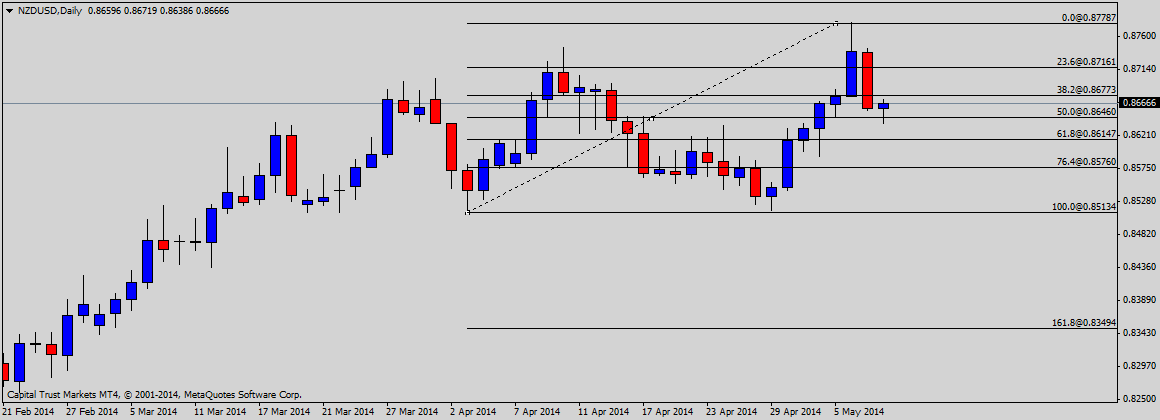
On the downside, the pair is likely to find a support near 0.8646, the 50% fib level ahead of 0.8555 that is the swing low of the previous wave as demonstrated in the above chart.
Yellen Testifies
The recent dip in the US Gross Domestic Product (GDP) report was mainly due to the below-average temperatures across the Northern America during the winter season and the growth should see considerable increase during the second quarter, Fed chair Janet Yellen said yesterday in her testimony to the joint committee.
She expressed satisfaction over the surprise slump in the unemployment rate during April which fell below the central bank’s 6.5% threshold.
Trade Ideas
Selling the pair on rallies appears to be a good strategy. The stop should be placed at the swing high of the recent upward wave while the target may be near the 0.8576 support as described above.
Trade over 50 forex markets 24 hours a day with FXOpen. Take advantage of low commissions, deep liquidity, and spreads from 0.0 pips (additional fees may apply). Open your FXOpen account now or learn more about trading forex with FXOpen.
This article represents the opinion of the Companies operating under the FXOpen brand only. It is not to be construed as an offer, solicitation, or recommendation with respect to products and services provided by the Companies operating under the FXOpen brand, nor is it to be considered financial advice.
Stay ahead of the market!
Subscribe now to our mailing list and receive the latest market news and insights delivered directly to your inbox.


Latest articles

US Dollar Index: A Defining Week for the King of the Markets
The dollar heads into a pivotal week trading near 101.80, just off a 15-month high, with the Fed's July 29 meeting standing as the clear focal point. Markets currently price roughly a 65% chance of a hold, though renewed

NZD/USD: Inflation Surge Meets Strong US Dollar Pressure
On 21 July, Stats NZ reported an acceleration in inflation: the Consumer Price Index rose 1.5% in the second quarter, while the annual inflation rate climbed to 4.1%, its highest level in more than two years and slightly

Weekly Market Insights with Gary Thomson: The Week of Central Banks and Earnings
In this video, we’ll explore the key economic events and market trends, shaping the financial landscape. Get ready for insights into financial markets to help you navigate the week ahead. Let’s dive in!
In this episode of Market