


Australian Dollar Loses Momentum After May Peaks
FXOpen

Fundamental Background
The RBA’s third consecutive interest rate increase to 4.35% reflects the regulator’s concern over rising inflation: the conflict in the Middle East is increasing energy costs and putting upward pressure on prices. Annual consumer inflation stood at 4.6% in March. Analysts at CBA believe this rate hike should be sufficient, with the base-case scenario pointing to rates remaining unchanged until the end of 2026, provided neither the federal budget nor second-quarter inflation data deliver major surprises.
At the same time, the Australian dollar failed to hold near its May highs, as rising demand for safe-haven assets amid global uncertainty weighed on risk-sensitive currencies.
AUD/USD Technical Picture
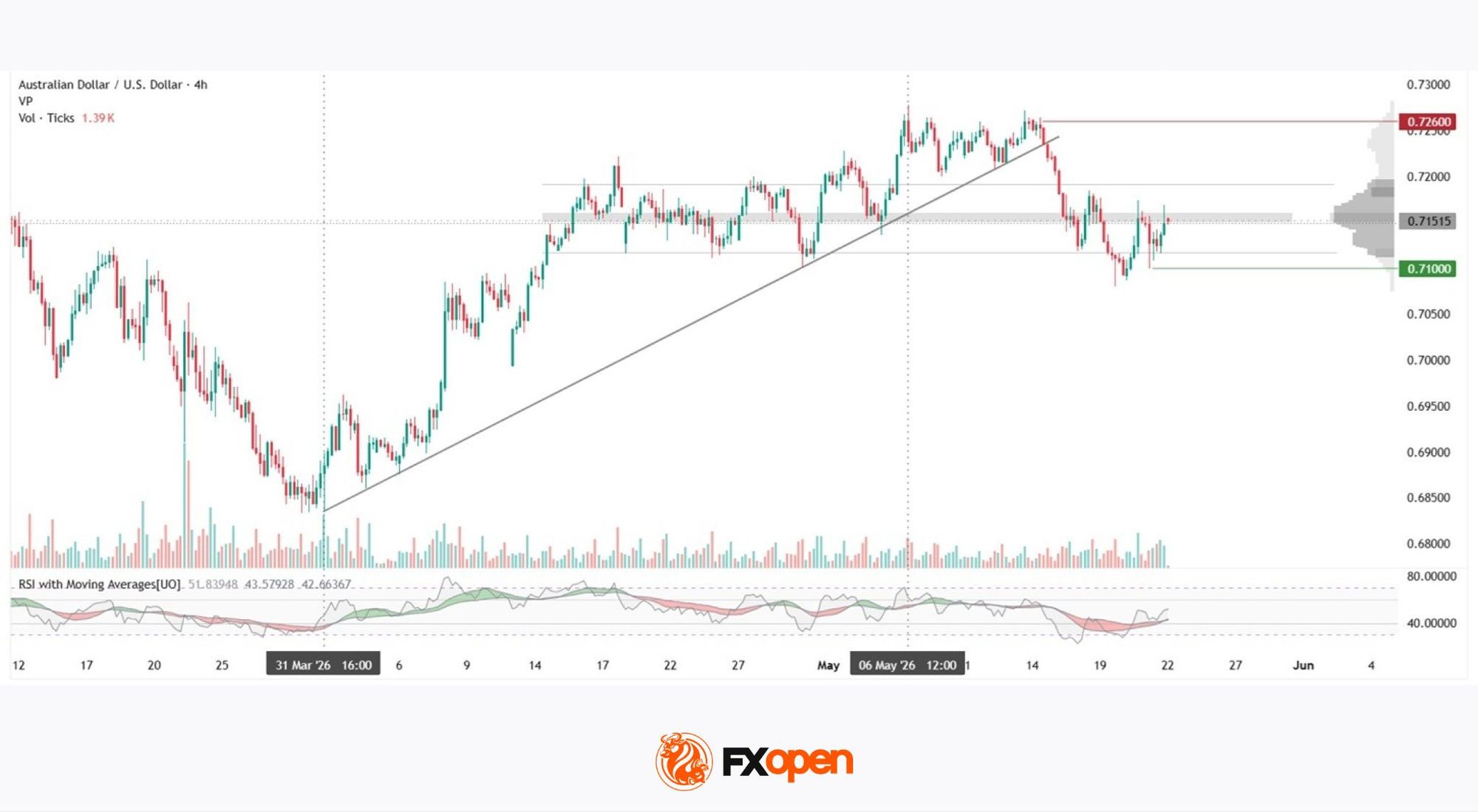
On the 4-hour AUD/USD chart, the upward movement from late March to early May is clearly visible, forming a pronounced trend with a characteristic wave structure. In mid-May, the trend was broken and the price declined towards the 0.7100 area, ultimately forming a green support level. The Point of Control (POC) zone is currently being tested from below, while the horizontal volume profile boundaries cover the 0.7120–0.7190 range — the corridor where the bulk of market activity is concentrated.
The 0.7190 level could act as resistance in the event of recovery attempts within the profile. The red resistance level at 0.7260 — the local May high — may remain an important reference point should the pair test the upper trend levels. The RSI + MAs indicator currently shows readings of 51 / 43 / 42, reflecting the market’s restrained and neutral character.
Key Takeaways
The key driver for the pair remains the balance between expectations for further RBA action and demand for safe-haven assets — for now, both forces continue to compete with one another. The RSI picture offers no clear advantage to either side, while price action remains close to the POC zone within a relatively narrow market profile.
Trade over 50 forex markets 24 hours a day with FXOpen. Take advantage of low commissions, deep liquidity, and spreads from 0.0 pips (additional fees may apply). Open your FXOpen account now or learn more about trading forex with FXOpen.
This article represents the opinion of the Companies operating under the FXOpen brand only. It is not to be construed as an offer, solicitation, or recommendation with respect to products and services provided by the Companies operating under the FXOpen brand, nor is it to be considered financial advice.
Stay ahead of the market!
Subscribe now to our mailing list and receive the latest market news and insights delivered directly to your inbox.


Latest articles

CAD/JPY: The Yen's Most Historic Move in 30 Years Meets a Fragile Support
Two central banks are heading in genuinely opposite directions this week, and the tension is unmistakable. The Bank of Canada held rates steady at 2.25% on September 2, with a mildly hawkish tilt as policymakers acknowledged a broadening economic

USD/JPY and USD/CAD Await Key Fed Decision
The US dollar is consolidating against the yen and Canadian dollar ahead of the key event of the week — the Federal Reserve meeting. The Fed is widely expected to raise its policy rate by 25 basis points to a range

UnitedHealth: Fundamentals Are Healing, Now the Chart Must Agree
UnitedHealth finds itself in a genuinely split narrative right now, trading near $388, down about 15.9% from its 52-week high, even as the fundamental picture keeps improving. Q2 earnings beat expectations, with revenue of $112.03 billion, and the