


FXOpen

The first factor is the news that Warren Buffett is halving his position in AAPL shares. Whether this indicates that the legendary investor foresees the company losing its market leadership or a recession threat, Buffett's authority may create a psychological effect on retail investors and prompt them to sell their shares.
The second factor is the breach of the $200 psychological level. After the strong rise above $200 per share in June, it seemed the price had securely settled above this round number. However, it's not uncommon for breakout tests to occur, stop-loss orders to be triggered, and the supply-demand balance to shift, resulting in price growth. For example, yesterday's price action saw the bulls nearly close a 7% bearish gap.
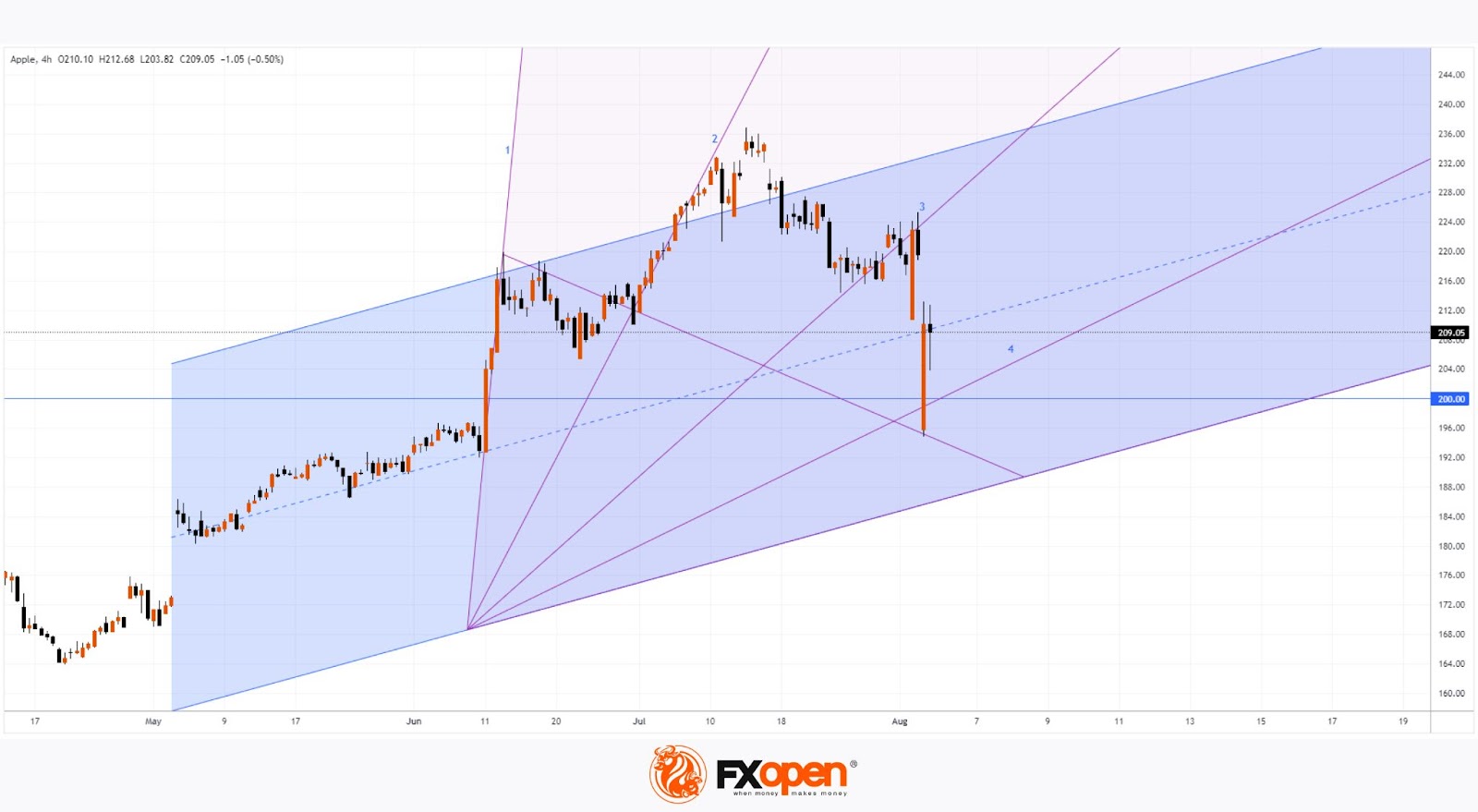
Today's technical analysis of the AAPL stock chart shows that:
→ Opening at the lows and closing at the highs for the last two wide candles indicates demand activity.
→ Since May, the stock price has been moving within an ascending channel (shown in blue). Yesterday, the price closed near the median line, where it might stabilize.
→ If the bears attempt to resume pressure, pitchfan ray #4 may provide support. As the AAPL chart shows, the stock price found support in the previous three instances, visualized on the chart as days of upward trends with decreasing angle steepness.
Interestingly, CNN Money's Fear & Greed Index showed a further decline in overall market sentiment, moving into the "Extreme Fear" zone on Monday. Would Buffett now follow his famous 1986 advice: "Be fearful when others are greedy, and be greedy when others are fearful"?
According to a survey of 32 Wall Street analysts by TipRanks, 24 recommend buying Apple stock. Their average price forecast for AAPL is $248.96 over the next 12 months.
Read analytical AAPL price forecasts for 2024 and beyond.
Buy and sell stocks of the world's biggest publicly-listed companies with CFDs on FXOpen’s trading platform. Open your FXOpen account now or learn more about trading share CFDs with FXOpen.
This article represents the opinion of the Companies operating under the FXOpen brand only. It is not to be construed as an offer, solicitation, or recommendation with respect to products and services provided by the Companies operating under the FXOpen brand, nor is it to be considered financial advice.
Stay ahead of the market!
Subscribe now to our mailing list and receive the latest market news and insights delivered directly to your inbox.


Latest articles

Consolidation Ahead of NFP: Commodity Currencies Search for Direction
Commodity-linked currencies have entered a consolidation phase following recent directional moves, as market participants adopt a wait-and-see approach ahead of key US labour market data. Current price action reflects a balance between ongoing demand for the US dollar and attempts

The Real Driver Behind the Dollar Rally: Market Insights with Gary Thomson
The US dollar has been firm, but the drivers behind the move may be more complex than they first appear.
While geopolitical tension and shifts in risk sentiment play a role, current price behaviour seems increasingly influenced by inflation expectations

EUR/USD and USD/CHF Pull Back: Market Reacts to Fundamentals
European currencies have shown a recovery in recent trading sessions after their recent decline, displaying early signs of a reversal. The US dollar is weakening amid expectations surrounding upcoming US macroeconomic data, while market participants are reassessing their short-term positions