


FXOpen

While the leading cryptocurrency was trading above $125k in October 2025, it fell to around $60k yesterday. The decline accelerated sharply — a pattern typical of panic-driven markets where excessive leverage is widely used. According to Coinglass, roughly $2bn worth of long positions were liquidated across crypto exchanges over the past 24 hours.
Bitcoin’s drop of more than 50% over five months has had a direct impact on Coinbase (COIN) shares, which slid below $150 for the first time since April 2025.
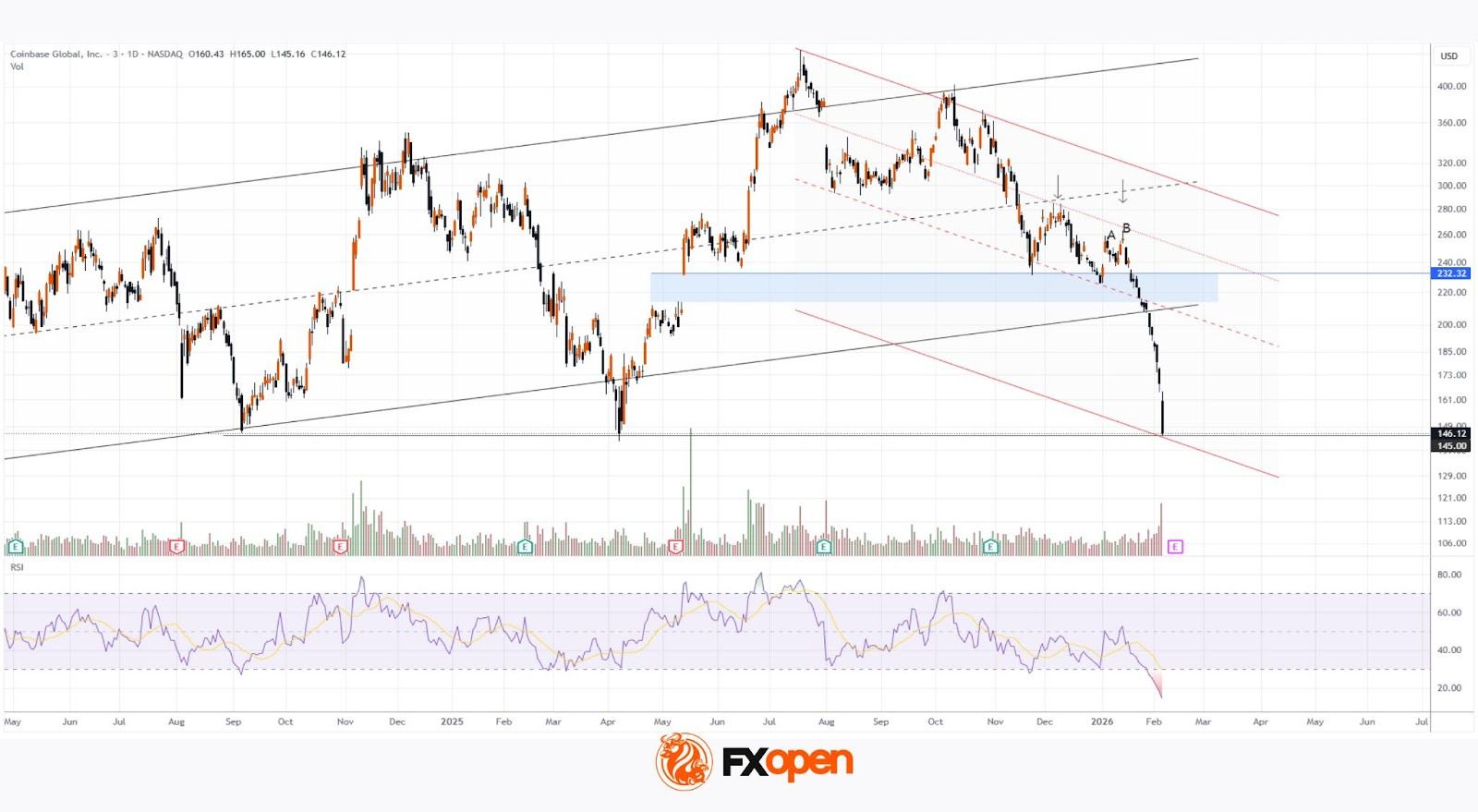
Technical analysis of COIN shares
Recall that on 16 January, when analysing the Coinbase (COIN) chart, we:
→ highlighted bearish signals, including a bull trap at peak B;
→ outlined a descending red price channel;
→ suggested that despite COIN trading near a key support area (marked in blue), a strong bullish reversal was unlikely.
Since then:
→ the narrow candle bodies between 20 and 28 January showed that buyers attempted to defend the highlighted support zone, but without success;
→ on 29 January, price broke bearishly below the long-term ascending channel (shown in black), after which COIN continued to fall without finding support. As a result, 13 consecutive bearish daily candles formed.
That said, the extreme fear currently dominating the market is creating conditions for a technical rebound:
→ the RSI indicator has fallen to its lowest level since COIN began trading on the Nasdaq, encouraging profit-taking on short positions;
→ price is hovering near the lower boundary of the descending channel, which has now doubled in width;
→ price is also close to the $145 level, which acted as support in 2024–2025. A false bearish break below this area cannot be ruled out, potentially triggering a psychological shift and altering the balance between supply and demand.
It is reasonable to assume that the sharp collapse in COIN’s share price could attract large-scale investors who may view it as undervalued from a long-term perspective.
Sentiment could also improve following the release of the quarterly earnings report, scheduled for 12 February, as well as the exchange’s strategic plans for 2026.
Buy and sell stocks of the world's biggest publicly-listed companies with CFDs on FXOpen’s trading platform. Open your FXOpen account now or learn more about trading share CFDs with FXOpen.
This article represents the opinion of the Companies operating under the FXOpen brand only. It is not to be construed as an offer, solicitation, or recommendation with respect to products and services provided by the Companies operating under the FXOpen brand, nor is it to be considered financial advice.
Stay ahead of the market!
Subscribe now to our mailing list and receive the latest market news and insights delivered directly to your inbox.


Latest articles


Market Insights with Gary Thomson: Oil, US Retail Sales & NFP in Focus
In this video, we’ll explore the key economic events and market trends, shaping the financial landscape. Get ready for insights into financial markets to help you navigate the week ahead. Let’s dive in!
In this episode of Market

Geopolitics Fuels Volatility: AUD/USD and USD/CAD Near Key Levels
Commodity-linked currencies continue to weaken amid rising geopolitical tensions, which are boosting demand for safe-haven assets and increasing volatility across both FX and commodity markets. The US dollar is gaining support from demand for liquid and defensive assets, while currencies