


US Delays Vote On Key Cryptocurrency Market Bill
FXOpen

Yesterday, the US Senate postponed a vote on a bill aimed at defining the structure of the cryptocurrency market. The delay followed the withdrawal of support by one of the industry’s leading players, the Coinbase exchange.
Coinbase CEO Brian Armstrong said the current version of the bill was “worse than having no legislation at all”. According to media reports:
→ the bill could have banned rewards for holding stablecoins (USDC), depriving Coinbase of a substantial share of its revenue;
→ the text was found to contain an effective ban on trading tokenised equities;
→ the bill imposed strict requirements on decentralised finance, undermining user privacy.
A market that had been expecting a regulatory “green light” has instead received another dose of uncertainty. As a result, COIN shares fell by more than 6% yesterday, opening with a bearish gap.
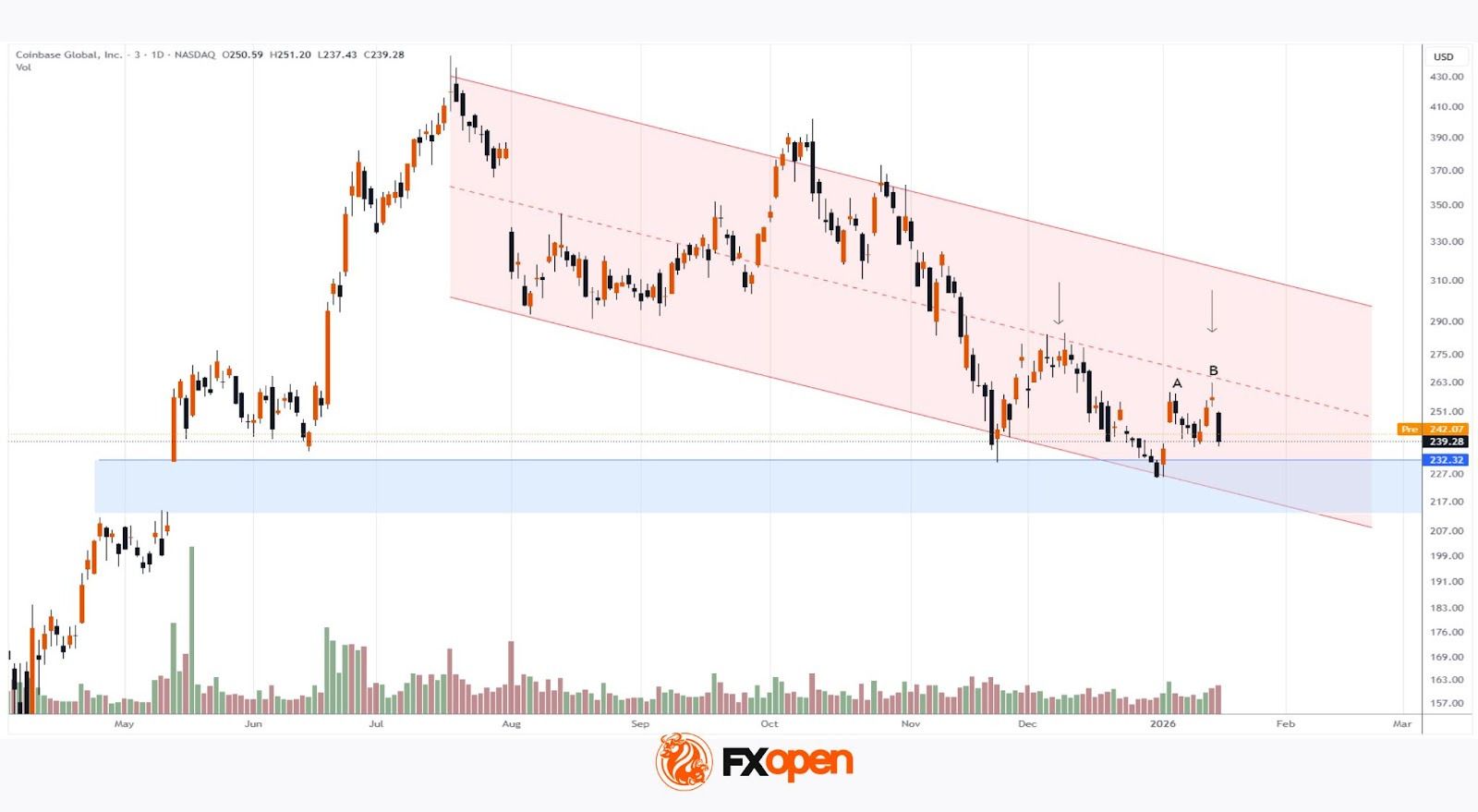
Technical Analysis of COIN Shares
As a reminder, in November we identified a descending channel and noted that Coinbase (COIN) shares were underperforming the broader market.
Since then, COIN has continued to move lower within this channel, with the following developments (marked by arrows):
→ the channel median acted as resistance in mid-December;
→ a bearish reversal formed in January.
Additional bearish signals include:
→ peak B only marginally exceeded peak A, resembling a bull trap;
→ yesterday’s decline occurred on rising volumes, with the close near the session low.
Today, COIN is trading near an important support area around $232.32, formed by a bullish gap from May last year. This could offer some hope to buyers and slow the decline within the channel. However, a strong upside reversal appears unlikely if the fundamental backdrop continues to disappoint cryptocurrency market participants.
Buy and sell stocks of the world's biggest publicly-listed companies with CFDs on FXOpen’s trading platform. Open your FXOpen account now or learn more about trading share CFDs with FXOpen.
This article represents the opinion of the Companies operating under the FXOpen brand only. It is not to be construed as an offer, solicitation, or recommendation with respect to products and services provided by the Companies operating under the FXOpen brand, nor is it to be considered financial advice.
Stay ahead of the market!
Subscribe now to our mailing list and receive the latest market news and insights delivered directly to your inbox.


Latest articles

CAD/JPY: The Yen's Most Historic Move in 30 Years Meets a Fragile Support
Two central banks are heading in genuinely opposite directions this week, and the tension is unmistakable. The Bank of Canada held rates steady at 2.25% on September 2, with a mildly hawkish tilt as policymakers acknowledged a broadening economic

USD/JPY and USD/CAD Await Key Fed Decision
The US dollar is consolidating against the yen and Canadian dollar ahead of the key event of the week — the Federal Reserve meeting. The Fed is widely expected to raise its policy rate by 25 basis points to a range

UnitedHealth: Fundamentals Are Healing, Now the Chart Must Agree
UnitedHealth finds itself in a genuinely split narrative right now, trading near $388, down about 15.9% from its 52-week high, even as the fundamental picture keeps improving. Q2 earnings beat expectations, with revenue of $112.03 billion, and the