


EUR/USD Falls to Two-Month Low
FXOpen

As shown on the EUR/USD chart today, the euro has dropped below 1.1550 against the US dollar — its lowest level since early August. The main driver of pressure on the single currency remains the political crisis in France:
President Emmanuel Macron is currently seeking a candidate for the position of prime minister. The situation is complicated by the fact that:
→ the government needs to quickly approve a rather tight budget reflecting the country’s significant deficit;
→ media reports highlight unrest in the streets;
→ financial market turbulence is intensifying amid uncertainty surrounding the ongoing US government shutdown.
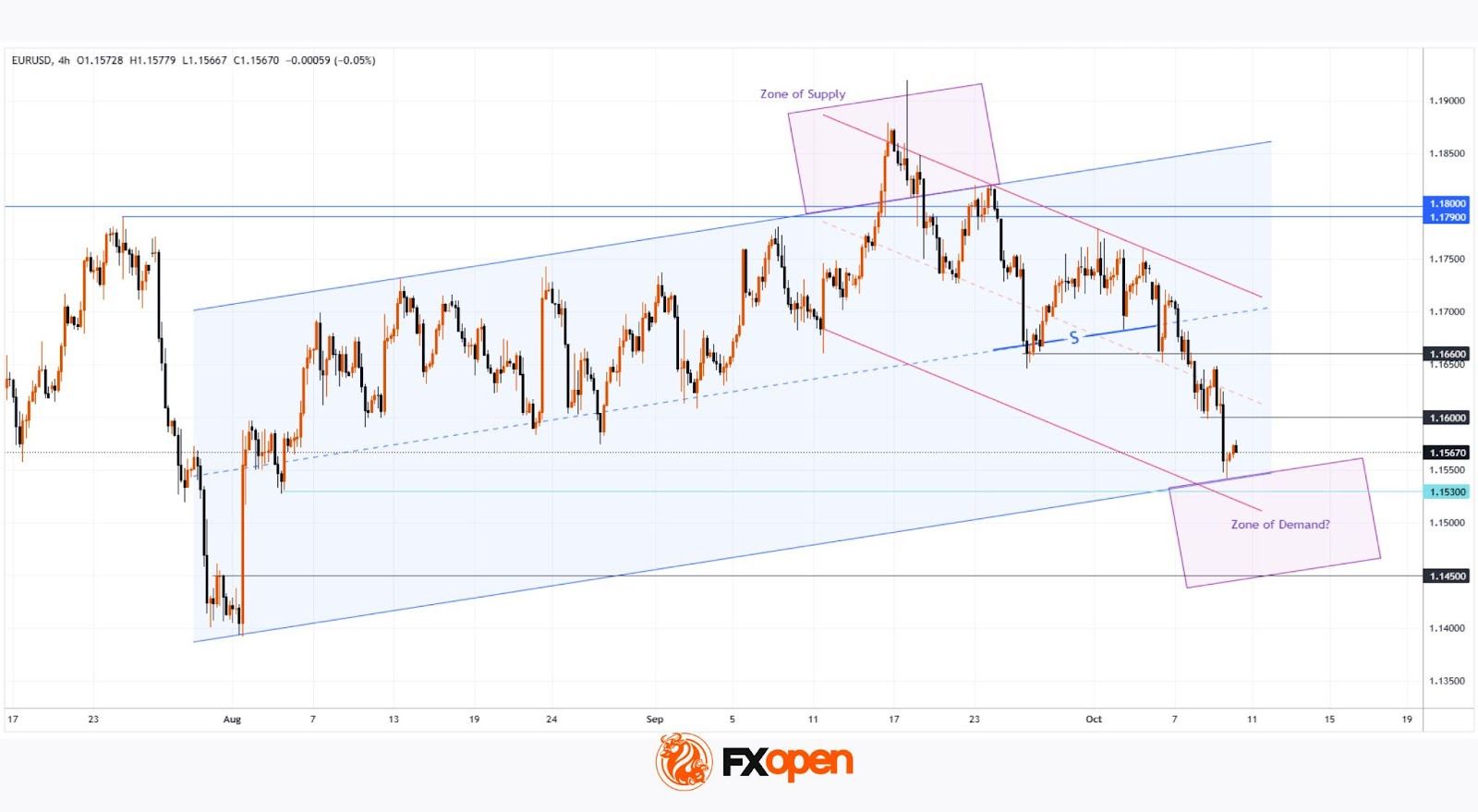
Technical Analysis of the EUR/USD Chart
On 6 October, we noted that:
→ fluctuations in EUR/USD over recent months had formed an upward channel (shown in blue);
→ we highlighted a break below line S;
→ and suggested that a bearish break below 1.16600 would pave the way for a decline towards key support at 1.14500.
Indeed, following the break of 1.16600, the downtrend continued. How might the situation develop from here? To explore this, we extended the ascending channel and proposed a hypothesis that in mid-September, the price entered a supply zone (marked in purple) above the previous peak near 1.1790 and the psychological level of 1.1800. In other words, smart money appeared to be forming short positions, as described by the Liquidity Sweep pattern.
Since then, the market has been moving in search of liquidity on the opposite side. On the EUR/USD chart, we have identified a potential demand zone around key levels:
→ the lower boundary of the blue channel;
→ the 1.1530 level, where buyers’ stop-losses may be located;
→ and the mentioned support at 1.14500.
From a bearish perspective:
→ the market is moving within a descending channel (shown in red);
→ resistance may be provided by both its median line and the former local support at 1.1600.
In light of the above:
→ in the short term, the market remains bearish;
→ in the medium term, bearish pressure may ease, and EUR/USD could begin to consolidate.
Whether this scenario unfolds — and in what configuration — will largely depend on the news flow and political developments in both the US and France.
Trade over 50 forex markets 24 hours a day with FXOpen. Take advantage of low commissions, deep liquidity, and spreads from 0.0 pips (additional fees may apply). Open your FXOpen account now or learn more about trading forex with FXOpen.
This article represents the opinion of the Companies operating under the FXOpen brand only. It is not to be construed as an offer, solicitation, or recommendation with respect to products and services provided by the Companies operating under the FXOpen brand, nor is it to be considered financial advice.
Stay ahead of the market!
Subscribe now to our mailing list and receive the latest market news and insights delivered directly to your inbox.


Latest articles

CAD/JPY: The Yen's Most Historic Move in 30 Years Meets a Fragile Support
Two central banks are heading in genuinely opposite directions this week, and the tension is unmistakable. The Bank of Canada held rates steady at 2.25% on September 2, with a mildly hawkish tilt as policymakers acknowledged a broadening economic

USD/JPY and USD/CAD Await Key Fed Decision
The US dollar is consolidating against the yen and Canadian dollar ahead of the key event of the week — the Federal Reserve meeting. The Fed is widely expected to raise its policy rate by 25 basis points to a range

UnitedHealth: Fundamentals Are Healing, Now the Chart Must Agree
UnitedHealth finds itself in a genuinely split narrative right now, trading near $388, down about 15.9% from its 52-week high, even as the fundamental picture keeps improving. Q2 earnings beat expectations, with revenue of $112.03 billion, and the