


Gold Price Falls to 2026 Low
FXOpen

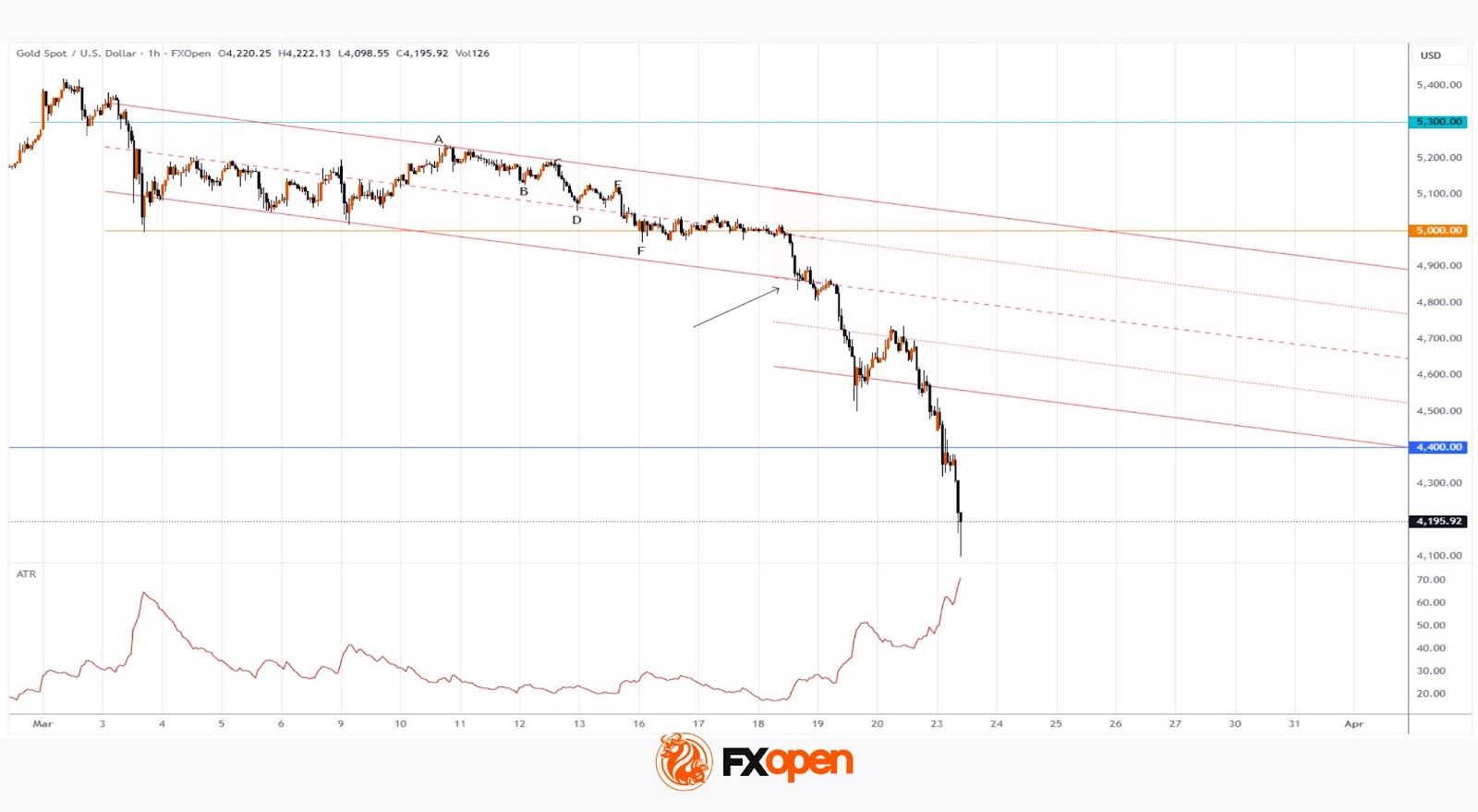
As the XAU/USD chart indicates, today, shortly after the start of the trading week, gold fell below $4,150 (the low of the year). The last time prices were at this level was in early December 2025, before the rally towards the all-time high.
Why Is Gold Declining?
Gold prices are being pressured by a combination of factors, including:
→ expectations that the Federal Reserve will keep interest rates higher for longer;
→ rising inflation risks driven by elevated oil prices.
In such conditions, market participants may shift capital into bonds, which appear more attractive than gold, as the metal does not generate yield.
Technical Analysis of XAU/USD
On the morning of 16 March, while analysing gold’s price movements, we identified a sequence of lower highs and lower lows (A–B–C–D–E). In addition:
→ key technical support levels were broken;
→ the outline of a descending channel was established;
→ we suggested that if bears maintained control, the price could move towards the lower boundary of the channel.
As the XAU/USD chart shows, by 18 March a renewed bearish impulse had emerged. Price not only declined towards the lower boundary (as marked by the arrow) but also broke below it, providing grounds to expand the descending channel. However, the lower boundary of the extended channel has so far held against selling pressure.
The current situation appears highly stressed:
→ from the March high, gold has lost around 25%;
→ media reports point to the worst week since 1983;
→ virtually any oscillator indicates strong oversold conditions;
→ the ATR indicator has surged to extremely high levels, which may signal cascading liquidations of long positions.
In this environment, traders should take into account the heightened volatility in gold prices in order to manage risk more effectively. A slowdown in the decline cannot be ruled out, supported by:
→ the proximity of the psychological $4,000 level;
→ an elevated geopolitical backdrop, primarily driven by the ongoing conflict in the Middle East.
Start trading commodity CFDs with tight spreads (additional fees may apply). Open your trading account now or learn more about trading commodity CFDs with FXOpen.
This article represents the opinion of the Companies operating under the FXOpen brand only. It is not to be construed as an offer, solicitation, or recommendation with respect to products and services provided by the Companies operating under the FXOpen brand, nor is it to be considered financial advice.
Stay ahead of the market!
Subscribe now to our mailing list and receive the latest market news and insights delivered directly to your inbox.


Latest articles

CAD/JPY: The Yen's Most Historic Move in 30 Years Meets a Fragile Support
Two central banks are heading in genuinely opposite directions this week, and the tension is unmistakable. The Bank of Canada held rates steady at 2.25% on September 2, with a mildly hawkish tilt as policymakers acknowledged a broadening economic

USD/JPY and USD/CAD Await Key Fed Decision
The US dollar is consolidating against the yen and Canadian dollar ahead of the key event of the week — the Federal Reserve meeting. The Fed is widely expected to raise its policy rate by 25 basis points to a range

UnitedHealth: Fundamentals Are Healing, Now the Chart Must Agree
UnitedHealth finds itself in a genuinely split narrative right now, trading near $388, down about 15.9% from its 52-week high, even as the fundamental picture keeps improving. Q2 earnings beat expectations, with revenue of $112.03 billion, and the