


Market Analysis. On Factors Influencing the Price of Oil: Biden, Israel, Venezuela
FXOpen

Pushing off the lower boundary of the ascending channel, the price of Brent oil rose by more than 8% amid fears of an escalation of conflict in the Middle East, which should pose a problem both for the US economy, which suffers from high inflation, and for President Biden personally on the eve of the elections.
The situation is aggravated by the fact that oil reserves in US strategic storage facilities are near minimums since 2014. That is why:
→ it can be assumed that the goal of containing the rise in oil prices was one of the motives for Biden’s visit to Israel on Wednesday. It is expected that the price of oil may be affected by Biden's speech from the Oval Office, scheduled for Thursday evening 20:00 ET (or Friday night at 03:00 GMT+3);
→ the United States has eased sanctions against Venezuela, which has the largest oil reserves in the world.
From a technical analysis perspective, a rally from the October lows (B) after a decline from the September highs (A) may confirm that important divergent drivers are battling in the market.
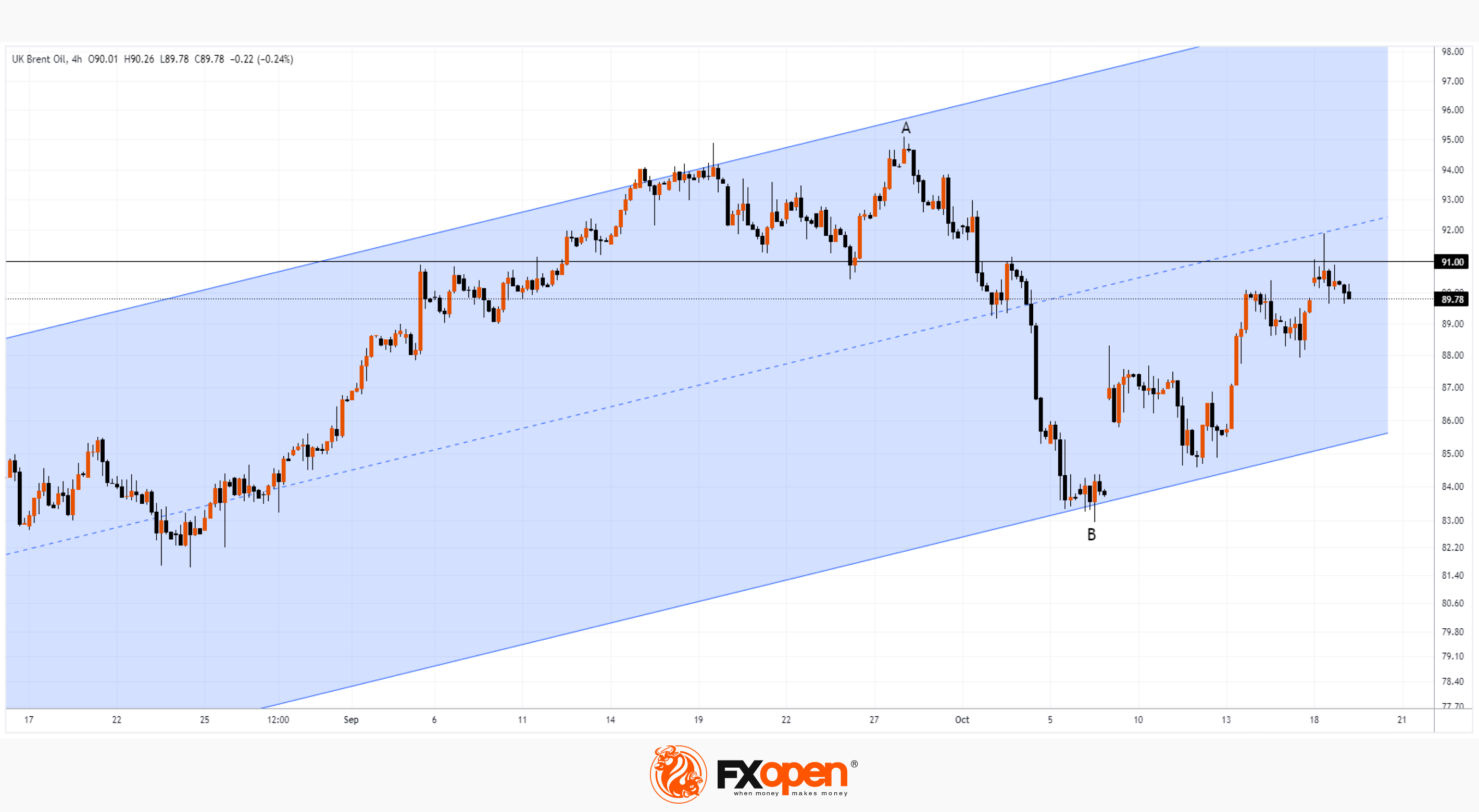
The Brent crude oil chart shows that:
→ resistance is provided by the median line of the ascending channel;
→ resistance is also observed from the level of USD 91, which served as support in September;
→ the presence of selling pressure is also evidenced by the long upper shadow on yesterday’s candle.
However, will the resistance be able to hold out if the situation in the Middle East, which provides a third of world oil consumption, continues to escalate? According to Bloomberg, there are concerns that Israel's expected ground offensive on the Gaza Strip could provoke a more aggressive response from Iran-backed Hezbollah in southern Lebanon and perhaps from Tehran itself.
Start trading commodity CFDs with tight spreads (additional fees may apply). Open your trading account now or learn more about trading commodity CFDs with FXOpen.
This article represents the opinion of the Companies operating under the FXOpen brand only. It is not to be construed as an offer, solicitation, or recommendation with respect to products and services provided by the Companies operating under the FXOpen brand, nor is it to be considered financial advice.
Stay ahead of the market!
Subscribe now to our mailing list and receive the latest market news and insights delivered directly to your inbox.


Latest articles

CAD/JPY: The Yen's Most Historic Move in 30 Years Meets a Fragile Support
Two central banks are heading in genuinely opposite directions this week, and the tension is unmistakable. The Bank of Canada held rates steady at 2.25% on September 2, with a mildly hawkish tilt as policymakers acknowledged a broadening economic

USD/JPY and USD/CAD Await Key Fed Decision
The US dollar is consolidating against the yen and Canadian dollar ahead of the key event of the week — the Federal Reserve meeting. The Fed is widely expected to raise its policy rate by 25 basis points to a range

UnitedHealth: Fundamentals Are Healing, Now the Chart Must Agree
UnitedHealth finds itself in a genuinely split narrative right now, trading near $388, down about 15.9% from its 52-week high, even as the fundamental picture keeps improving. Q2 earnings beat expectations, with revenue of $112.03 billion, and the