


FXOpen

Yesterday, Netflix (NFLX) released its quarterly results, which, albeit only slightly, exceeded Wall Street analysts’ expectations — both in terms of earnings per share (EPS) and gross revenue. Despite this, NFLX shares fell in after-hours trading to around the $82.50 level.
Why Did NFLX Shares Fall?
Bearish sentiment is being driven by the following factors (according to media reports):
→ Cautious guidance from management. Netflix expects revenue growth to slow to 11–13%, compared with 15–16% in 2025.
→ Subscriber growth dynamics. While total subscriber numbers increased to a record level of around 325 million, the pace of growth is slowing. By comparison, the company added roughly 23 million new users in 2025, versus 41 million in 2024.
→ M&A considerations. As we noted on 8 December, Netflix’s share price could be significantly affected by a potential acquisition of Warner Bros. Discovery. Such a large-scale deal carries risks related to increased debt and adds to uncertainty.
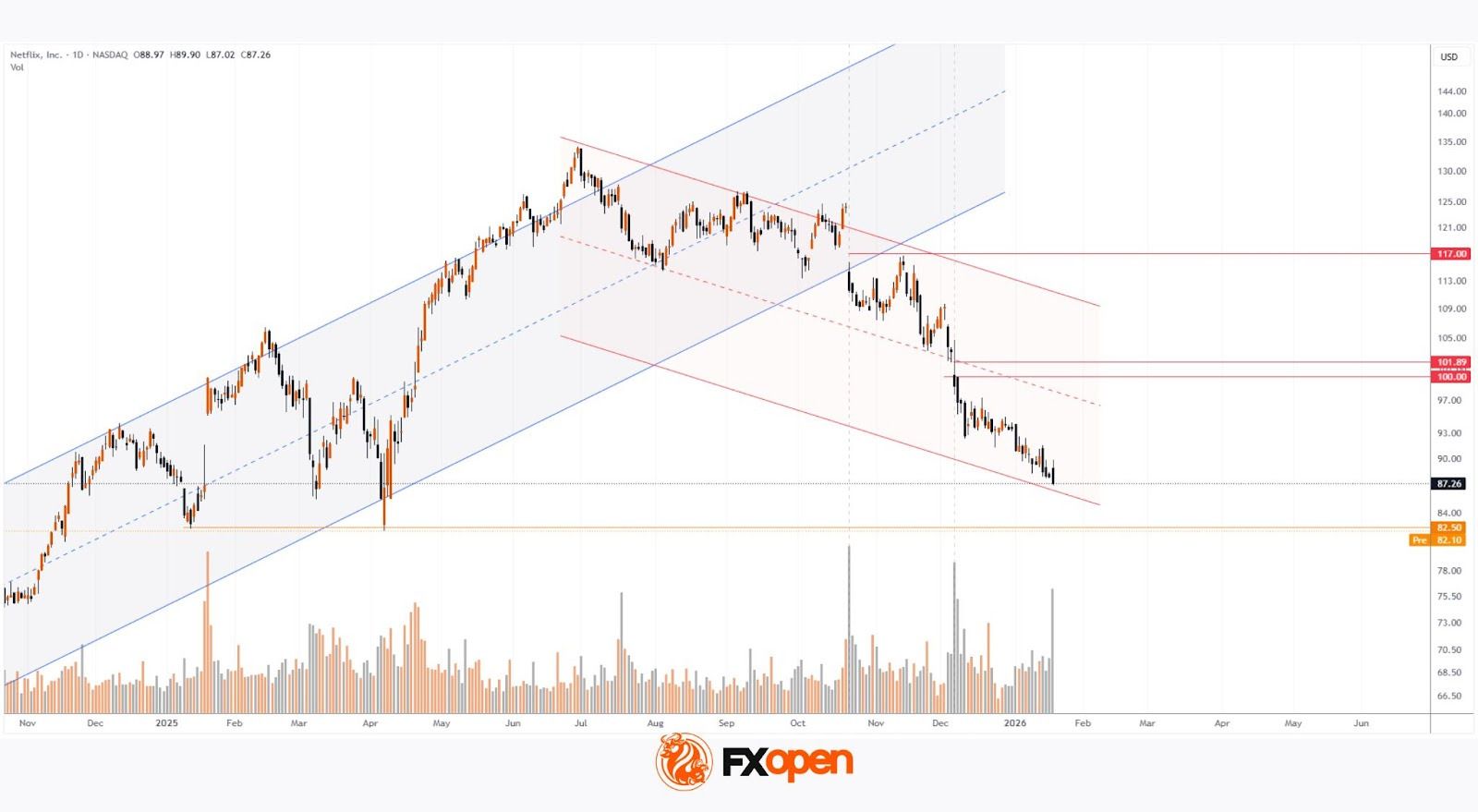
Technical Analysis of the NFLX Chart
In our earlier analysis of Netflix (NFLX) share price action, we identified both ascending and descending channels, noting that:
→ In October, the ascending channel was broken to the downside, with the breakout level around $117 acting as resistance, reinforcing the relevance of the descending trajectory.
→ In December, NFLX shares moved into the lower half of the descending channel, accompanied by rising volumes and accelerating downside momentum — a bearish signal — and settled below the psychological $100 level, which may now act as resistance.
If NFLX trading opens today around $82.50, then:
→ the price will be below the lower boundary of the channel;
→ it will be close to key 2025 lows, which may provide support;
→ oscillators will indicate oversold conditions.
Under these circumstances, a short-term rebound in NFLX shares is possible. However, it appears that more substantial catalysts are required to reverse the current sustained downtrend.
Buy and sell stocks of the world's biggest publicly-listed companies with CFDs on FXOpen’s trading platform. Open your FXOpen account now or learn more about trading share CFDs with FXOpen.
This article represents the opinion of the Companies operating under the FXOpen brand only. It is not to be construed as an offer, solicitation, or recommendation with respect to products and services provided by the Companies operating under the FXOpen brand, nor is it to be considered financial advice.
Stay ahead of the market!
Subscribe now to our mailing list and receive the latest market news and insights delivered directly to your inbox.


Latest articles

The Real Driver Behind the Dollar Rally: Market Insights with Gary Thomson
The US dollar has been firm, but the drivers behind the move may be more complex than they first appear.
While geopolitical tension and shifts in risk sentiment play a role, current price behaviour seems increasingly influenced by inflation expectations

EUR/USD and USD/CHF Pull Back: Market Reacts to Fundamentals
European currencies have shown a recovery in recent trading sessions after their recent decline, displaying early signs of a reversal. The US dollar is weakening amid expectations surrounding upcoming US macroeconomic data, while market participants are reassessing their short-term positions

Weak Data Weigh on the Dollar: Market Awaits Trend Confirmation
The US dollar is retreating from recent highs, moving into a moderate correction after a prolonged period of gains. Pressure on the currency is building amid weaker-than-expected macroeconomic data, while market participants adopt a wait-and-see approach ahead of key labour