


Netflix (NFLX) Shares See a Sharp Decline
FXOpen

According to recent charts, Netflix (NFLX) shares have traded below $1,100 this week — for the first time since late May. The stock has fallen more than 17% from its July peak, while the S&P 500 index (US SPX 500 mini on FXOpen) remains close to record highs.
Why Has Netflix (NFLX) Fallen?
The main catalyst for the drop was the company’s earnings report, which showed results well below expectations: actual EPS came in at $5.87 versus a forecast of $6.96 and a previous reading of $7.19.
Despite the success of several new releases, the figures were weighed down by a tax dispute in Brazil, which significantly dampened market sentiment. Nevertheless, the bulls still have reasons for cautious optimism.
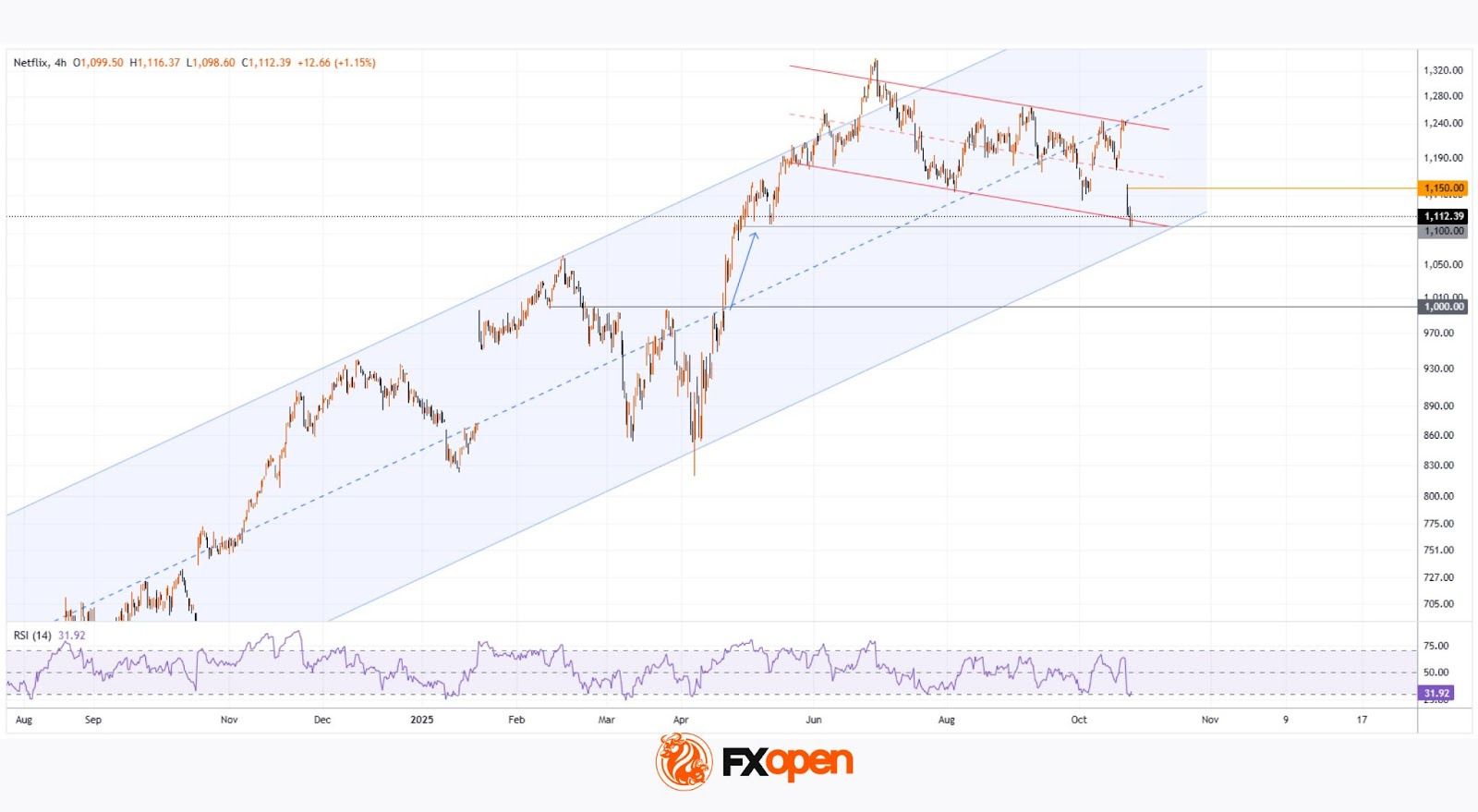
Technical Analysis of the NFLX Chart
The NFLX share price remains within a long-term upward channel (marked in blue). It has now approached a key support zone formed by:
→ the lower boundary of the main channel, which previously provided support in April;
→ the lower line of a short-term downward trajectory (marked in red);
→ the psychological level of $1,100.
Bulls are taking encouragement from the fact that:
→ the RSI indicator has entered oversold territory;
→ the price previously moved confidently through the $1,000–$1,100 range, suggesting that strong buying interest may still persist in this area.
From the sellers’ perspective, however, attention should be paid to the large bearish gap formed earlier this week, with its lower edge near $1,100, which could now act as resistance.
Taking all this into account, it seems reasonable to assume that:
→ the current support zone may prevent further declines in NFLX shares;
→ the impact of the Brazilian tax case (reported losses of around $600 million) may already be priced in;
→ bulls could attempt to resume the broader uptrend, potentially turning the red trajectory into a bullish flag pattern.
On the other hand, failure to hold within the blue channel would expose the $1,000 level to another test.
Buy and sell stocks of the world's biggest publicly-listed companies with CFDs on FXOpen’s trading platform. Open your FXOpen account now or learn more about trading share CFDs with FXOpen.
This article represents the opinion of the Companies operating under the FXOpen brand only. It is not to be construed as an offer, solicitation, or recommendation with respect to products and services provided by the Companies operating under the FXOpen brand, nor is it to be considered financial advice.
Stay ahead of the market!
Subscribe now to our mailing list and receive the latest market news and insights delivered directly to your inbox.


Latest articles

CAD/JPY: The Yen's Most Historic Move in 30 Years Meets a Fragile Support
Two central banks are heading in genuinely opposite directions this week, and the tension is unmistakable. The Bank of Canada held rates steady at 2.25% on September 2, with a mildly hawkish tilt as policymakers acknowledged a broadening economic

USD/JPY and USD/CAD Await Key Fed Decision
The US dollar is consolidating against the yen and Canadian dollar ahead of the key event of the week — the Federal Reserve meeting. The Fed is widely expected to raise its policy rate by 25 basis points to a range

UnitedHealth: Fundamentals Are Healing, Now the Chart Must Agree
UnitedHealth finds itself in a genuinely split narrative right now, trading near $388, down about 15.9% from its 52-week high, even as the fundamental picture keeps improving. Q2 earnings beat expectations, with revenue of $112.03 billion, and the