


FXOpen
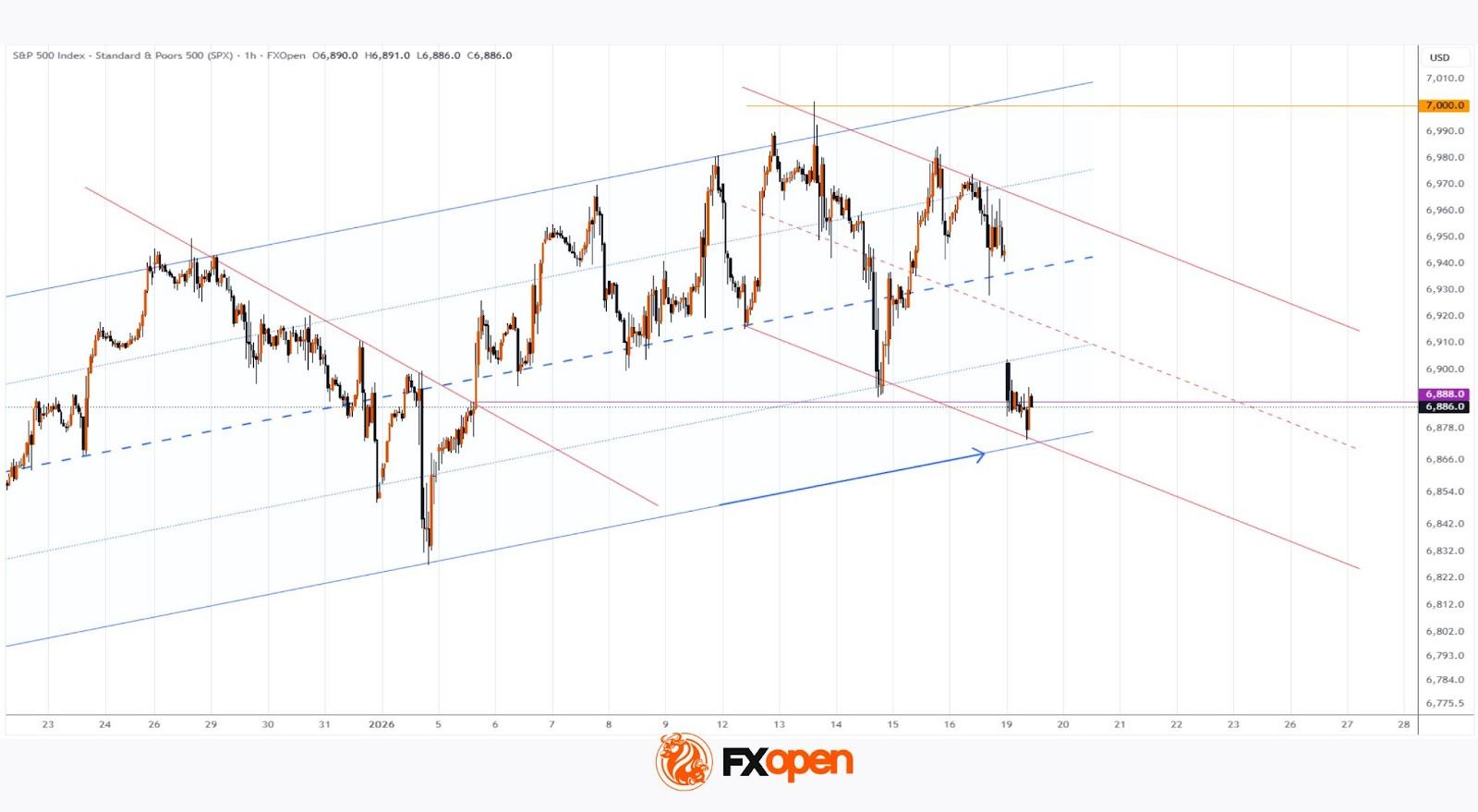
Despite a public holiday in the US (Martin Luther King Jr Day), the US stock market is showing volatility this morning. As the S&P 500 index chart (US SPX 500 mini on FXOpen) indicates, trading on Monday opened with a sizeable bearish gap, driven by Donald Trump’s activity over the weekend.
According to media reports, the US president threatened to impose new tariffs on goods from eight European countries in order to force them to “fully and completely buy Greenland”. The proposed measures target Germany, the UK, France, Denmark, Norway, Sweden, the Netherlands and Finland. A 10% tariff is set to take effect on 1 February and would rise to 25% in June if no agreement is reached.
In response to the US threats, European leaders are considering suspending the ratification of last year’s trade agreement. Clearly, the market could not ignore such an escalation in international trade tensions.
Technical Analysis of the S&P 500 Chart
The decline in the S&P 500 (US SPX 500 mini on FXOpen) appears to confirm the bearish signals highlighted in the article S&P 500 Hits a Record – But Is Everything Really So Positive? published on 13 January.
As anticipated:
→ bears proved effective in defending the psychological 7,000-point level (with the price posting a false bullish breakout on the same day);
→ on 14 January, bulls confidently met the decline near the marked support at 6,888, after which the price moved higher.
At the same time, the previously identified ascending channel remains relevant. In this context:
→ the channel median acted as support on Friday;
→ today’s bearish gap has pushed the price down to the lower boundary of the channel (shown by the blue arrow).
The lower boundary has already demonstrated its strength as support in the first days of 2026. However, if geopolitical tensions and disappointing releases during the ongoing earnings season continue to fuel anxiety, bears may break through it and steer the S&P 500 onto a downward path that is becoming increasingly apparent.
Trade global index CFDs with zero commission and tight spreads (additional fees may apply). Open your FXOpen account now or learn more about trading index CFDs with FXOpen.
This article represents the opinion of the Companies operating under the FXOpen brand only. It is not to be construed as an offer, solicitation, or recommendation with respect to products and services provided by the Companies operating under the FXOpen brand, nor is it to be considered financial advice.
Stay ahead of the market!
Subscribe now to our mailing list and receive the latest market news and insights delivered directly to your inbox.


Latest articles

Gold Price Holds Near Key Support
As the XAU/USD chart shows, the gold price has been holding within the $5,060–$5,200 range over the past several sessions.
Bullish view: the key support is the lower boundary of the long-term channel that has been

EUR/USD Chart Analysis: Pair Rebounds from the Year’s Low
Analysing the EUR/USD chart five days ago, we:
→ constructed a downward channel, noting signs that the bears remained in control;
→ outlined a scenario in which the rate would decline to a new yearly low (and test the lower boundary
Dollar Index (DXY) Hits Yearly High
Today, the dollar index rose above last week’s peak around the 99.68 level, setting a new high for 2026. This movement is supported by a tense fundamental backdrop:
→ Inflationary pressures from rising oil prices. Markets may be pricing