


FXOpen

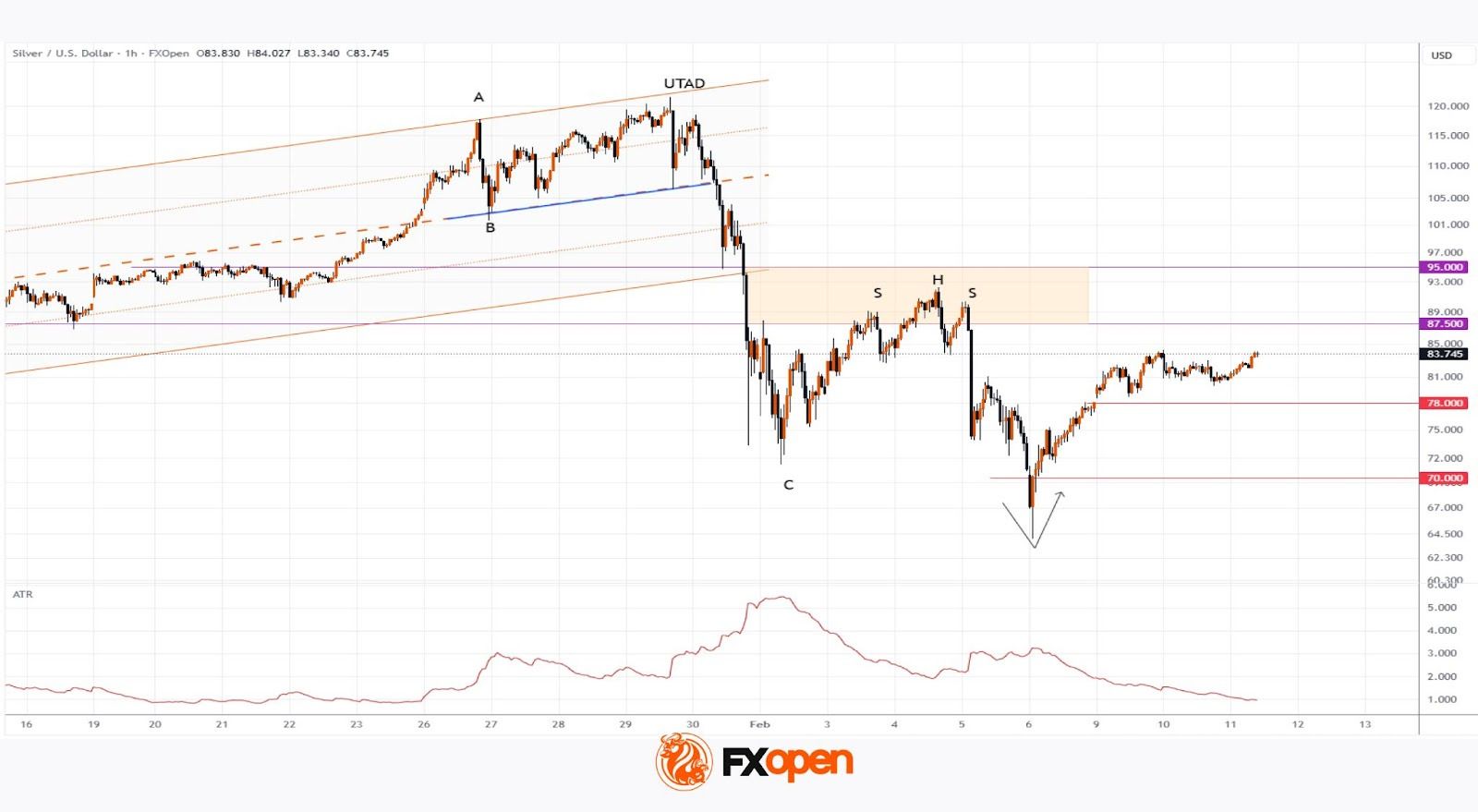
As indicated by today’s ATR reading on the XAG/USD chart, trading activity has returned to the more normal levels seen prior to the third week of January, when:
→ silver entered a phase of exuberant growth towards its record high around the $120 mark;
→ this was followed by a dramatic collapse towards the $75 area.
The volatility indicator has now fallen back to customary levels, suggesting that supply and demand are gradually moving into balance.
Yesterday’s release of weaker US retail sales data could have served as a bullish catalyst for gold and silver, as signs of slowing economic activity ahead of key employment figures tend to increase demand for safe-haven assets. However, this did not occur, reinforcing the view that the market is stabilising.
On 2 February, when analysing the XAG/USD chart, we wrote:
“Even if silver attempts to turn higher under the current conditions of extreme oversold territory, it may encounter a strong resistance zone in the $87.5–95 range, where bears previously demonstrated clear dominance by breaking the long-term ascending channel.”
Indeed, the highlighted area not only halted the recovery impulse but also — after forming a head and shoulders reversal pattern — pushed silver down to a lower low.
Price action analysis allows for several important observations:
→ the V-shaped rebound below the psychological $70 level appears to reflect the liquidation of a cascade of buyers’ stop-loss orders, followed by a wave of buying that signals aggressive demand;
→ the bullish gap around $78 now appears to be acting as support.
In light of the above, it is reasonable to conclude that the XAG/USD market may continue developing a consolidation phase, fluctuating between two key zones:
→ resistance near $95;
→ support around $70.
For a long-term outlook on silver prices, see this article.
Start trading commodity CFDs with tight spreads (additional fees may apply). Open your trading account now or learn more about trading commodity CFDs with FXOpen.
This article represents the opinion of the Companies operating under the FXOpen brand only. It is not to be construed as an offer, solicitation, or recommendation with respect to products and services provided by the Companies operating under the FXOpen brand, nor is it to be considered financial advice.
Stay ahead of the market!
Subscribe now to our mailing list and receive the latest market news and insights delivered directly to your inbox.


Latest articles
USD/CAD Rises to a Two-Month High
Today, the USD/CAD currency pair climbed above the 1.3787 level for the first time since late January.
→ Demand for the US dollar is being supported by concerns over escalating tensions in the Middle East. Market participants are favouring

Alphabet (GOOGL) Shares Fall to 2026 Low
As the chart shows, Alphabet (GOOGL) shares have dropped to their lowest level of 2026, with trading closing well below the psychological $300 per share mark.
Why Have Alphabet (GOOGL) Shares Declined?
The bearish move is driven by a combination

FX Market Awaits Macro Data: EUR/USD and GBP/USD Near Range Boundaries
European currencies are trading without a clear direction against the US dollar, remaining in a consolidation phase following the earlier decline driven by USD strength. At the start of the week, both EUR/USD and GBP/USD attempted a recovery,