


The EUR/AUD Pair Rose by More Than 2% Over the Week
FXOpen

If last Thursday trading was taking place below the 1.6300 level, today one euro is worth more than 1.6660 Australian dollars. The upward trend seen in recent days has been driven by a combination of factors, including:
→ Bullish factor for the euro: The European Central Bank (ECB) has revised its 2026 inflation forecast upwards (to 2.6%). The reason lies in the Middle East conflict and rising energy prices. This signals to the market that the ECB may not only refrain from cutting rates but could also begin discussing potential rate hikes this year.
→ Bearish factor for the Australian dollar: The Middle East conflict is placing significant pressure on China’s economy (which is already dealing with a property market crisis). A slowdown in trade with China is weakening the Australian currency. For more details, see the article: What Are Commodity Currencies?
However, the chart indicates that the bullish momentum is fading — this is reflected in a series of bearish divergences, with the RSI moving down from overbought territory.
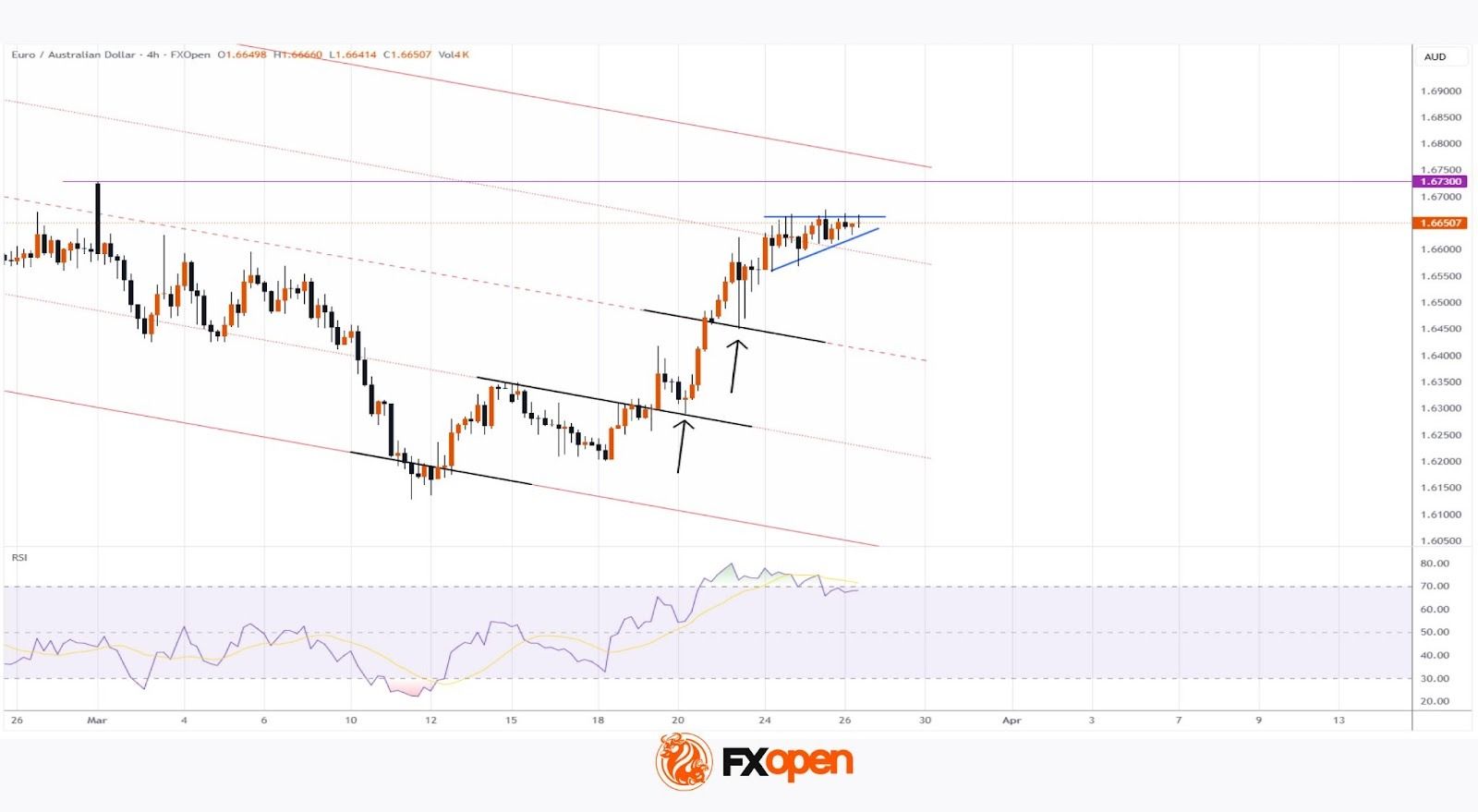
Continuing the technical analysis of the EUR/AUD chart, it can be observed that price fluctuations have formed a long-term descending channel. In this context:
→ Bulls have shown initiative: after touching the lower boundary of the channel, they (as marked by arrows) gradually took control over intermediate channel levels.
→ The current situation can be interpreted as a period of short-term consolidation (with the formation of a narrowing triangle pattern). The triangle may have been broken this morning, but Australia’s inflation report came in line with expectations — and the market continues to consolidate.
If we assume that bulls manage to gather enough strength for another upward push, they may face a significant test in the form of a resistance zone:
→ the March high around the 1.6730 level;
→ the upper boundary of the descending channel.
Trade over 50 forex markets 24 hours a day with FXOpen. Take advantage of low commissions, deep liquidity, and spreads from 0.0 pips (additional fees may apply). Open your FXOpen account now or learn more about trading forex with FXOpen.
This article represents the opinion of the Companies operating under the FXOpen brand only. It is not to be construed as an offer, solicitation, or recommendation with respect to products and services provided by the Companies operating under the FXOpen brand, nor is it to be considered financial advice.
Stay ahead of the market!
Subscribe now to our mailing list and receive the latest market news and insights delivered directly to your inbox.


Latest articles

CAD/JPY: The Yen's Most Historic Move in 30 Years Meets a Fragile Support
Two central banks are heading in genuinely opposite directions this week, and the tension is unmistakable. The Bank of Canada held rates steady at 2.25% on September 2, with a mildly hawkish tilt as policymakers acknowledged a broadening economic

USD/JPY and USD/CAD Await Key Fed Decision
The US dollar is consolidating against the yen and Canadian dollar ahead of the key event of the week — the Federal Reserve meeting. The Fed is widely expected to raise its policy rate by 25 basis points to a range

UnitedHealth: Fundamentals Are Healing, Now the Chart Must Agree
UnitedHealth finds itself in a genuinely split narrative right now, trading near $388, down about 15.9% from its 52-week high, even as the fundamental picture keeps improving. Q2 earnings beat expectations, with revenue of $112.03 billion, and the