


The US Dollar Index (DXY) Falls to Its Lowest Level Since September
FXOpen
As the DXY chart shows, the US dollar index is trading today at its lowest level since September 2025. From this month’s peak, the decline has exceeded 2%.
Why Is the Dollar Weakening?
→ The Fed factor. The interest rate decision is due tomorrow. Markets are expecting dovish rhetoric from Jerome Powell to offset economic risks stemming from tariff wars. It cannot be ruled out that the Fed Chair may soften his stance under unprecedented pressure from the White House administration, including threats of criminal prosecution.
→ Loss of safe-haven status. The dollar is losing appeal as a defensive asset amid geopolitical tensions (the US–EU dispute over Greenland and strained relations with Canada). Capital is actively flowing out of fiat currencies into real assets, as confirmed by yesterday’s historic breakout in gold prices above $5,000.
That said, the technical picture offers some grounds for optimism among bulls.
Technical Analysis of the DXY Chart
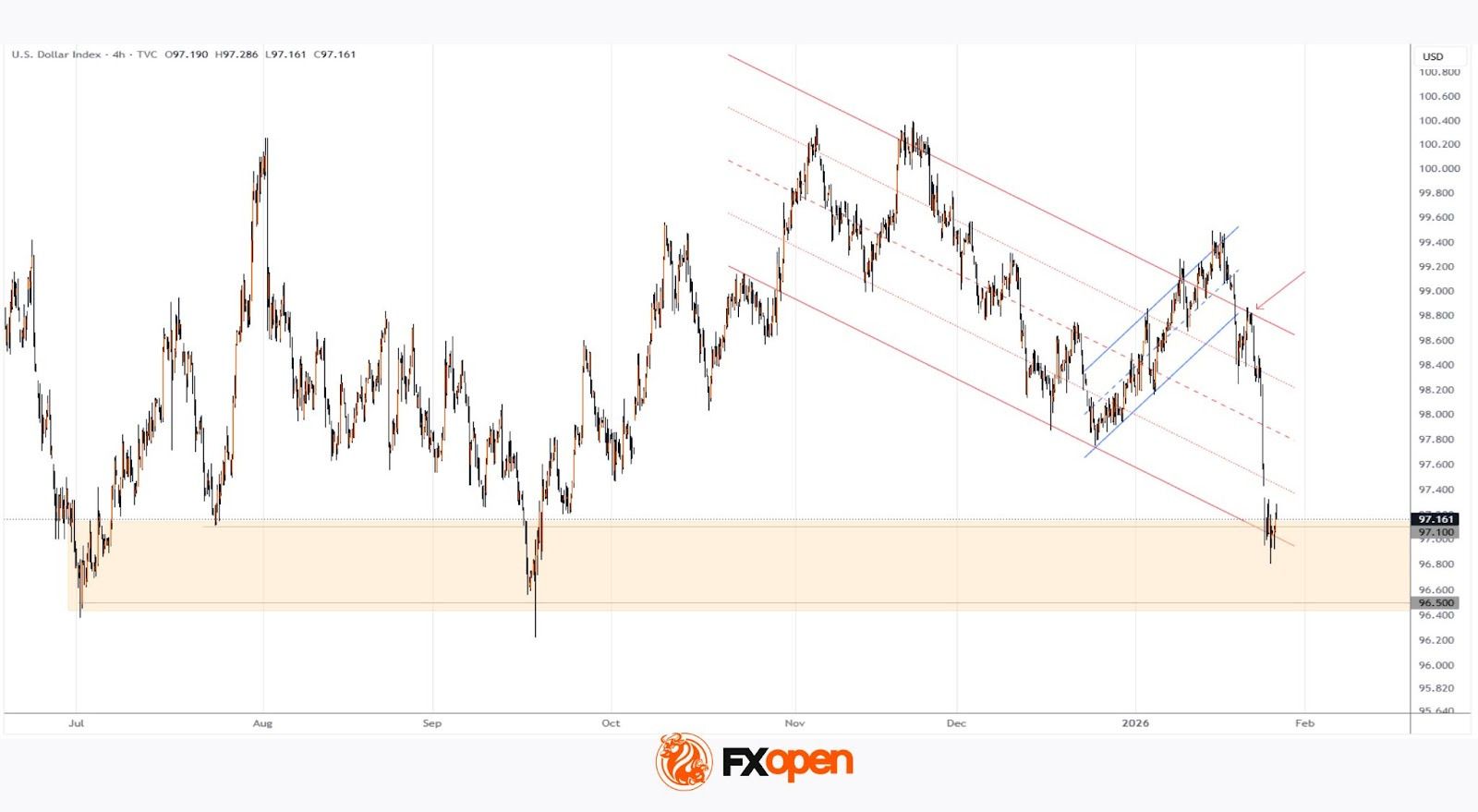
On 20 January, when analysing the US Dollar Index (DXY), we:
→ updated the descending channel (marked in red);
→ suggested that the downtrend could continue, with a move towards the channel median.
However, bears exceeded our expectations and, after testing the upper boundary on 21 January (as shown by the arrow), pushed the price towards the lower boundary of the channel, which tends to act as support.
Moreover, the DXY index is now hovering near a long-term support zone from which the price rebounded twice in the second half of 2025.
This suggests that the aggressive downward momentum may be running out of steam, with the market likely to shift into a wait-and-see mode ahead of the Fed’s decision. Be prepared for spikes in volatility tomorrow between 22:00 and 22:30 GMT+3.
Trade global index CFDs with zero commission and tight spreads (additional fees may apply). Open your FXOpen account now or learn more about trading index CFDs with FXOpen.
This article represents the opinion of the Companies operating under the FXOpen brand only. It is not to be construed as an offer, solicitation, or recommendation with respect to products and services provided by the Companies operating under the FXOpen brand, nor is it to be considered financial advice.
Stay ahead of the market!
Subscribe now to our mailing list and receive the latest market news and insights delivered directly to your inbox.


Latest articles

CAD/JPY: The Yen's Most Historic Move in 30 Years Meets a Fragile Support
Two central banks are heading in genuinely opposite directions this week, and the tension is unmistakable. The Bank of Canada held rates steady at 2.25% on September 2, with a mildly hawkish tilt as policymakers acknowledged a broadening economic

USD/JPY and USD/CAD Await Key Fed Decision
The US dollar is consolidating against the yen and Canadian dollar ahead of the key event of the week — the Federal Reserve meeting. The Fed is widely expected to raise its policy rate by 25 basis points to a range

UnitedHealth: Fundamentals Are Healing, Now the Chart Must Agree
UnitedHealth finds itself in a genuinely split narrative right now, trading near $388, down about 15.9% from its 52-week high, even as the fundamental picture keeps improving. Q2 earnings beat expectations, with revenue of $112.03 billion, and the