


Tesla (TSLA) Shares Surge Following Musk’s Announcements
FXOpen

According to the chart, Tesla (TSLA) shares had been under significant pressure since the start of 2026: from their December high, they had lost around 25% of their value. The main bearish drivers included:
→ Intense competition from Chinese automakers, particularly BYD.
→ Falling margins. To maintain market share amid fierce competition, Tesla had to offer price concessions.
→ Doubts over whether Musk could launch the Robotaxi project on schedule, given incidents involving the Autopilot system in poor visibility conditions.
However, on 23 March, the shares staged a strong rebound — TSLA gained approximately 3.5% and closed above $380.
The rally was supported by Elon Musk officially unveiling the Terafab project over the weekend — a joint venture between Tesla, SpaceX, and the startup xAI, with investments estimated at $20–25 billion. The plan to build the world’s largest full-cycle semiconductor factory in Texas is intended to supply Tesla with its own advanced chips, including the new AI5 generation, for Full Self-Driving (FSD) systems, Cybercab robotaxis, and Optimus humanoid robots.
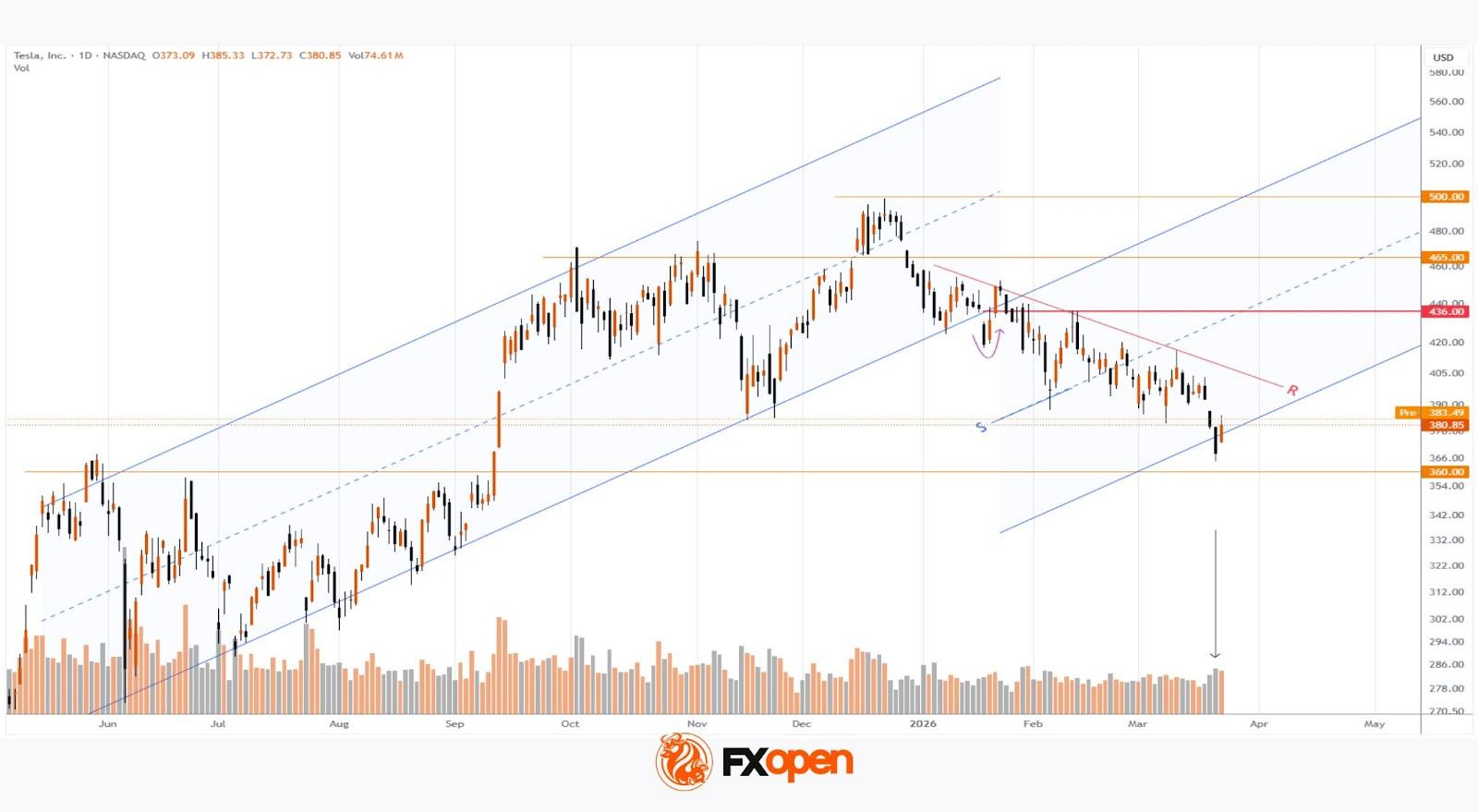
Technical Analysis of TSLA Shares
Analysing TSLA’s price on 23 January, we:
→ Updated the ascending channel, which had been in place since summer 2025;
→ Noted signs that bulls were regaining control near the lower boundary of this channel.
Despite this, the shares did not return to the main ascending channel, and the downtrend persisted. This led us to:
→ Draw a descending trendline;
→ Extend a parallel ascending channel downwards, which proved relevant on 5 February when TSLA bounced off its median.
The current upward reversal is notable:
→ It forms a bullish engulfing pattern;
→ It develops near the lower boundary of the parallel channel and the former resistance level at $360;
→ It suggests that Smart Money may be active, as indicated by the largest trading volumes since late January.
Thus, it is reasonable to suggest that the bearish trend for TSLA shares observed in 2026 may be approaching exhaustion.
Buy and sell stocks of the world's biggest publicly-listed companies with CFDs on FXOpen’s trading platform. Open your FXOpen account now or learn more about trading share CFDs with FXOpen.
This article represents the opinion of the Companies operating under the FXOpen brand only. It is not to be construed as an offer, solicitation, or recommendation with respect to products and services provided by the Companies operating under the FXOpen brand, nor is it to be considered financial advice.
Stay ahead of the market!
Subscribe now to our mailing list and receive the latest market news and insights delivered directly to your inbox.


Latest articles

CAD/JPY: The Yen's Most Historic Move in 30 Years Meets a Fragile Support
Two central banks are heading in genuinely opposite directions this week, and the tension is unmistakable. The Bank of Canada held rates steady at 2.25% on September 2, with a mildly hawkish tilt as policymakers acknowledged a broadening economic

USD/JPY and USD/CAD Await Key Fed Decision
The US dollar is consolidating against the yen and Canadian dollar ahead of the key event of the week — the Federal Reserve meeting. The Fed is widely expected to raise its policy rate by 25 basis points to a range

UnitedHealth: Fundamentals Are Healing, Now the Chart Must Agree
UnitedHealth finds itself in a genuinely split narrative right now, trading near $388, down about 15.9% from its 52-week high, even as the fundamental picture keeps improving. Q2 earnings beat expectations, with revenue of $112.03 billion, and the