


NZD/USD: RBNZ Decision Strengthens Expectations of Further Rate Hikes
FXOpen

Fundamental backdrop
On 27 May, the Reserve Bank of New Zealand kept the Official Cash Rate (OCR) unchanged at 2.25%, in line with market expectations. However, the decision proved finely balanced: the Monetary Policy Committee voted 3–3, with the final decision resting with Governor Anna Brehman.
In its updated rate projection path, the regulator signalled that the OCR could rise to around 2.8% by the end of the year, implying several rate hikes before year-end. Additional caution stems from the inflation backdrop: the conflict in the Middle East continues to keep inflation above the target range, while the central bank also warned about the weak pace of economic recovery. The split vote and the signal of likely future tightening supported the New Zealand dollar during the Asian session.
Technical picture
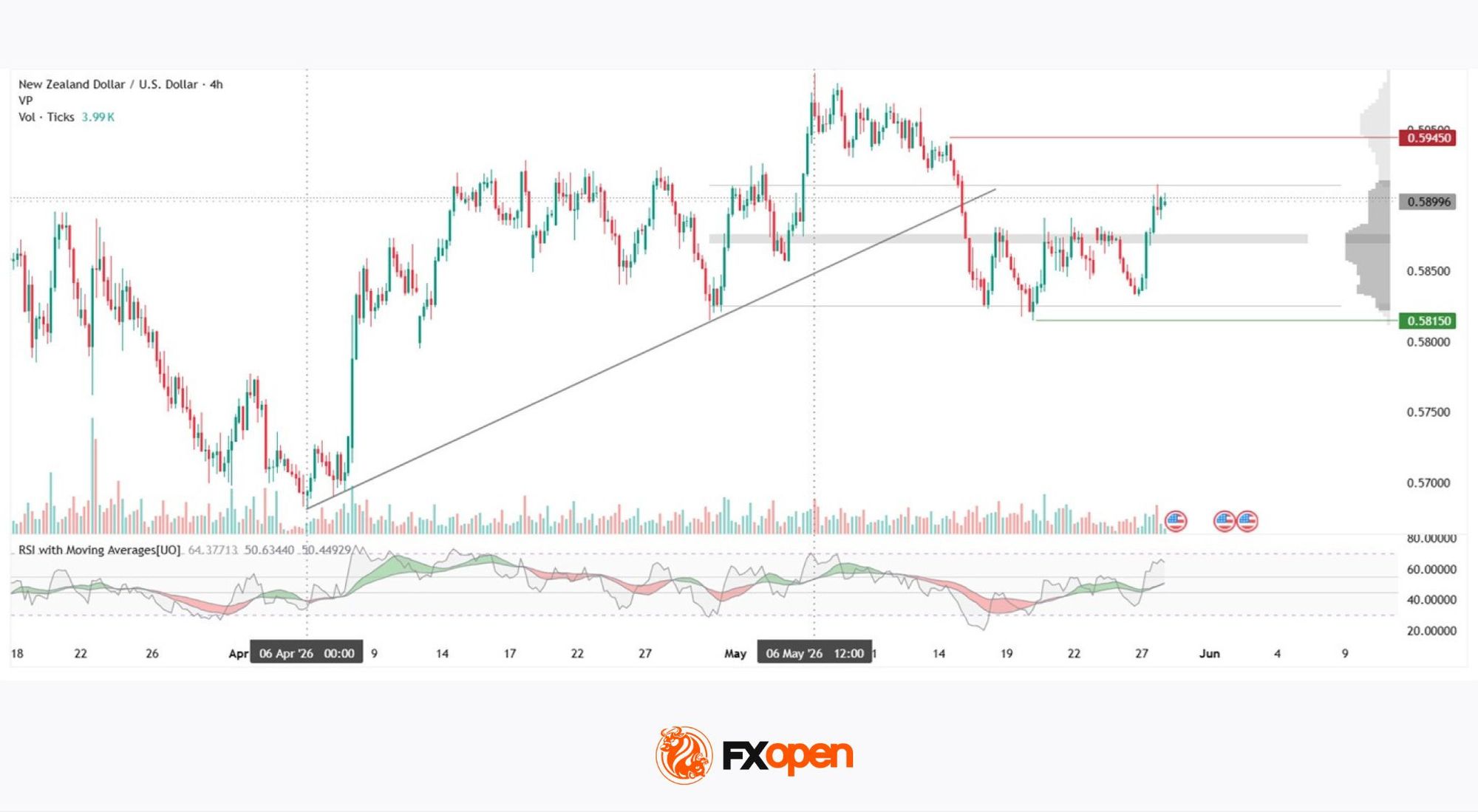
On the four-hour chart, NZD/USD displays a two-phase structure. In April, the pair established an upward trend: from the lows near 0.5680 at the beginning of the month, price gradually moved higher. The move culminated in early May with a peak around 0.5990, after which the trendline was broken to the downside and the pair entered a corrective phase, refreshing local lows near the 0.5815 area.
This was followed by a consolidation phase, during which the volume profile formed a point of control around 0.5870–0.5875, while the profile boundaries were established near 0.5910 and 0.5825.
At the time of writing, price is testing the upper boundary of the profile from below, and a breakout could draw market attention towards the 0.5945 area — the nearest resistance level. Should quotations return below the point of control, focus may shift towards the lower boundary of the profile at 0.5825, with a potential support zone located beneath it around 0.5815.
RSI + MAs currently show readings of 64 / 50 / 50. The oscillator remains noticeably above both moving averages and has not yet entered overbought territory, indicating the presence of a local bullish impulse. At the same time, the RSI moving averages themselves remain close to the neutral 50 mark, meaning that the character of the move will largely depend on how price reacts to the upper boundary of the profile.
Key takeaways
The split RBNZ vote and the updated rate outlook have created a situation in which the market may continue to reassess expectations as new New Zealand inflation data emerge. The technical picture reflects the same duality: the RSI curve points higher, yet the neutral positioning of its moving averages does not provide sufficient confirmation of a sustained upward trend.
Trade over 50 forex markets 24 hours a day with FXOpen. Take advantage of low commissions, deep liquidity, and spreads from 0.0 pips (additional fees may apply). Open your FXOpen account now or learn more about trading forex with FXOpen.
This article represents the opinion of the Companies operating under the FXOpen brand only. It is not to be construed as an offer, solicitation, or recommendation with respect to products and services provided by the Companies operating under the FXOpen brand, nor is it to be considered financial advice.
Stay ahead of the market!
Subscribe now to our mailing list and receive the latest market news and insights delivered directly to your inbox.


Latest articles

CAD/JPY: The Yen's Most Historic Move in 30 Years Meets a Fragile Support
Two central banks are heading in genuinely opposite directions this week, and the tension is unmistakable. The Bank of Canada held rates steady at 2.25% on September 2, with a mildly hawkish tilt as policymakers acknowledged a broadening economic

USD/JPY and USD/CAD Await Key Fed Decision
The US dollar is consolidating against the yen and Canadian dollar ahead of the key event of the week — the Federal Reserve meeting. The Fed is widely expected to raise its policy rate by 25 basis points to a range

UnitedHealth: Fundamentals Are Healing, Now the Chart Must Agree
UnitedHealth finds itself in a genuinely split narrative right now, trading near $388, down about 15.9% from its 52-week high, even as the fundamental picture keeps improving. Q2 earnings beat expectations, with revenue of $112.03 billion, and the