


US Dollar Index (DXY) Rises Above the 100 Level
FXOpen
Today the US Dollar Index (DXY) climbed above the psychological 100 mark for the first time in 2026, supported by a tense fundamental backdrop, with the military conflict in the Middle East acting as the main driver.
→ Financial market participants are selling riskier assets (such as equities and emerging market currencies) and reallocating funds into the US dollar, which is traditionally viewed as a safe haven during periods of war.
→ Iran’s statements about potentially closing the Strait of Hormuz, along with strikes on fuel infrastructure, are driving oil prices higher and increasing global inflation risks.
→ The strength of the US economy is also supporting the dollar. Yesterday’s labour market data showed no increase in unemployment.
Technical Analysis of the DXY Chart
On the morning of 9 March, while analysing the US Dollar Index (DXY) chart, we:
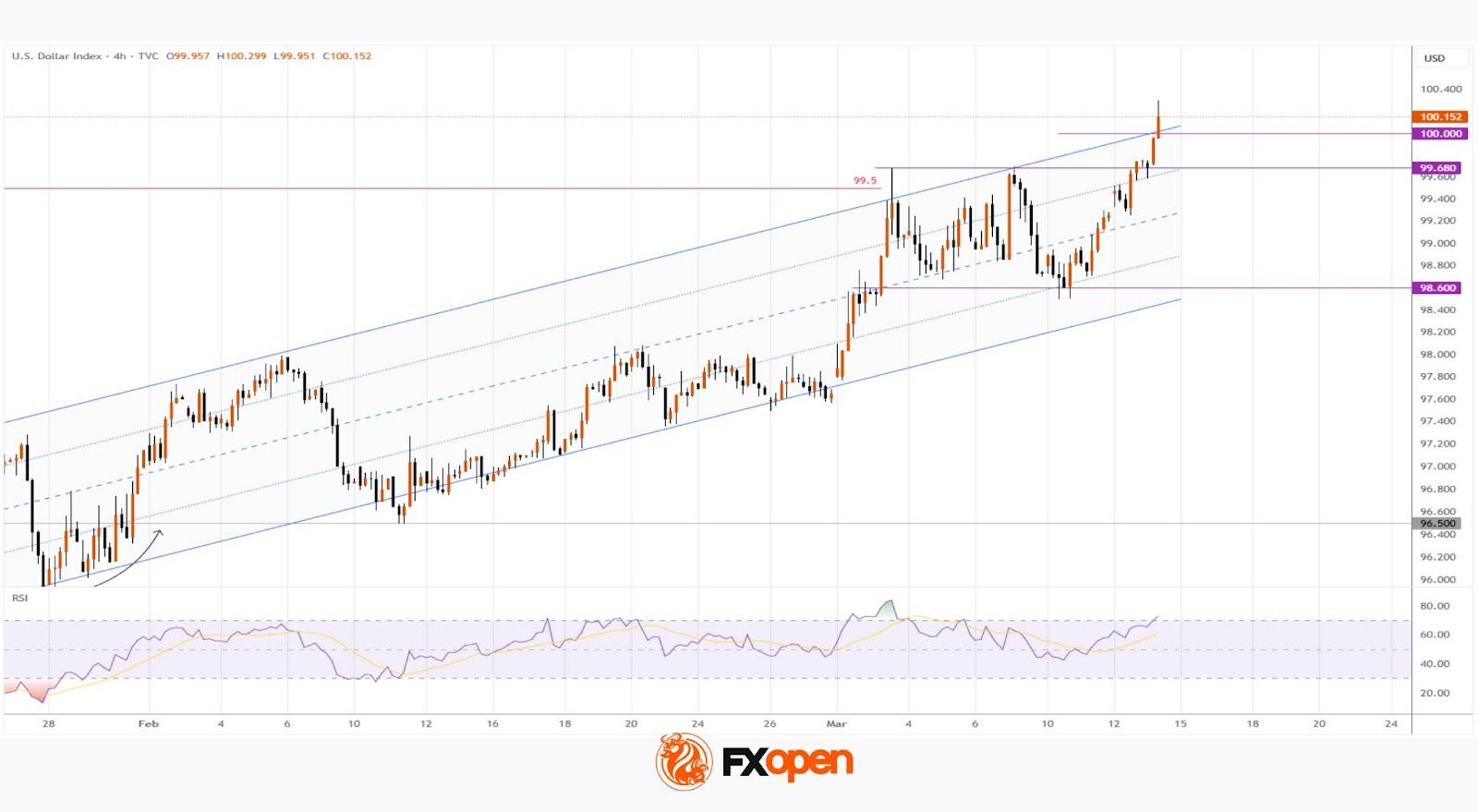
→ updated the ascending channel (marked in blue), within which the index had set its yearly high at that time;
→ suggested that DXY price movements might begin to stabilise.
Between 9 and 12 March, the DXY chart showed a pullback followed by a renewed upward move, which remained within the range defined by last week’s levels:
→ support at 98.60;
→ resistance at 99.68.
However, the developments mentioned above allowed bulls to regain momentum and extend the rally within the blue channel. In other words, if the earlier fluctuations between these levels reflected a balance between supply and demand, then today, 13 March, buyers appear to be taking the initiative, showing a willingness to pay more for the US dollar.
At present, the market looks overbought, as:
→ the RSI indicator has moved above the 70 level;
→ the price is trading above the upper boundary of the channel that had contained it since late January.
In the short term, a modest pullback cannot be ruled out, although it is unlikely to significantly alter the current market picture.
Trade global index CFDs with zero commission and tight spreads (additional fees may apply). Open your FXOpen account now or learn more about trading index CFDs with FXOpen.
This article represents the opinion of the Companies operating under the FXOpen brand only. It is not to be construed as an offer, solicitation, or recommendation with respect to products and services provided by the Companies operating under the FXOpen brand, nor is it to be considered financial advice.
Stay ahead of the market!
Subscribe now to our mailing list and receive the latest market news and insights delivered directly to your inbox.


Latest articles

CAD/JPY: The Yen's Most Historic Move in 30 Years Meets a Fragile Support
Two central banks are heading in genuinely opposite directions this week, and the tension is unmistakable. The Bank of Canada held rates steady at 2.25% on September 2, with a mildly hawkish tilt as policymakers acknowledged a broadening economic

USD/JPY and USD/CAD Await Key Fed Decision
The US dollar is consolidating against the yen and Canadian dollar ahead of the key event of the week — the Federal Reserve meeting. The Fed is widely expected to raise its policy rate by 25 basis points to a range

UnitedHealth: Fundamentals Are Healing, Now the Chart Must Agree
UnitedHealth finds itself in a genuinely split narrative right now, trading near $388, down about 15.9% from its 52-week high, even as the fundamental picture keeps improving. Q2 earnings beat expectations, with revenue of $112.03 billion, and the