


What’s Happening with Beyond Meat (BYND) Shares
FXOpen

Beyond Meat (BYND) shares have been experiencing extreme volatility today, with price swings measured in hundreds of per cent — turning the stock into a textbook example of a meme asset. Here’s a brief overview of the situation.
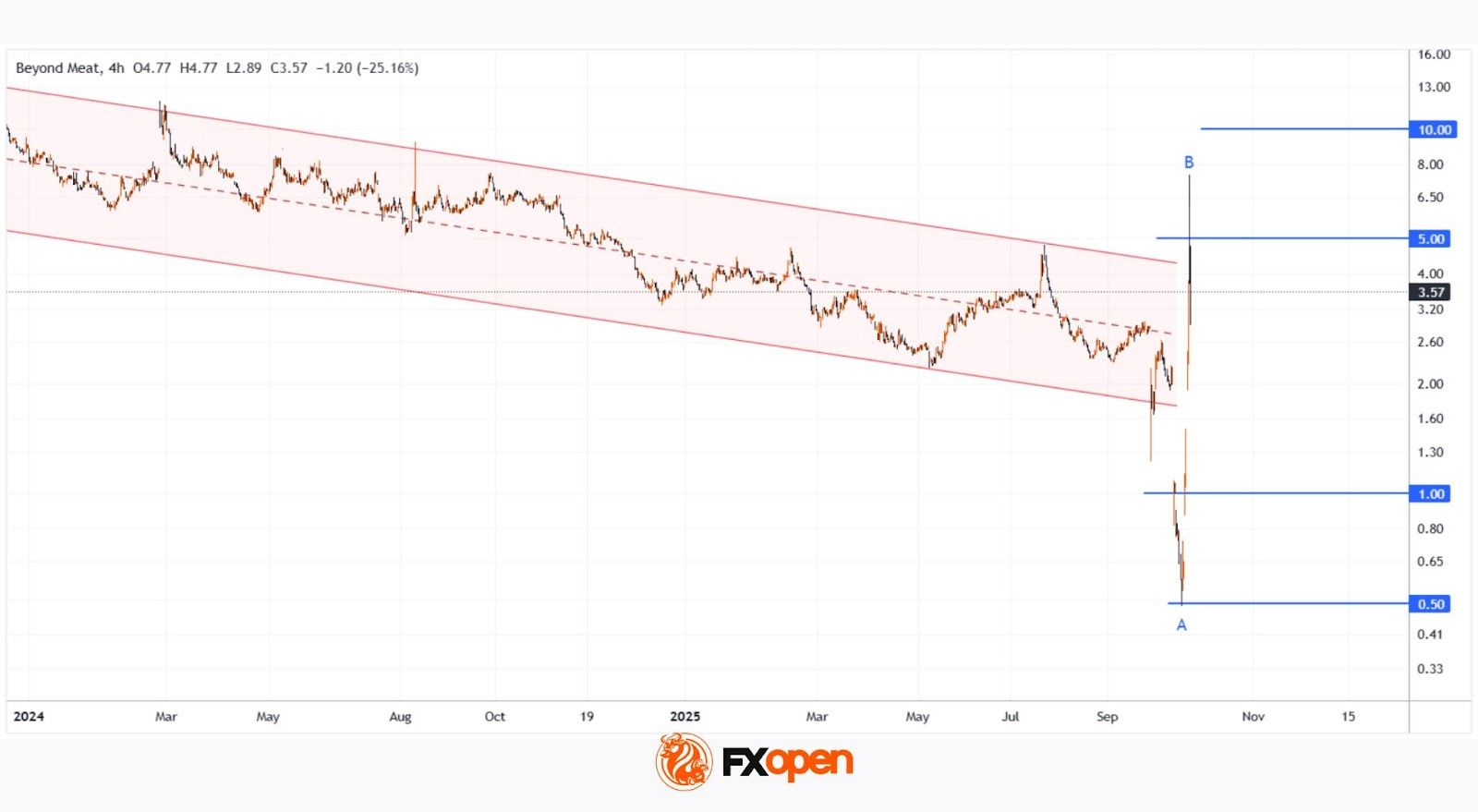
Drop Below $0.50
Throughout 2025 (and in the preceding years), the share price of the plant-based meat producer had been locked in a long-term downtrend, reflecting its financial difficulties.
Facing a substantial debt load due for repayment in 2027, Beyond Meat restructured its liabilities — extending maturity to 2030 at a higher interest rate in exchange for issuing more than 316 million new shares. This dilution of shareholder equity was viewed as a deeply negative signal.
The market reacted instantly: BYND plunged to point A, falling below $0.50 per share (a striking contrast to its peak above $200 less than five years ago). The steep drop also attracted a surge of new short sellers.
Spike Above $7
Spotting the low price and the high short interest (around 10.5% of total shares), retail traders began coordinating mass purchases through social media platforms. The result was a classic short squeeze, as forced short-covering combined with speculative buying propelled BYND above $7 per share (point B).
What Could Be Next?
Despite the spectacular rebound from point A to point B, the company’s fundamentals remain weak. Beyond Meat’s upcoming earnings report (scheduled for 4 November) may continue the trend of falling revenue — as seen in Q2 2025, when sales dropped by nearly 20% year-on-year.
The company is still loss-making, and high-profile partnerships — such as McPlant with McDonald’s — have yet to deliver meaningful results.
In the short term, market hype could push BYND towards the $10 psychological level, but it’s unlikely to change the broader picture. The company’s long-term outlook remains overshadowed by deteriorating financials.
Buy and sell stocks of the world's biggest publicly-listed companies with CFDs on FXOpen’s trading platform. Open your FXOpen account now or learn more about trading share CFDs with FXOpen.
This article represents the opinion of the Companies operating under the FXOpen brand only. It is not to be construed as an offer, solicitation, or recommendation with respect to products and services provided by the Companies operating under the FXOpen brand, nor is it to be considered financial advice.
Stay ahead of the market!
Subscribe now to our mailing list and receive the latest market news and insights delivered directly to your inbox.


Latest articles

CAD/JPY: The Yen's Most Historic Move in 30 Years Meets a Fragile Support
Two central banks are heading in genuinely opposite directions this week, and the tension is unmistakable. The Bank of Canada held rates steady at 2.25% on September 2, with a mildly hawkish tilt as policymakers acknowledged a broadening economic

USD/JPY and USD/CAD Await Key Fed Decision
The US dollar is consolidating against the yen and Canadian dollar ahead of the key event of the week — the Federal Reserve meeting. The Fed is widely expected to raise its policy rate by 25 basis points to a range

UnitedHealth: Fundamentals Are Healing, Now the Chart Must Agree
UnitedHealth finds itself in a genuinely split narrative right now, trading near $388, down about 15.9% from its 52-week high, even as the fundamental picture keeps improving. Q2 earnings beat expectations, with revenue of $112.03 billion, and the