


Commodity Currencies Test New Lows Ahead of FOMC Minutes
FXOpen

A strong US labour market report, released last week, has contributed to the decline in European and commodity currencies. The USD/CAD pair managed to strengthen above 1.3600, the AUD/USD pair tested 0.6720 as support, and the NZD/USD pair dropped below the 0.6100 mark. The increase in average wages (0.4% vs. expected 0.3%) and the rise in new jobs (254K vs. a forecast of 147K) have reduced investors' confidence that the Federal Reserve will lower rates at its next meeting.
USD/CAD
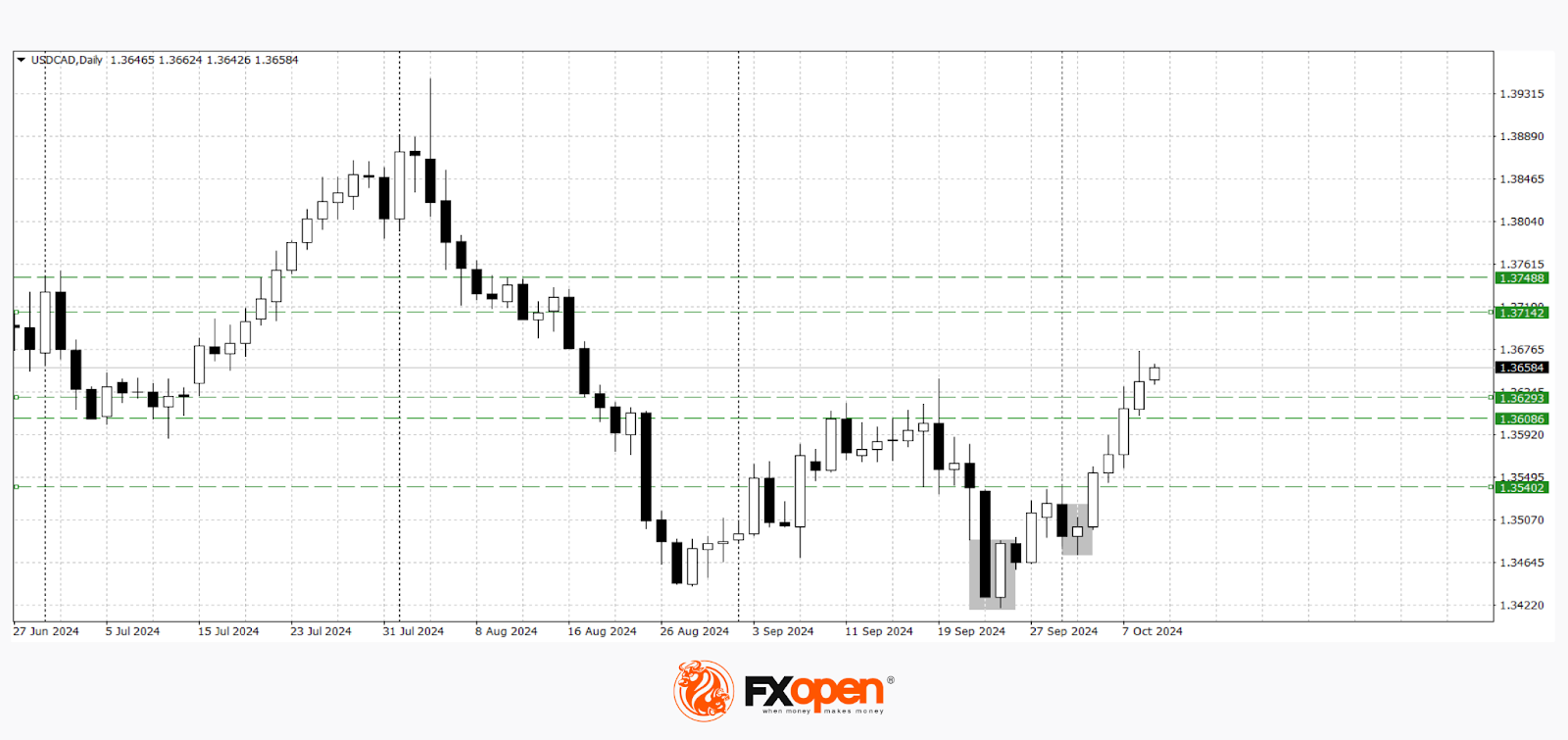
Strong data from the US and escalating geopolitical tensions in the Middle East have pushed USD/CAD out of the short-term flat corridor of 1.3600–1.3480. Technical analysis of USD/CAD indicates potential further growth if the upper boundary of the recently broken range becomes support. On the daily time frame, the previously formed "Piercing Line" pattern is in play. The nearest growth target is the 1.3750–1.3710 range. The bullish scenario would be invalidated if the price firmly settles below 1.3630–1.3600.
Key events impacting USD/CAD pricing today:
- 15:00 (GMT+3): Speech by FOMC member Raphael Bostic.
- 17:30 (GMT+3): US crude oil inventories report.
- 21:00 (GMT+3): Release of the FOMC meeting minutes.
NZD/USD
Major central banks are gradually shifting from a hawkish stance to easing monetary policies. The Reserve Bank of New Zealand followed suit this morning by cutting its base interest rate by 0.50% – from 5.25% to 4.75%.
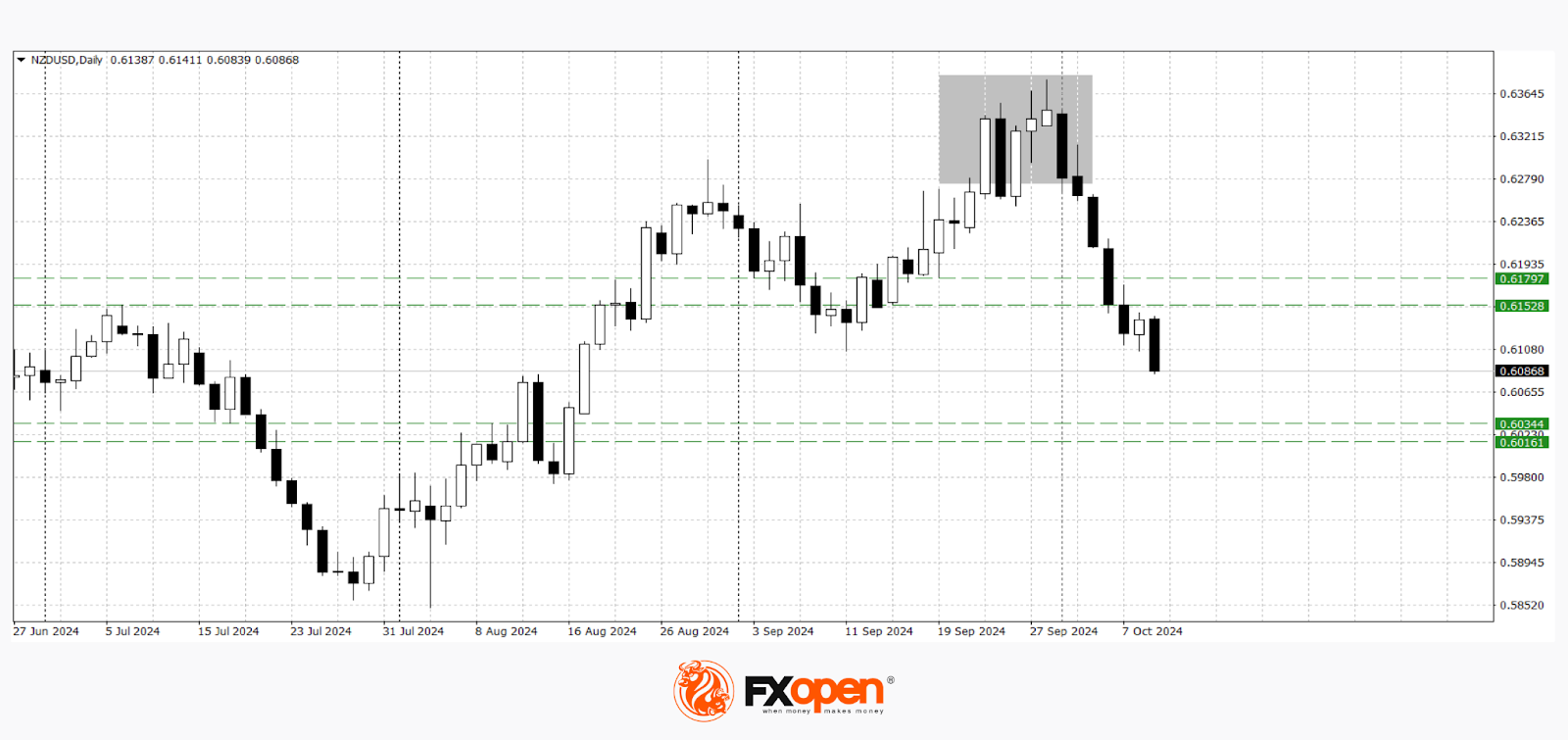
This decision has led to the continuation of the downward trend in NZD/USD, which has been observed since late September. According to technical analysis, the pair may continue its decline towards the 0.6640–0.6610 range. A bearish "Tower" pattern has formed on the daily time frame, and the price has settled below the important 0.6150–0.6100 range.
Trade over 50 forex markets 24 hours a day with FXOpen. Take advantage of low commissions, deep liquidity, and spreads from 0.0 pips (additional fees may apply). Open your FXOpen account now or learn more about trading forex with FXOpen.
This article represents the opinion of the Companies operating under the FXOpen brand only. It is not to be construed as an offer, solicitation, or recommendation with respect to products and services provided by the Companies operating under the FXOpen brand, nor is it to be considered financial advice.
Stay ahead of the market!
Subscribe now to our mailing list and receive the latest market news and insights delivered directly to your inbox.


Latest articles

CAD/JPY: The Yen's Most Historic Move in 30 Years Meets a Fragile Support
Two central banks are heading in genuinely opposite directions this week, and the tension is unmistakable. The Bank of Canada held rates steady at 2.25% on September 2, with a mildly hawkish tilt as policymakers acknowledged a broadening economic

USD/JPY and USD/CAD Await Key Fed Decision
The US dollar is consolidating against the yen and Canadian dollar ahead of the key event of the week — the Federal Reserve meeting. The Fed is widely expected to raise its policy rate by 25 basis points to a range

UnitedHealth: Fundamentals Are Healing, Now the Chart Must Agree
UnitedHealth finds itself in a genuinely split narrative right now, trading near $388, down about 15.9% from its 52-week high, even as the fundamental picture keeps improving. Q2 earnings beat expectations, with revenue of $112.03 billion, and the