


Amazon: New Bond Issuance to Fund AI Infrastructure
FXOpen

On 7 July, Amazon announced an eight-tranche bond offering worth at least $25 billion, with the proceeds expected to finance the construction of data centres and the expansion of its artificial intelligence infrastructure. Investor demand peaked at $62 billion, highlighting strong appetite for debt issued by major technology companies. Amazon has planned $200 billion in capital expenditure for 2026, up from $131 billion in 2025, with the majority of spending allocated to data centres, AI chips, and related infrastructure.
Technical Outlook
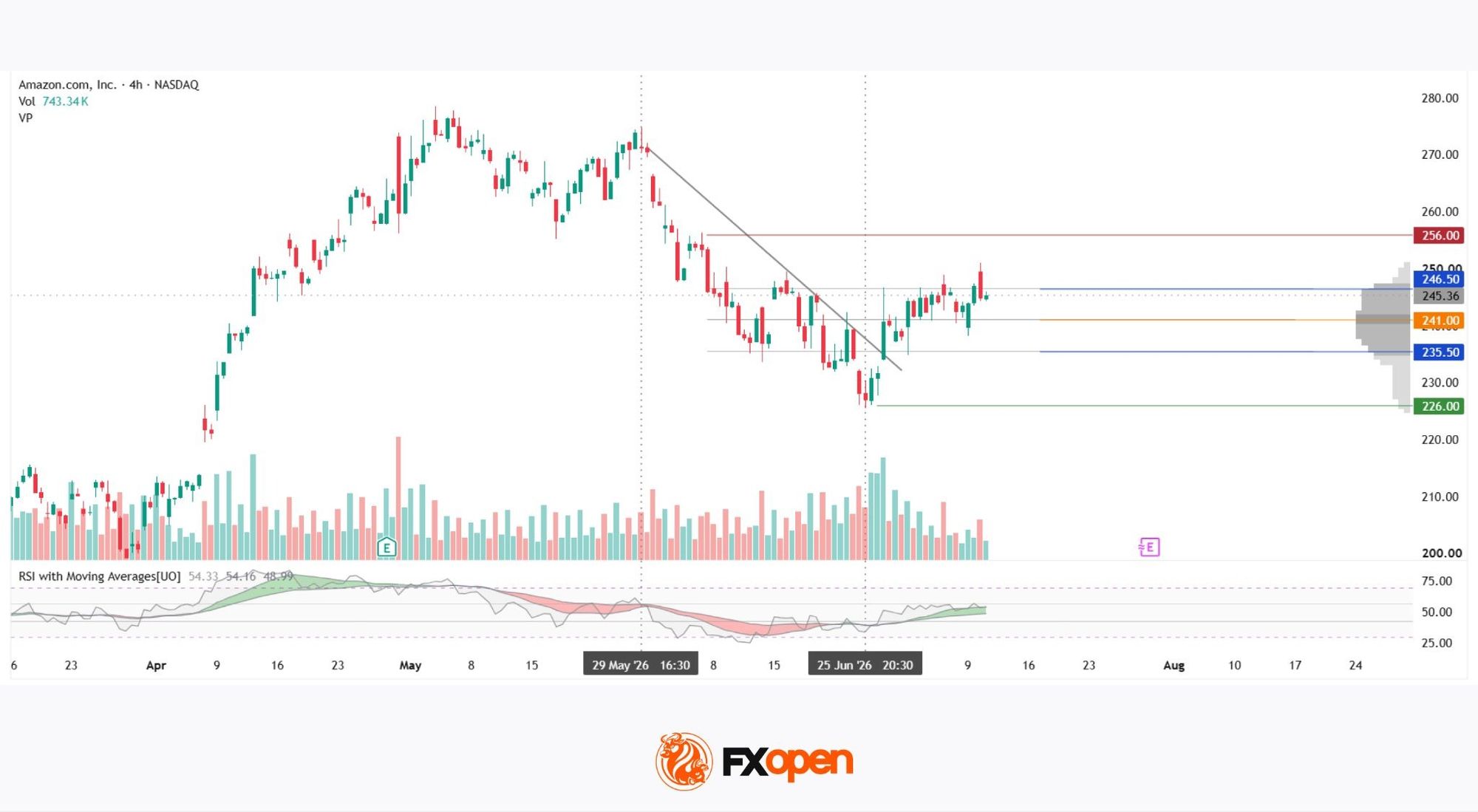
Following its May high near $278, AMZN shares (H4 timeframe) spent the next two months trading in a short-term downtrend, eventually falling to a low around $226. From that level, the stock reversed on strong volume, broke above the descending trendline, and recovered to current levels, signalling a shift in market sentiment.
However, after the breakout, the price consolidated within the current Market Profile, between the Point of Control (POC) at $241 and the profile's upper boundary at $246.50. If the breakout continues to develop, the resistance area around $256 could become the next significant hurdle for buyers.
Should the price move lower and break below the lower edge of the profile at $235.50, support could emerge near the $226 level. The RSI + MAs indicator currently shows readings of 54, 54, and 48, all within neutral territory and without a clear directional bias. Although the moving averages remain green, the RSI continues to move sideways, reflecting a lack of strong momentum.
Summary
The recovery from the June low, supported by rising trading volume and a break above the trendline, has so far failed to push beyond the current Market Profile range. With the RSI + MAs remaining in neutral territory, the overall technical picture remains mixed. The stock's next move may depend on whether investors remain confident that Amazon's substantial AI investments will generate sufficient returns to offset its rising debt burden.
Buy and sell stocks of the world's biggest publicly-listed companies with CFDs on FXOpen’s trading platform. Open your FXOpen account now or learn more about trading share CFDs with FXOpen.
This article represents the opinion of the Companies operating under the FXOpen brand only. It is not to be construed as an offer, solicitation, or recommendation with respect to products and services provided by the Companies operating under the FXOpen brand, nor is it to be considered financial advice.
Stay ahead of the market!
Subscribe now to our mailing list and receive the latest market news and insights delivered directly to your inbox.


Latest articles

CAD/JPY: The Yen's Most Historic Move in 30 Years Meets a Fragile Support
Two central banks are heading in genuinely opposite directions this week, and the tension is unmistakable. The Bank of Canada held rates steady at 2.25% on September 2, with a mildly hawkish tilt as policymakers acknowledged a broadening economic

USD/JPY and USD/CAD Await Key Fed Decision
The US dollar is consolidating against the yen and Canadian dollar ahead of the key event of the week — the Federal Reserve meeting. The Fed is widely expected to raise its policy rate by 25 basis points to a range

UnitedHealth: Fundamentals Are Healing, Now the Chart Must Agree
UnitedHealth finds itself in a genuinely split narrative right now, trading near $388, down about 15.9% from its 52-week high, even as the fundamental picture keeps improving. Q2 earnings beat expectations, with revenue of $112.03 billion, and the