


Brent Analysis: Oil Retreats from $100 as Saudi Arabia Proposes Maritime Coalition Initiative
FXOpen

On 23 July 2026, Brent crude rose above $100 amid reports of attacks on tankers and infrastructure in the Red Sea area, as well as strong statements from Donald Trump towards Iran over threats to shipping security through the Strait of Hormuz. The move proved short-lived: on 30 July, Saudi Arabia proposed creating a maritime coalition to protect key shipping routes amid the ongoing confrontation between the US and Iran. According to CNBC data from 31 July, tanker traffic through the Strait of Hormuz partially resumed, although the Islamic Revolutionary Guard Corps claimed attacks on vessels under US escort — claims that have not been confirmed by Western maritime authorities.
Technical Analysis of Brent Crude Oil
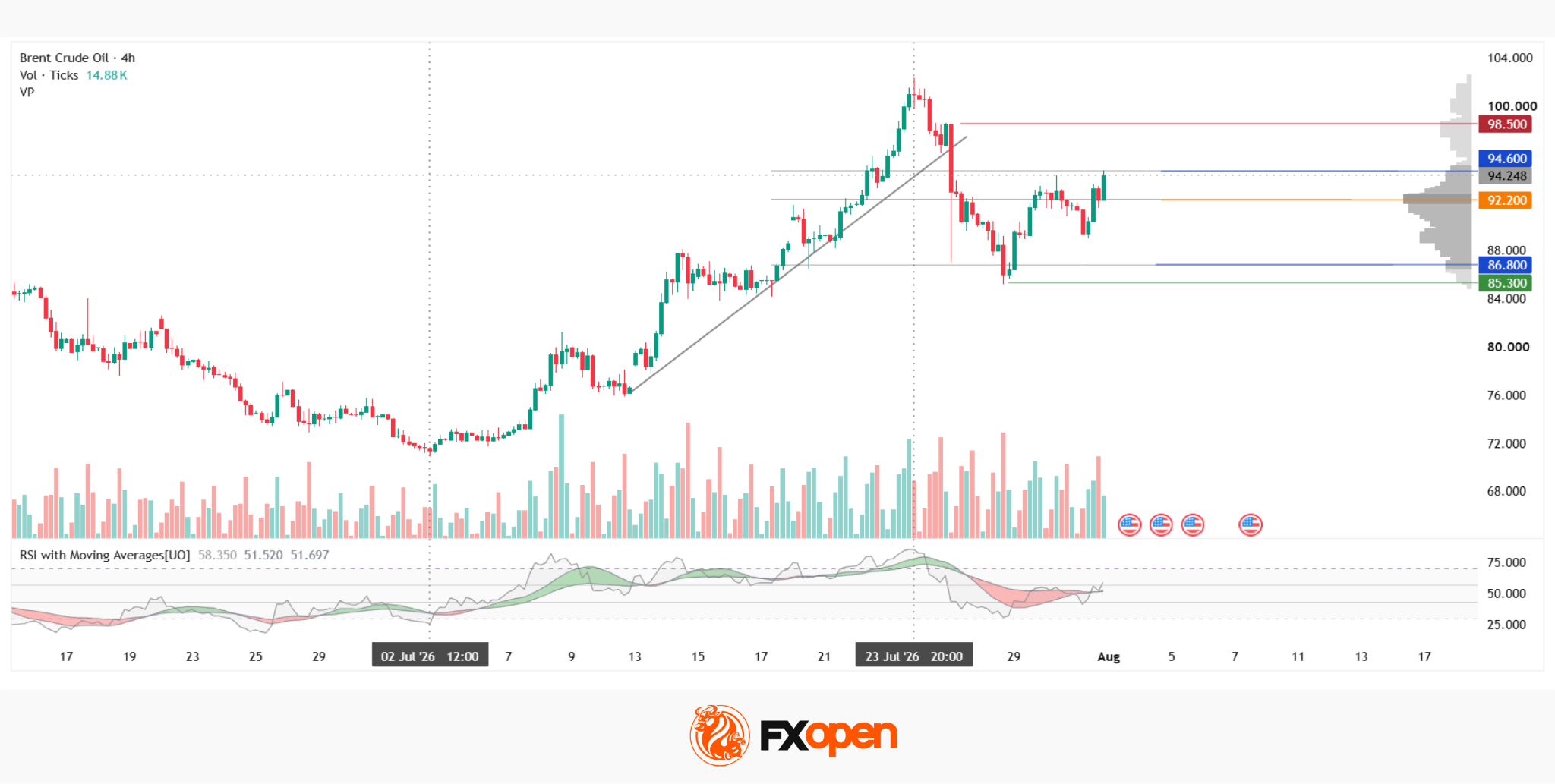
On the four-hour XBRUSD chart, the asset formed a short-term trend from the beginning of July, moving from around $71 towards the $102 area. The trendline was then broken, after which the current market profile was formed, within which the price is currently trading. The asset is now positioned between the POC (Point of Control) zone at $92.20 and the upper boundary of the profile at $94.60. A breakout above this boundary could open the way towards the red resistance level at $98.50.
If the price moves below the POC zone, the next area of interest would be the cluster of two important levels: the lower profile boundary at $86.80 and the green support level at $85.30. The RSI + MAs indicator shows readings of 58, 51 and 51, with all oscillator values returning to the neutral zone after a period of elevated volatility. Trading volume remains relatively high, confirming continued market interest from participants.
Summary
Saudi Arabia’s initiative to create a maritime coalition could gradually reduce the geopolitical risk premium priced into oil if diplomatic efforts continue to make progress. However, unconfirmed reports of incidents in the Strait of Hormuz continue to leave room for increased volatility. The neutral positioning of the RSI + MAs indicators currently suggests that there is no clear directional momentum.
Start trading commodity CFDs with tight spreads (additional fees may apply). Open your trading account now or learn more about trading commodity CFDs with FXOpen.
This article represents the opinion of the Companies operating under the FXOpen brand only. It is not to be construed as an offer, solicitation, or recommendation with respect to products and services provided by the Companies operating under the FXOpen brand, nor is it to be considered financial advice.
Stay ahead of the market!
Subscribe now to our mailing list and receive the latest market news and insights delivered directly to your inbox.


Latest articles

CAD/JPY: The Yen's Most Historic Move in 30 Years Meets a Fragile Support
Two central banks are heading in genuinely opposite directions this week, and the tension is unmistakable. The Bank of Canada held rates steady at 2.25% on September 2, with a mildly hawkish tilt as policymakers acknowledged a broadening economic

USD/JPY and USD/CAD Await Key Fed Decision
The US dollar is consolidating against the yen and Canadian dollar ahead of the key event of the week — the Federal Reserve meeting. The Fed is widely expected to raise its policy rate by 25 basis points to a range

UnitedHealth: Fundamentals Are Healing, Now the Chart Must Agree
UnitedHealth finds itself in a genuinely split narrative right now, trading near $388, down about 15.9% from its 52-week high, even as the fundamental picture keeps improving. Q2 earnings beat expectations, with revenue of $112.03 billion, and the