


EUR/USD Analysis: Downtrend Breakout Still Lacks Confirmation
FXOpen

Today, 4 September, the market’s main focus is the August US employment report. According to CNBC, the consensus forecast calls for just 53,000 nonfarm jobs to be added following July’s decline, highlighting the continued weakness of the labour market. At the same time, the Federal Reserve’s focus is shifting towards inflation risks. In the eurozone, a Reuters poll showed that all 65 economists surveyed expect the ECB to raise its deposit rate by 25 basis points to 2.50% at its 10 September meeting, while around 91% expect the rate to remain at that level through the end of the year.
Technical Analysis of EUR/USD
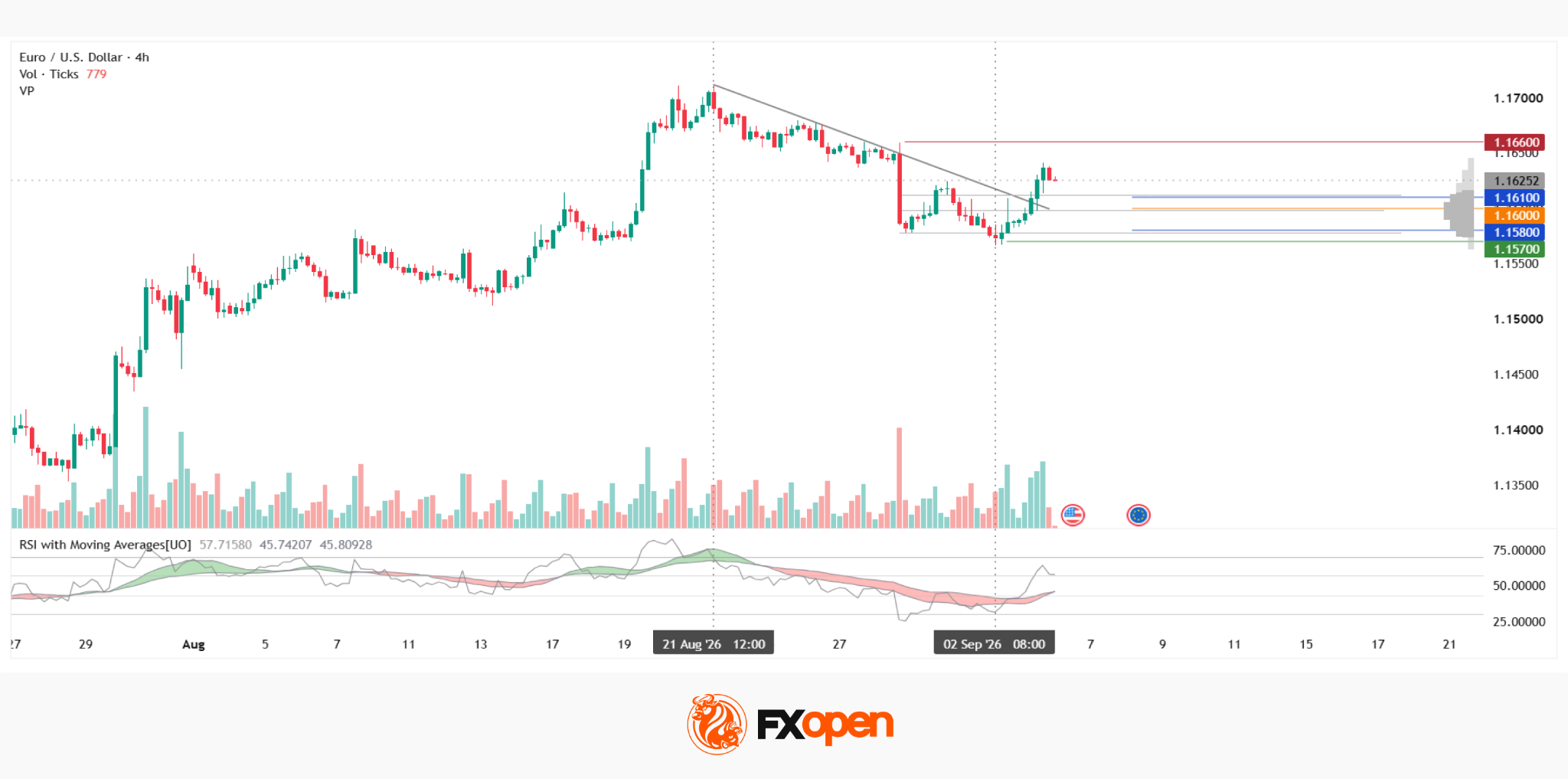
On 21 August, a peak formed around 1.1700 on the four-hour chart, from which a trend and a descending trendline developed. The price repeatedly rejected this trendline to the downside, eventually reaching a low of 1.1570 on 2 September. The following day, the trendline was broken to the upside on increased volume, and the price is now attempting to establish itself above it, as well as above the upper boundary of the current market profile at 1.1610.
A red resistance area is located around 1.1660 above the established market density. In the event of a false breakout followed by a further decline, the asset could trade within the market density or continue lower. However, for this to happen, the price would need not only to test the upper boundary but also break through the Point of Control (POC) at 1.1600 and the lower boundary of the profile at 1.1580. Just below the lower boundary of the profile, there is also a green support area around 1.1570.
The RSI + MAs indicator is showing readings of 58, 45 and 45. The oscillator has moved above the neutral zone, while both moving averages remain red and close to its lower boundary, so they are not yet confirming the breakout.
Key Takeaways
The divergence between the RSI and its moving averages leaves the sustainability of the recovery uncertain, and the market may need more time for the other components of the breakout to develop. The August US employment report could provide an additional catalyst for the pair over the coming hours, with its significance for the Fed’s September decision having increased further against the backdrop of an expected ECB rate hike.
Trade over 50 forex markets 24 hours a day with FXOpen. Take advantage of low commissions, deep liquidity, and spreads from 0.0 pips (additional fees may apply). Open your FXOpen account now or learn more about trading forex with FXOpen.
This article represents the opinion of the Companies operating under the FXOpen brand only. It is not to be construed as an offer, solicitation, or recommendation with respect to products and services provided by the Companies operating under the FXOpen brand, nor is it to be considered financial advice.
Stay ahead of the market!
Subscribe now to our mailing list and receive the latest market news and insights delivered directly to your inbox.


Latest articles

CAD/JPY: The Yen's Most Historic Move in 30 Years Meets a Fragile Support
Two central banks are heading in genuinely opposite directions this week, and the tension is unmistakable. The Bank of Canada held rates steady at 2.25% on September 2, with a mildly hawkish tilt as policymakers acknowledged a broadening economic

USD/JPY and USD/CAD Await Key Fed Decision
The US dollar is consolidating against the yen and Canadian dollar ahead of the key event of the week — the Federal Reserve meeting. The Fed is widely expected to raise its policy rate by 25 basis points to a range

UnitedHealth: Fundamentals Are Healing, Now the Chart Must Agree
UnitedHealth finds itself in a genuinely split narrative right now, trading near $388, down about 15.9% from its 52-week high, even as the fundamental picture keeps improving. Q2 earnings beat expectations, with revenue of $112.03 billion, and the