


Natural Gas: Key Support Amid Renewed Escalation
FXOpen
A key development on 13 April was the start of a naval blockade of Iranian ports, a direct consequence of the collapse of negotiations in Islamabad on 12 April. The blockade covers all vessels entering and leaving Iranian ports in the Persian Gulf and the Gulf of Oman. Around 20% of global natural gas trade passes through the Strait of Hormuz, and the renewed escalation has once again heightened risks to global LNG supplies. European TTF has previously reacted with sharp widening spreads during earlier flare-ups, while the Asian JKM benchmark also remains sensitive to regional disruptions.
Against this backdrop, natural gas as an asset class is caught between two opposing forces: a geopolitical risk premium is providing price support at the global level, while a structural supply surplus — record production, accelerated injections into storage, and an unusually warm spring in the Northern Hemisphere — is weighing on prices from a fundamental perspective.
Technical picture
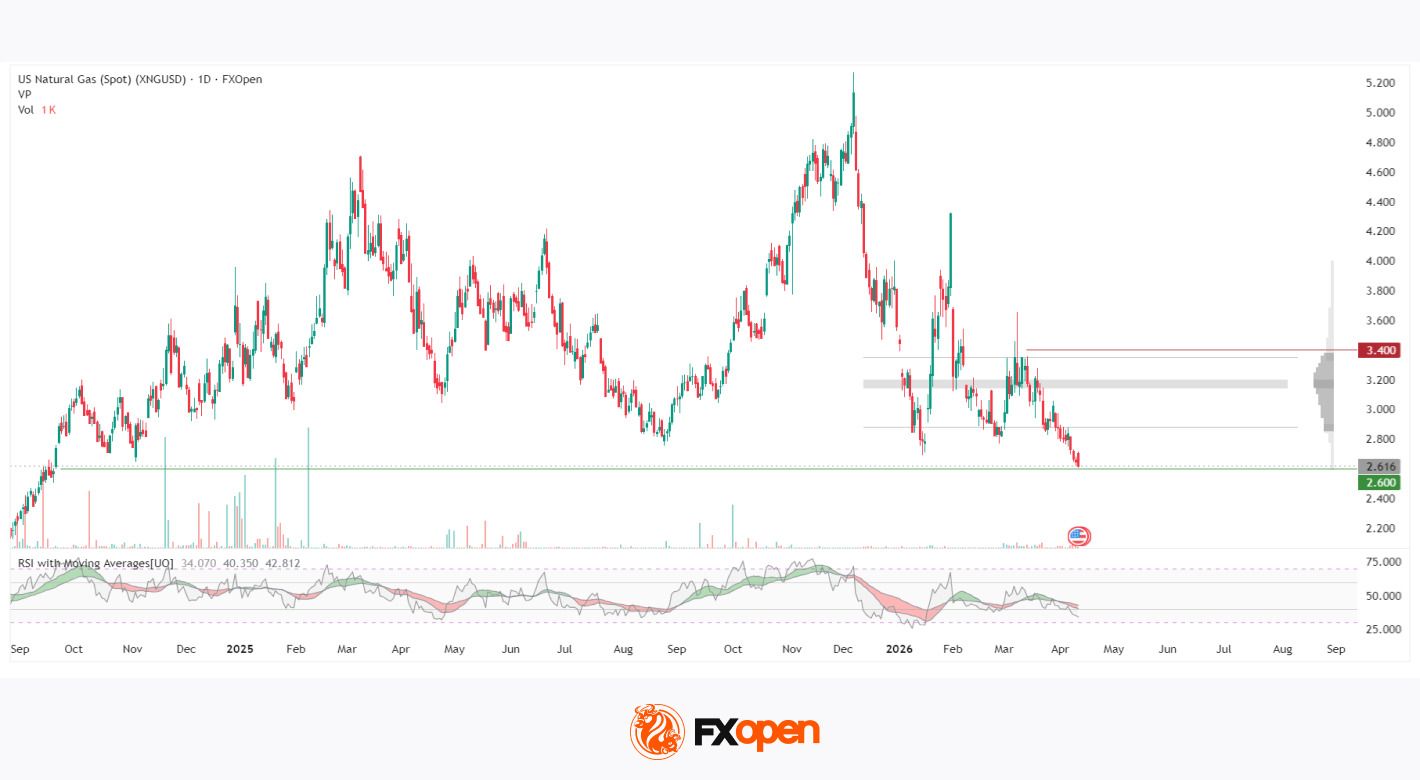
On the daily chart of XNGUSD, the move from the December 2025 high near 5.200 appears to remain downward but structurally uneven, with the sequence of interim highs and lows not forming a classic trending impulse. Volatility seems to be compressing, and each rebound is shorter than the previous one, which may indicate a gradual loss of selling momentum as price approaches a key support area. Quotes are now trading close to the psychological 2.600 level, which has acted as an important reference point since late 2024.
The volume profile shows a Point of Control (POC) in the 3.150–3.200 range, where the bulk of trading activity is concentrated. This zone may act as the first major barrier to any recovery. The 3.400 level remains the next significant resistance above.
The RSI with Moving Averages reads 34 / 40 / 42, with all three metrics remaining below the neutral 50 level and the moving averages pointing lower, suggesting continued downside pressure.
Summary
Natural gas prices are approaching the key psychological level of 2.600, the lower boundary of a consolidation range that has been in place since late 2024, while the blockade of Iranian ports may be keeping global energy markets in a state of heightened uncertainty. The RSI with Moving Averages remains below the neutral threshold across all three readings.
Start trading commodity CFDs with tight spreads (additional fees may apply). Open your trading account now or learn more about trading commodity CFDs with FXOpen.
This article represents the opinion of the Companies operating under the FXOpen brand only. It is not to be construed as an offer, solicitation, or recommendation with respect to products and services provided by the Companies operating under the FXOpen brand, nor is it to be considered financial advice.
Stay ahead of the market!
Subscribe now to our mailing list and receive the latest market news and insights delivered directly to your inbox.


Latest articles

CAD/JPY: The Yen's Most Historic Move in 30 Years Meets a Fragile Support
Two central banks are heading in genuinely opposite directions this week, and the tension is unmistakable. The Bank of Canada held rates steady at 2.25% on September 2, with a mildly hawkish tilt as policymakers acknowledged a broadening economic

USD/JPY and USD/CAD Await Key Fed Decision
The US dollar is consolidating against the yen and Canadian dollar ahead of the key event of the week — the Federal Reserve meeting. The Fed is widely expected to raise its policy rate by 25 basis points to a range

UnitedHealth: Fundamentals Are Healing, Now the Chart Must Agree
UnitedHealth finds itself in a genuinely split narrative right now, trading near $388, down about 15.9% from its 52-week high, even as the fundamental picture keeps improving. Q2 earnings beat expectations, with revenue of $112.03 billion, and the