


NVIDIA Analysis: Attempted Rising Wedge Breakout Amid Pressure on the AI Sector
FXOpen

Nvidia’s short-term fundamental backdrop has deteriorated. On 14 September, the company’s shares fell 3.4% amid a sell-off in AI-related stocks driven by concerns over a potential slowdown in the pace of artificial intelligence development. However, Nvidia’s business outlook remains strong, with the company forecasting revenue growth of around 70% in fiscal 2028. An additional risk factor is a US Department of Justice investigation into Nvidia’s $17 billion agreement with Groq over potential attempts to circumvent antitrust oversight.
NVIDIA Technical Analysis
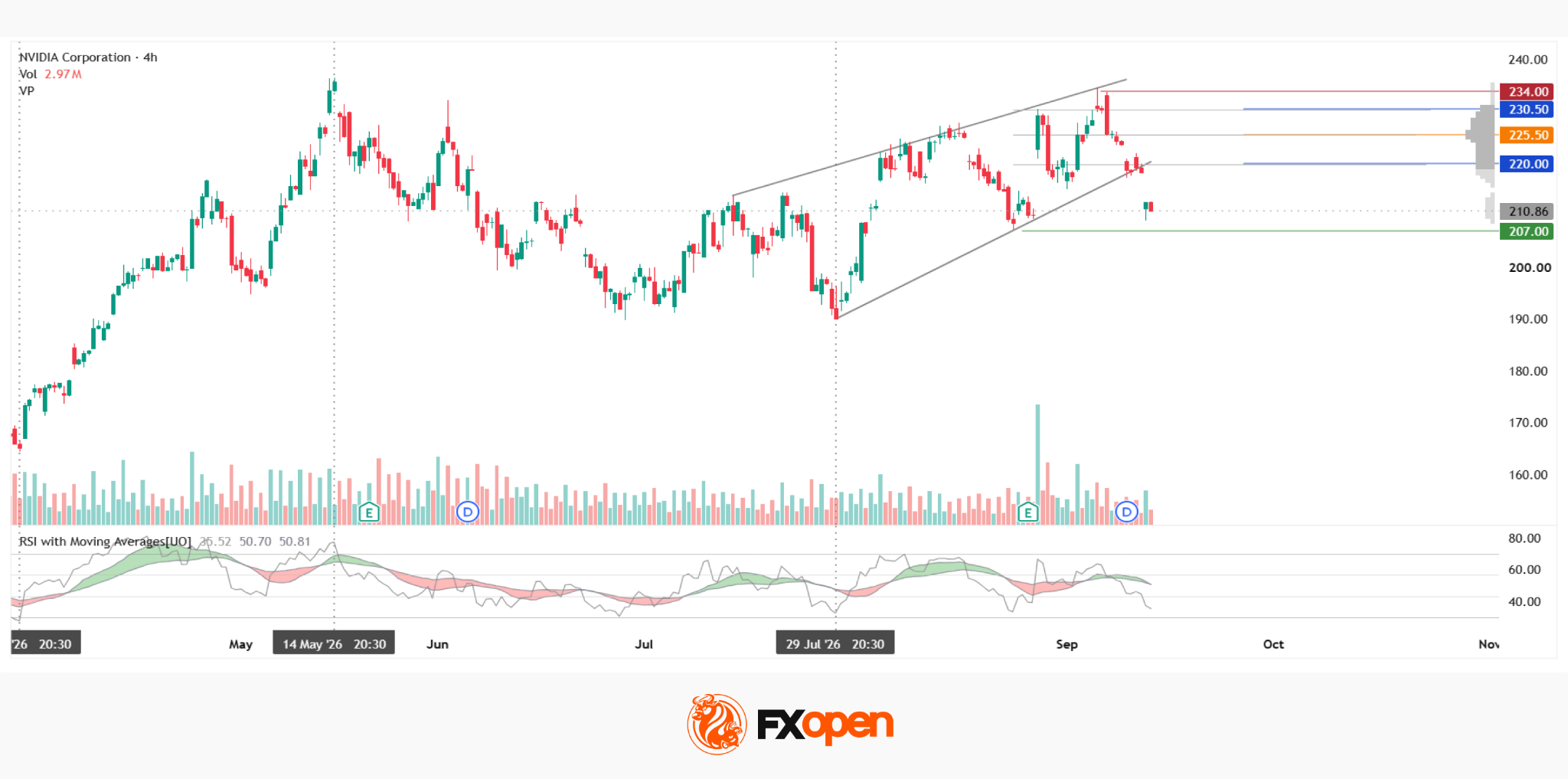
On the NVDA four-hour chart, a corrective phase developed following a pronounced uptrend. After the correction ended, the price resumed its advance and formed a pattern resembling a rising wedge. The price subsequently broke below not only the wedge but also the current profile boundary around $220.00 and is now attempting to establish itself below this level. If the price manages to hold below the profile, the next potential target could be the green support level at $207.00.
If the price returns to the market profile, attention could shift to the Point of Control (POC) at $225.50, followed by the upper part of the profile at $230.50. Above the profile, at the top of the pattern, lies the red resistance level at $234.00. The RSI + MAs indicator shows readings of 35, 50 and 50. The RSI has moved out of the neutral zone, while both moving averages remain within it, meaning it is still too early to confirm the breakout.
Key Takeaways
The price has broken below the rising wedge, but the RSI + MAs indicator has yet to confirm further downside. At the same time, the short-term fundamental backdrop remains mixed: pressure on the AI sector has increased, although Nvidia’s business outlook remains strong.
Buy and sell stocks of the world's biggest publicly-listed companies with CFDs on FXOpen’s trading platform. Open your FXOpen account now or learn more about trading share CFDs with FXOpen.
This article represents the opinion of the Companies operating under the FXOpen brand only. It is not to be construed as an offer, solicitation, or recommendation with respect to products and services provided by the Companies operating under the FXOpen brand, nor is it to be considered financial advice.
Stay ahead of the market!
Subscribe now to our mailing list and receive the latest market news and insights delivered directly to your inbox.


Latest articles

CAD/JPY: The Yen's Most Historic Move in 30 Years Meets a Fragile Support
Two central banks are heading in genuinely opposite directions this week, and the tension is unmistakable. The Bank of Canada held rates steady at 2.25% on September 2, with a mildly hawkish tilt as policymakers acknowledged a broadening economic

USD/JPY and USD/CAD Await Key Fed Decision
The US dollar is consolidating against the yen and Canadian dollar ahead of the key event of the week — the Federal Reserve meeting. The Fed is widely expected to raise its policy rate by 25 basis points to a range

UnitedHealth: Fundamentals Are Healing, Now the Chart Must Agree
UnitedHealth finds itself in a genuinely split narrative right now, trading near $388, down about 15.9% from its 52-week high, even as the fundamental picture keeps improving. Q2 earnings beat expectations, with revenue of $112.03 billion, and the