


USD/JPY Builds Positioning Ahead of Signals from the Bank of Japan
FXOpen

USD/JPY dynamics continue to be driven by the persistent yield gap between US and Japanese government bonds. With the Federal Reserve maintaining a relatively hawkish stance and keeping rates elevated as of April 2026, the Bank of Japan remains extremely cautious in its path towards policy normalisation. This divergence in monetary policy continues to underpin demand for the US dollar.
The dollar is also supported by its safe-haven appeal amid ongoing geopolitical uncertainty. However, upside momentum is being restrained by the proximity of the key 160.00 level. Historical precedent suggests a heightened risk of currency intervention by Japan’s Ministry of Finance around this threshold. Investors are now focused on the upcoming Bank of Japan meeting on 28 April, which could reshape market expectations for the pair’s next move.
Technical Overview
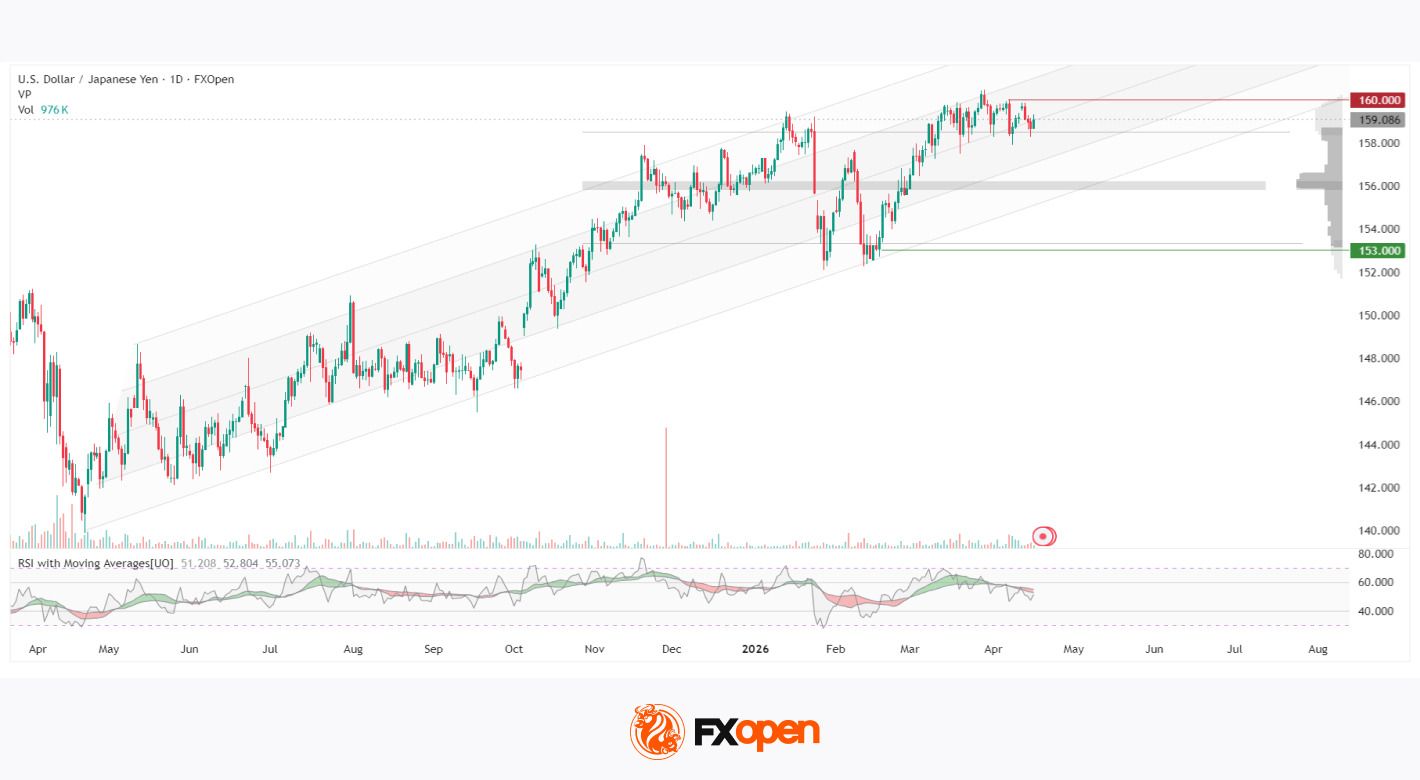
Since April 2025, the pair appears to have been developing a steady uptrend within a well-defined parallel channel. Price action has remained highly responsive, consistently respecting the channel structure and reinforcing the strength of the broader trend. Each test of the lower boundary over the past year seems to have triggered renewed buying interest.
Currently, the pair is consolidating just below the critical 160.00 level, while holding above the upper boundary of the horizontal volume zone near 158.500. The Point of Control (POC) is concentrated around 156.00, acting as the midpoint of the current structure and a key reference level in the event of a corrective move.
The slowdown near current levels may reflect ongoing position-building, as market participants appear reluctant to drive a breakout above 160.00 without a strong fundamental catalyst. The RSI with Moving Averages shows a reading of 51, indicating neutral conditions and no signs of extreme overbought territory despite proximity to yearly highs. Both moving averages of the oscillator also remain in neutral territory, reinforcing the current market balance.
Summary
USD/JPY remains in sharp focus. The wide interest rate differential and geopolitical backdrop continue to support the dollar, but the approach to the psychological 160.00 level, combined with intervention risks, may be encouraging a more cautious stance among buyers.
Trade over 50 forex markets 24 hours a day with FXOpen. Take advantage of low commissions, deep liquidity, and spreads from 0.0 pips (additional fees may apply). Open your FXOpen account now or learn more about trading forex with FXOpen.
This article represents the opinion of the Companies operating under the FXOpen brand only. It is not to be construed as an offer, solicitation, or recommendation with respect to products and services provided by the Companies operating under the FXOpen brand, nor is it to be considered financial advice.
Stay ahead of the market!
Subscribe now to our mailing list and receive the latest market news and insights delivered directly to your inbox.


Latest articles

CAD/JPY: The Yen's Most Historic Move in 30 Years Meets a Fragile Support
Two central banks are heading in genuinely opposite directions this week, and the tension is unmistakable. The Bank of Canada held rates steady at 2.25% on September 2, with a mildly hawkish tilt as policymakers acknowledged a broadening economic

USD/JPY and USD/CAD Await Key Fed Decision
The US dollar is consolidating against the yen and Canadian dollar ahead of the key event of the week — the Federal Reserve meeting. The Fed is widely expected to raise its policy rate by 25 basis points to a range

UnitedHealth: Fundamentals Are Healing, Now the Chart Must Agree
UnitedHealth finds itself in a genuinely split narrative right now, trading near $388, down about 15.9% from its 52-week high, even as the fundamental picture keeps improving. Q2 earnings beat expectations, with revenue of $112.03 billion, and the