


WTI Analysis: Gap Breaks Short-Term Trend as Price Remains Trapped Between the POC and Profile Boundary
FXOpen

WTI crude oil plunged by more than 7% on 27 July 2026 after the US suspended a series of strikes against Iran over the weekend, raising hopes of a diplomatic solution and the reopening of shipping through the Strait of Hormuz, according to CNBC. Brent crude also fell below $90 per barrel. Meanwhile, Bloomberg reported that Yemen's Houthi movement had claimed attacks on Saudi Aramco facilities in Jizan and Yanbu, suggesting that the conflict remains far from resolved.
WTI Technical Analysis
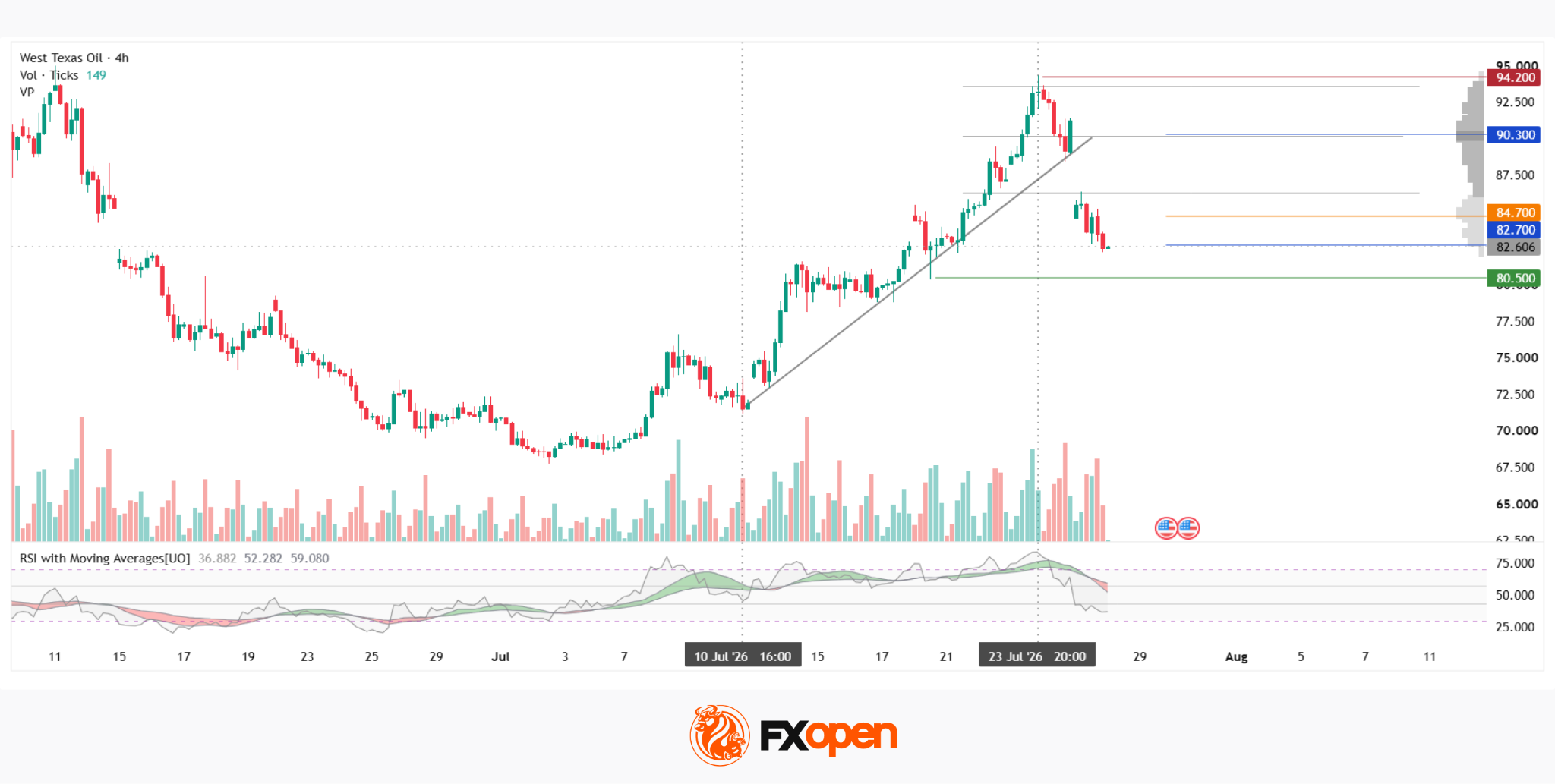
Since the beginning of July, XTIUSD had been developing a short-term uptrend. A rebound from the $68 area on 2 July evolved into a sustained rally, supported by an ascending trendline. This trendline held until the market peaked near $94.2, but it was broken on 27 July following a sharp gap lower. Since then, the price has been attempting to move through two key levels within the current market profile: the POC at $84.7 and the lower profile boundary at $82.7. If this area fails to hold and the decline continues, the green support level at $80.5 could become increasingly important. Notably, the gap occurred on relatively modest trading volume considering the scale of the price move.
Above current levels lies the upper boundary of the market profile at $90.3, which could become the next upside target if the market reverses. Beyond that, traders will be watching the red resistance level at $94.2. The RSI + MAs indicator currently reads 36, 55 and 60, suggesting that the market remains unbalanced and is still searching for equilibrium.
Summary
The relatively low trading volume accompanying the gap suggests that the sell-off may have been driven largely by emotion, leaving room for buyers to return if the geopolitical risk premium begins to rebuild. For now, oil prices remain confined to a narrow range between the POC and the lower boundary of the market profile, where momentum for the next significant move may be building.
Start trading commodity CFDs with tight spreads (additional fees may apply). Open your trading account now or learn more about trading commodity CFDs with FXOpen.
This article represents the opinion of the Companies operating under the FXOpen brand only. It is not to be construed as an offer, solicitation, or recommendation with respect to products and services provided by the Companies operating under the FXOpen brand, nor is it to be considered financial advice.
Stay ahead of the market!
Subscribe now to our mailing list and receive the latest market news and insights delivered directly to your inbox.


Latest articles

CAD/JPY: The Yen's Most Historic Move in 30 Years Meets a Fragile Support
Two central banks are heading in genuinely opposite directions this week, and the tension is unmistakable. The Bank of Canada held rates steady at 2.25% on September 2, with a mildly hawkish tilt as policymakers acknowledged a broadening economic

USD/JPY and USD/CAD Await Key Fed Decision
The US dollar is consolidating against the yen and Canadian dollar ahead of the key event of the week — the Federal Reserve meeting. The Fed is widely expected to raise its policy rate by 25 basis points to a range

UnitedHealth: Fundamentals Are Healing, Now the Chart Must Agree
UnitedHealth finds itself in a genuinely split narrative right now, trading near $388, down about 15.9% from its 52-week high, even as the fundamental picture keeps improving. Q2 earnings beat expectations, with revenue of $112.03 billion, and the