


GBP/NZD: Political Noise Meets a Hawkish Kiwi at a Critical Apex
FXOpen

Sterling enters this week on a mixed footing. Last month's Bank of England decision struck a notably hawkish tone, with the vote split 6-3 in favor of holding rates, three members pushed for a hike, a signal the Bank remains genuinely worried about inflation as Middle East-driven energy costs work through the economy. Yet political uncertainty continues to simmer following Keir Starmer's unexpected June resignation, leaving fiscal credibility, and by extension sterling, more sensitive than usual to how Labour manages the transition.
The kiwi, meanwhile, is being propped up almost entirely by rate expectations. Markets currently price an 88% probability of an RBNZ hike in September, even after New Zealand's unemployment rate climbed to a decade-high 5.6%. UBS argues the labor data isn't as bearish as it looks, since the rise was driven mainly by more people entering the workforce rather than layoffs, keeping the central bank's tightening path intact. Softer inflation expectations and a weaker July manufacturing PMI, however, have started to inject some doubt into just how far the RBNZ can realistically go.
The result: a pound navigating political noise against a kiwi riding hawkish rate bets that may be more fragile than markets currently assume.
Technical Analysis of GBP/NZD
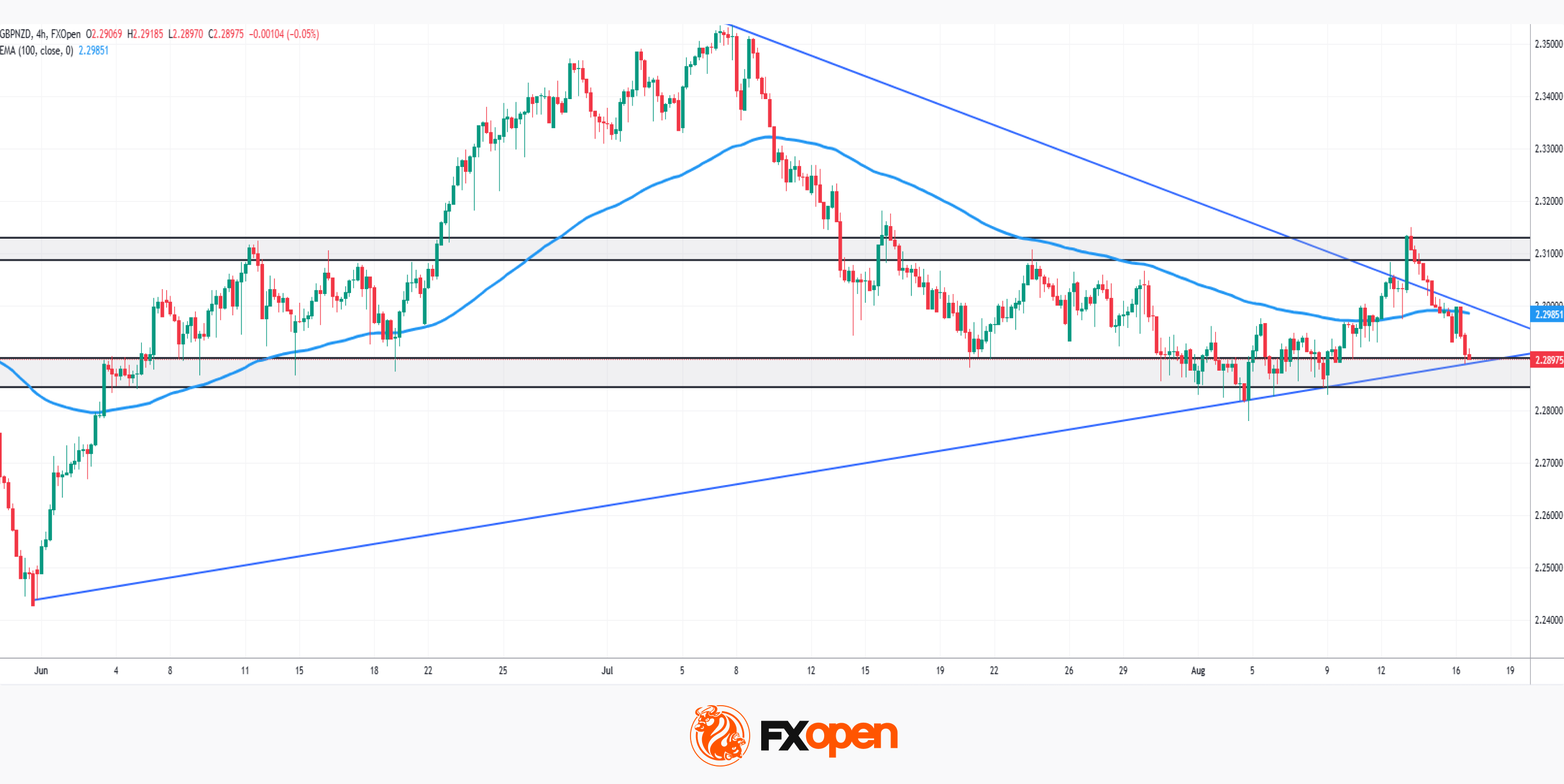
As GBP/NZD chart shows, the pair has been compressing into a broad symmetrical triangle since early June, with a descending trendline from July's highs near 2.3550 converging with an ascending trendline off June's lows, both meeting right around current price near 2.2900-2.2980, where the 100-period EMA also sits. This confluence, together with the well-established 2.2900-2.3100 support and resistance zone, marks a decisive juncture for the pair.
Bullish Scenario
Should buyers defend the ascending trendline and reclaim the 100-period EMA, the path would open toward the 2.3100 resistance, the upper boundary of the recent range. A confirmed break above this zone, and the descending trendline itself, would signal a genuine shift in momentum, opening the door toward a retest of the July highs near 2.3550.
Bearish Scenario
Conversely, a break below the ascending trendline and the 2.2900 support would expose the broader downtrend that has dominated since early July, with price risking a slide back toward the 2.2800 area and beyond, as the months-long descending structure reasserts itself.
With price coiled right at the apex of this triangle, sitting exactly on the 100-period EMA, GBP/NZD looks primed for a decisive move—will sterling's political noise finally give way to the kiwi's rate story, or does this range hold just a little longer?
Trade over 50 forex markets 24 hours a day with FXOpen. Take advantage of low commissions, deep liquidity, and spreads from 0.0 pips (additional fees may apply). Open your FXOpen account now or learn more about trading forex with FXOpen.
This article represents the opinion of the Companies operating under the FXOpen brand only. It is not to be construed as an offer, solicitation, or recommendation with respect to products and services provided by the Companies operating under the FXOpen brand, nor is it to be considered financial advice.
Stay ahead of the market!
Subscribe now to our mailing list and receive the latest market news and insights delivered directly to your inbox.


Latest articles

CAD/JPY: The Yen's Most Historic Move in 30 Years Meets a Fragile Support
Two central banks are heading in genuinely opposite directions this week, and the tension is unmistakable. The Bank of Canada held rates steady at 2.25% on September 2, with a mildly hawkish tilt as policymakers acknowledged a broadening economic

USD/JPY and USD/CAD Await Key Fed Decision
The US dollar is consolidating against the yen and Canadian dollar ahead of the key event of the week — the Federal Reserve meeting. The Fed is widely expected to raise its policy rate by 25 basis points to a range

UnitedHealth: Fundamentals Are Healing, Now the Chart Must Agree
UnitedHealth finds itself in a genuinely split narrative right now, trading near $388, down about 15.9% from its 52-week high, even as the fundamental picture keeps improving. Q2 earnings beat expectations, with revenue of $112.03 billion, and the