


Intel at a Crossroads: Earnings Beat Meets Technical Resistance
FXOpen

Intel has just delivered its strongest quarter in over fifteen years, and the market reaction says it all. Q2 2026 revenue surged 25% year-over-year to $16.1 billion, crushing the consensus estimate of $14.42 billion, while adjusted EPS of $0.42 nearly doubled the expected $0.21. The stock rallied over 12% in after-hours trading following the release.
The engine behind the beat was unmistakably AI: Intel's Data Center and AI segment jumped 59% year-over-year to $6.3 billion, with the company saying demand is now outpacing what its factories can supply. CEO Lip-Bu Tan pointed to faster production cycles and improved yields as key drivers behind the upside, while CFO Dave Zinsner said the company exceeded its guidance thanks to stronger execution.
There was a notable asterisk, however: Intel posted a GAAP net loss of $11 billion, driven by a $12.5 billion mark-to-market charge tied to its CHIPS Act agreement—a technical, non-operational hit that markets largely looked past. Looking ahead, Intel raised its Q3 guidance to a $16.3 billion midpoint, reinforcing confidence that this AI-driven turnaround has real momentum behind it.
Intel Technical Analysis
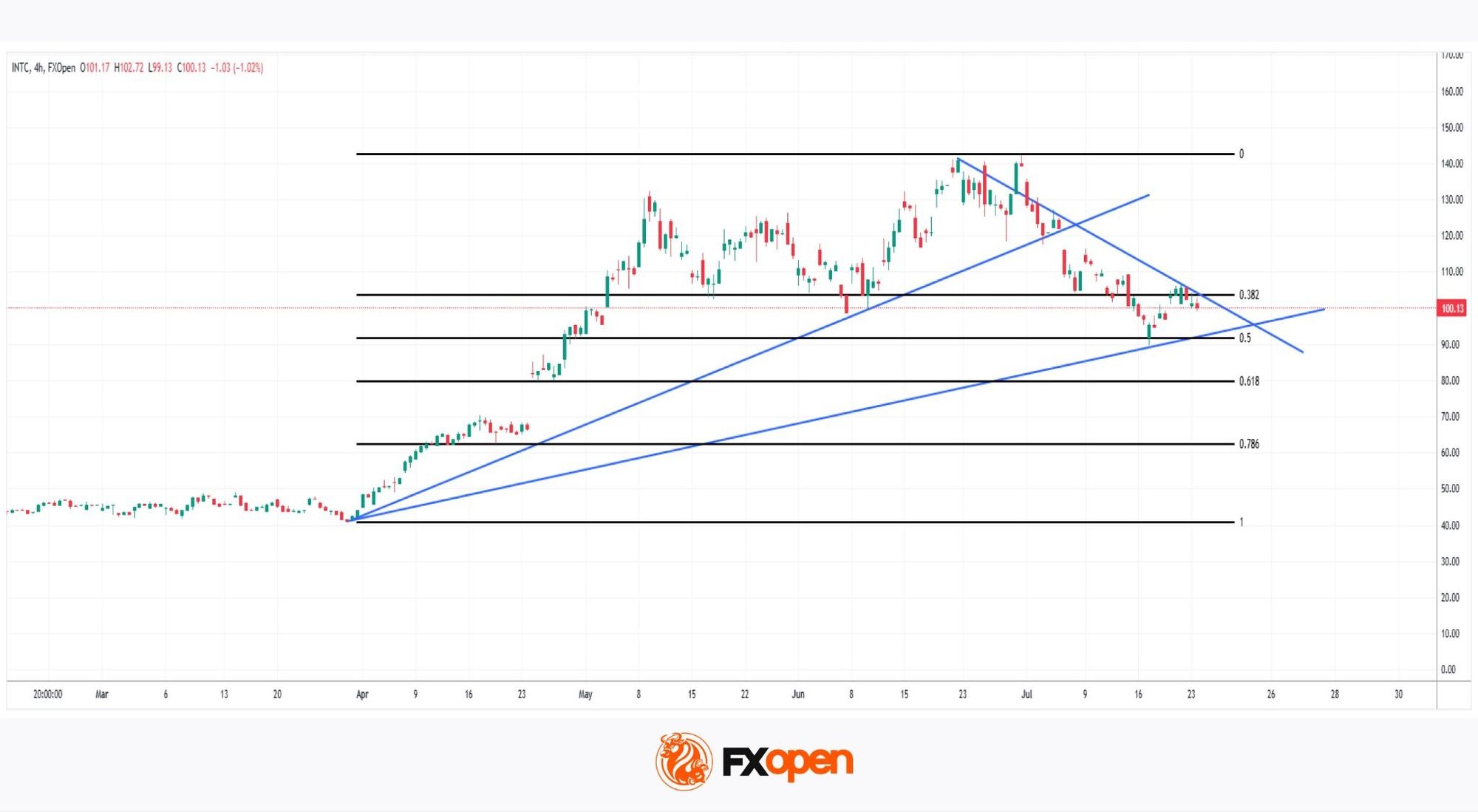
As the INTC stock chart shows, the explosive rally from March's lows near $40 to July's highs above $140 has since cooled into a broad falling wedge, with price now consolidating around the $100 level, sitting right between the 0.382 and 0.5 Fibonacci retracements of the entire move.
Bullish Scenario
Following yesterday's blowout earnings, price is testing the confluence of the descending trendline from the July highs and the 0.382 retracement near $108. A confirmed breakout above this zone would suggest buyers are back in control, opening the path toward a retest of the wedge highs near $130-$140 as fresh momentum builds following the earnings catalyst.
Bearish Scenario
Conversely, a rejection at this same trendline-Fibonacci confluence would keep the price capped within the wedge, increasing the odds of a deeper pullback toward the 0.5 retracement near $94, or even the rising trendline support closer to $85-$90 if selling pressure intensifies and the earnings pop fades.
With price wedged directly between trendline resistance and key Fibonacci support, Intel's next move looks set to be decisive. Will the earnings beat be enough to reignite the rally, or does the broader correction still have room to run?
Buy and sell stocks of the world's biggest publicly-listed companies with CFDs on FXOpen’s trading platform. Open your FXOpen account now or learn more about trading share CFDs with FXOpen.
This article represents the opinion of the Companies operating under the FXOpen brand only. It is not to be construed as an offer, solicitation, or recommendation with respect to products and services provided by the Companies operating under the FXOpen brand, nor is it to be considered financial advice.
Stay ahead of the market!
Subscribe now to our mailing list and receive the latest market news and insights delivered directly to your inbox.


Latest articles

CAD/JPY: The Yen's Most Historic Move in 30 Years Meets a Fragile Support
Two central banks are heading in genuinely opposite directions this week, and the tension is unmistakable. The Bank of Canada held rates steady at 2.25% on September 2, with a mildly hawkish tilt as policymakers acknowledged a broadening economic

USD/JPY and USD/CAD Await Key Fed Decision
The US dollar is consolidating against the yen and Canadian dollar ahead of the key event of the week — the Federal Reserve meeting. The Fed is widely expected to raise its policy rate by 25 basis points to a range

UnitedHealth: Fundamentals Are Healing, Now the Chart Must Agree
UnitedHealth finds itself in a genuinely split narrative right now, trading near $388, down about 15.9% from its 52-week high, even as the fundamental picture keeps improving. Q2 earnings beat expectations, with revenue of $112.03 billion, and the