


How Can FUD in Cryptocurrencies and Stocks Affect Your Trading?
FXOpen

FUD—fear, uncertainty, and doubt—shapes market sentiment, often leading to panic-driven sell-offs and volatility. Whether in stocks or crypto, FUD spreads through media, social platforms, and influential figures, sometimes distorting prices beyond fundamental value. This article explores “What does FUD mean in crypto and stocks?”, how it spreads, its psychological impact, and how traders assess whether fear is justified.
What Is FUD?
What does FUD mean in stocks and crypto? FUD stands for fear, uncertainty, and doubt and plays a significant role in financial markets. It refers to the spread of negative sentiment—whether intentional or not—that causes traders to hesitate, panic, or make decisions based on emotions rather than analysis. FUD can be natural and artificial and can come from a variety of sources, including media reports, social media discussions, regulatory updates, and influential investors voicing concerns.
In markets, FUD often leads to sell-offs, heightened volatility, and price fluctuations that don’t always reflect an asset’s true value. For example, if a major financial news outlet publishes a report suggesting a company is struggling, investors may rush to offload shares, pushing the price down. The same happens with digital assets when rumours of regulation, security flaws, or industry-wide collapses circulate.
Not all FUD is unfounded, but it thrives on uncertainty, making it difficult for traders to separate real risks from exaggerated fears. This distinction matters because reacting impulsively to FUD can mean exiting positions prematurely or missing potential opportunities when the market recovers.
How FUD Spreads in Financial Markets
FUD spreads quickly in financial markets because traders react to uncertainty, often before verifying the facts. Misinformation, speculation, or even vague concerns can lead to panic selling and price swings. While some FUD emerges from legitimate risks, much of it is fuelled by media, social platforms, and influential figures.
Media and Social Platforms
News outlets and financial media amplify uncertainty, sometimes unintentionally. A negative headline—even if the actual report is more balanced—can trigger a wave of selling. Social media accelerates this effect, as platforms like X (Twitter), Reddit, and Telegram allow rumours to spread within minutes. In some cases, misleading posts gain traction before facts emerge, shaping sentiment before traders have a chance to analyse the situation.
Regulatory Concerns
Markets react strongly to regulatory uncertainty. If a government proposes restrictions or new taxes, traders often assume the worst, even if details are unclear. This can lead to sharp downturns in affected sectors, with price movements driven by speculation rather than policy changes that have actually been implemented.
Influential Figures and Institutions
When well-known investors, CEOs, or policymakers express concerns, markets take notice. A single statement from a central bank official about inflation or interest rates can cause massive swings as traders scramble to reposition based on perceived risks.
Corporate and Economic Events
Earnings reports, executive resignations, or supply chain disruptions fuel uncertainty. Even misinterpreted data—like a temporary dip in revenue—can cause exaggerated market reactions. Likewise, broader economic concerns, such as rising inflation or geopolitical instability, create waves of uncertainty that affect multiple asset classes.
The Psychological Impact of FUD on Traders
FUD doesn’t just affect prices but influences how traders think and react. Markets are driven by psychology as much as by fundamentals, and uncertainty can lead to irrational decision-making. When fear takes over, traders often move away from analysis and start making emotional choices, which can create unnecessary losses or missed opportunities.
Fear-Driven Decision-Making
FUD triggers the fear of losing money, leading traders to close positions prematurely. Instead of assessing the actual risk, they react to the worst-case scenario, assuming a downturn will continue indefinitely. This often happens when negative news spreads rapidly, creating panic even when there’s no solid evidence that an asset is in trouble.
Herd Mentality and Overreaction
Markets are deeply influenced by herd behaviour. When enough traders sell due to FUD, others follow, fearing they’ll be left holding a declining asset. This amplifies volatility and can cause price drops that are far larger than justified by fundamentals. It also works in reverse—when FUD fades, prices often recover just as quickly.
Confirmation Bias and Selective Thinking
Once traders expect negative outcomes, they start looking for information that confirms their fears. This reinforces FUD, making it harder to take an objective view. Even if new data contradicts the negative sentiment, traders influenced by FUD may cling to the bearish narrative, staying on the sidelines while prices recover.
Notable Examples of FUD in Stocks and Digital Assets
Severe market swings are often triggered by FUD, meaning in crypto and stock markets, billions in market value can be quickly wiped out before sentiment stabilises. While some concerns turn out to be valid, many price drops triggered by FUD prove temporary once the fear fades.
Tesla’s Stock Volatility
Tesla has been a prime example of FUD in stocks, meaning speculative concerns causing sharp price swings despite strong fundamentals. Over the years, concerns about battery supply shortages, regulatory scrutiny, and Elon Musk’s public statements have triggered sell-offs. In 2022, news that Musk was selling Tesla shares to finance his Twitter acquisition led to a steep decline despite no fundamental issues with the company itself. The stock later rebounded when investor confidence returned.
2023 Banking Sector Panic
In March 2023, Silicon Valley Bank collapsed after concerns about liquidity and capital reserves caused depositors to pull funds en masse. Fear spread quickly, hitting other bank stocks—even those with strong balance sheets. Traders acted before understanding the full picture, leading to unnecessary declines in financial sector stocks.
Regulatory Crackdowns and Digital Asset Sell-Offs
The digital asset market has repeatedly been hit by crypto FUD surrounding government regulation. In 2021, China’s crackdown triggered FUD in crypto, meaning widespread fear of stricter regulations, leading to a market downturn. Similarly, in 2023, the SEC’s legal actions against major exchanges caused panic selling, even though long-term adoption trends remained positive.
Change in Market Sentiment
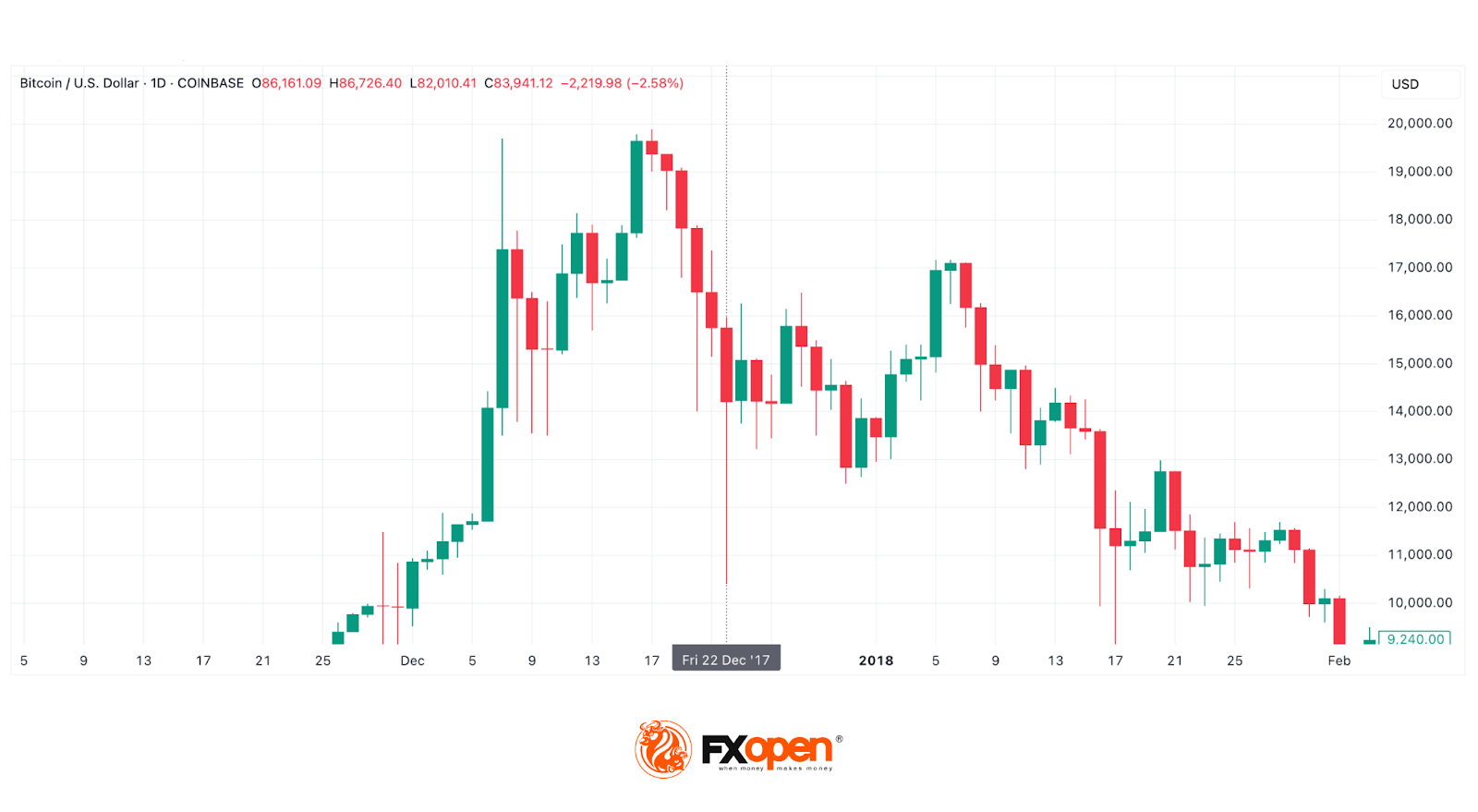
On 22 December 2017, Bitcoin dropped below $11,000, losing nearly a third of its value in just five days. This decline marked its worst week since 2013, following a rapid surge that brought it close to $20,000 on Sunday.
While no single factor fully explained the dramatic fall, growing warnings about the risks of investing in the volatile and unregulated market—Denmark’s central bank governor even labelled it a “deadly” gamble—contributed to the decline.
How Traders Analyse and React to FUD
FUD creates uncertainty, but traders who analyse market reactions critically can spot potential opportunities and avoid impulsive decisions. Instead of reacting emotionally, they assess whether the fear is justified by real data or if it's just market noise.
Fundamental Analysis vs. Speculation
Traders first determine whether FUD is backed by actual risks. If a company's financials remain strong despite negative news or a regulatory development lacks concrete action, the sell-off may be driven more by sentiment than reality. This applies to both stocks and digital assets, where FUD often causes overreactions that later correct.
Sentiment and News Monitoring
Some traders track social media sentiment, news headlines, and analyst opinions to gauge how widespread FUD has become. When negative sentiment peaks but no new damaging information emerges, the market may be nearing a reversal. Tools like Google Trends and market sentiment indices help traders understand whether fear is fading or intensifying.
Volume and Volatility Indicators
FUD-driven moves often come with spikes in trading volume and volatility as traders panic-sell into uncertainty. A surge in volume without a fundamental reason can signal a short-term emotional reaction rather than a lasting market shift.
Analyse markets with advanced indicators in FXOpen’s free TickTrader trading platform.
Contrarian Strategies
Some traders take advantage of oversold conditions caused by FUD, buying when prices drop irrationally. While risky, historical patterns show that FUD-driven dips often reverse once fear subsides. Analysing past market reactions helps traders identify whether fear has gone too far.
The Difference Between FUD and Genuine Market Concerns
FUD in crypto and stocks thrives on uncertainty, but not all negative news is exaggerated or baseless. The key difference between FUD and genuine market concerns is whether the fear is driven by facts and data or speculation and emotion.
Real market risks are backed by tangible developments—declining earnings, rising debt, regulatory enforcement, or economic downturns. When a company consistently misses revenue targets or central banks tighten monetary policy, the impact is measurable. Traders can assess financial reports, macroeconomic indicators, or industry trends to gauge the scale of the problem.
FUD, on the other hand, often stems from rumours, misleading headlines, or misinterpretations of events. For example, a vague statement about a possible regulatory crackdown can trigger panic, even if no concrete action follows. Similarly, a company’s stock might fall sharply on news of an executive resignation despite no change to its core business. These reactions are driven by perception rather than financial reality.
Traders separate the two by looking at historical market behaviour, financial fundamentals, and whether fear aligns with actual data. While both FUD and real risks can cause volatility, genuine concerns tend to have longer-term consequences, whereas FUD-driven sell-offs often reverse once sentiment stabilises.
The Bottom Line
After exploring “What is FUD in crypto and stocks?”, it’s clear that FUD drives emotional reactions, often leading to unnecessary sell-offs. Traders who analyse data rather than react to fear might navigate volatility more effectively. If you know how to trade with confidence and take advantage of potential market opportunities when FUD arises, open an FXOpen account and trade more than 700 markets across four advanced trading platforms with tight spreads and low commissions.
FAQ
How to Overcome FUD?
Traders overcome FUD by focusing on data rather than emotion. Analysing financial reports, market trends, and past reactions to similar events helps separate speculation from real risks. Monitoring volume and sentiment indicators can reveal whether fear is peaking. Avoiding knee-jerk decisions and maintaining a clear strategy prevents emotion-driven mistakes.
What Is the Opposite of FUD?
The opposite of FUD is confidence and conviction, often seen in bullish sentiment. When traders believe in an asset’s long-term value despite short-term uncertainty, they hold or buy rather than panic-sell. Market optimism, supported by strong fundamentals and positive news, counters fear-driven downturns.
What Does FOMO Mean in Crypto?
FOMO (fear of missing out) describes traders rushing into an asset due to rising prices and hype, often without analysis. It leads to overpaying for assets at their peak, increasing exposure to sharp downturns.
*Important: At FXOpen UK, Cryptocurrency trading via CFDs is only available to our Professional clients. They are not available for trading by Retail clients. To find out more information about how this may affect you, please get in touch with our team.
This article represents the opinion of the Companies operating under the FXOpen brand only. It is not to be construed as an offer, solicitation, or recommendation with respect to products and services provided by the Companies operating under the FXOpen brand, nor is it to be considered financial advice.
Stay ahead of the market!
Subscribe now to our mailing list and receive the latest market news and insights delivered directly to your inbox.


Latest articles

CAD/JPY: The Yen's Most Historic Move in 30 Years Meets a Fragile Support
Two central banks are heading in genuinely opposite directions this week, and the tension is unmistakable. The Bank of Canada held rates steady at 2.25% on September 2, with a mildly hawkish tilt as policymakers acknowledged a broadening economic

USD/JPY and USD/CAD Await Key Fed Decision
The US dollar is consolidating against the yen and Canadian dollar ahead of the key event of the week — the Federal Reserve meeting. The Fed is widely expected to raise its policy rate by 25 basis points to a range

UnitedHealth: Fundamentals Are Healing, Now the Chart Must Agree
UnitedHealth finds itself in a genuinely split narrative right now, trading near $388, down about 15.9% from its 52-week high, even as the fundamental picture keeps improving. Q2 earnings beat expectations, with revenue of $112.03 billion, and the