


EUR/NZD Pulls Back From Its December High
FXOpen

Today the EUR/NZD rate touched the 2.4000 level — the highest reading since late November — but then saw a fairly sharp pullback. Fundamentally, the heightened volatility is driven by a combination of factors.
The euro (EUR) is showing strength because:
→ industrial production in the euro area unexpectedly rose by 0.8% (above forecasts), easing recession fears;
→ the market expects a more measured tone from the European Central Bank amid stabilising data. The meeting will take place on Thursday, 18 December.
On the other hand, the New Zealand dollar (NZD) has come under pressure:
→ a report published on 9 December by the New Zealand Treasury (the Half Year Economic and Fiscal Update) delivered a gloomy outlook: the economic recovery is stalling, and unemployment could rise to 5.5%;
→ prices for dairy products (the country’s main export) are falling, undermining the resilience of the “kiwi”.
That said, the EUR/NZD chart suggests that the scope for further upside may be limited.
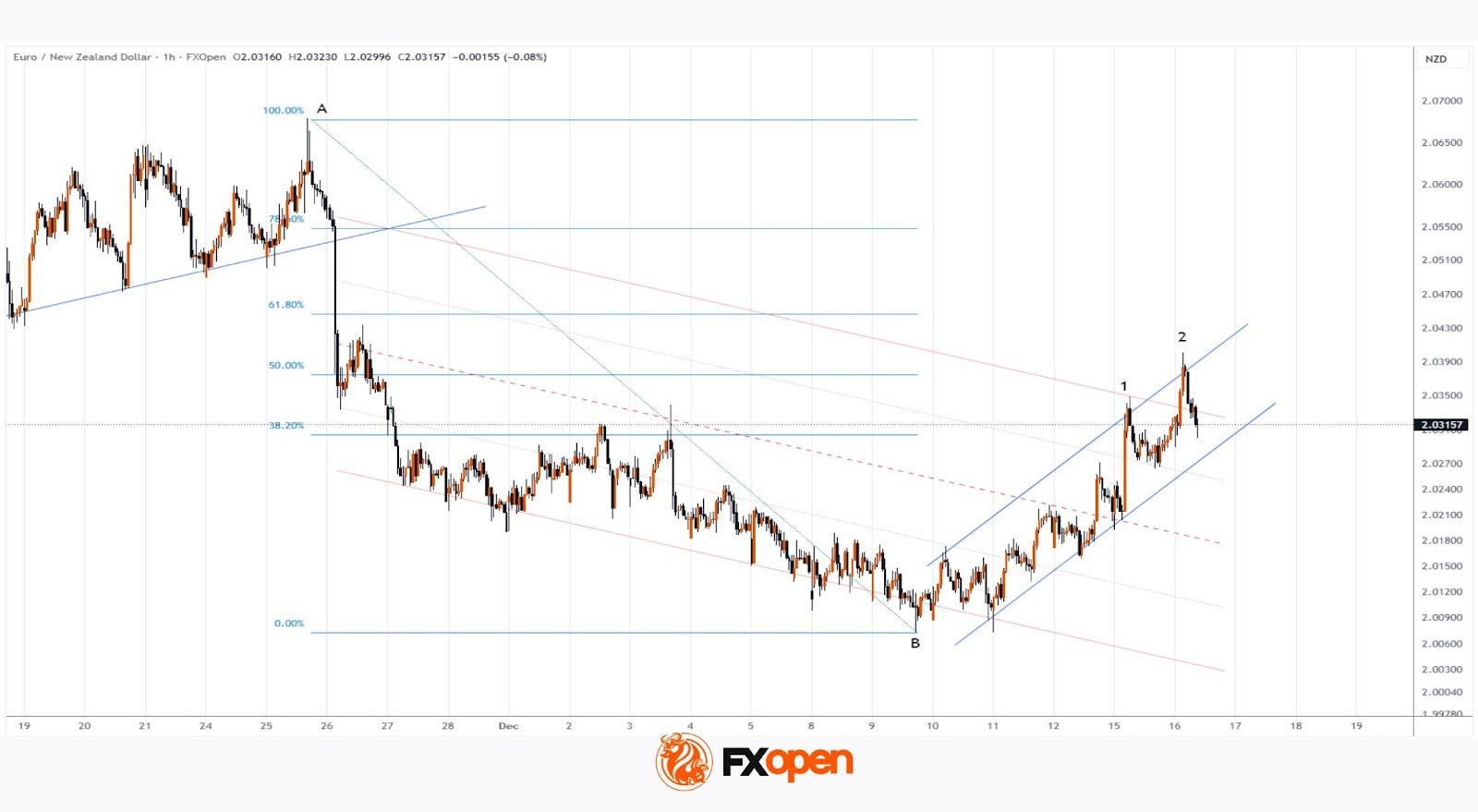
Technical Analysis of the EUR/NZD Chart
From 29 November to 12 December, the pair declined (A→B) by roughly 2.9%, and then rallied to today’s peak (2), which lies almost exactly midway between the extremes at A and B. From a Fibonacci perspective, this can reasonably be interpreted as a normal pullback to the 50% level, after which the downward move may resume.
From the viewpoint of trend channels, the descending channel has been expanded upwards, while today’s move (up then down) essentially resembles a Bearish Engulfing pattern — formed during an attempt to break above the upper boundary of the channel.
Many indicators are likely to show divergence between highs 1 and 2. Therefore, taking all of the above into account, forex traders should keep in mind a scenario in which the upward trajectory of the past seven days (shown in blue) is broken by the bears, and the EUR/NZD rate continues to develop within the descending channel.
Trade over 50 forex markets 24 hours a day with FXOpen. Take advantage of low commissions, deep liquidity, and spreads from 0.0 pips (additional fees may apply). Open your FXOpen account now or learn more about trading forex with FXOpen.
This article represents the opinion of the Companies operating under the FXOpen brand only. It is not to be construed as an offer, solicitation, or recommendation with respect to products and services provided by the Companies operating under the FXOpen brand, nor is it to be considered financial advice.
Stay ahead of the market!
Subscribe now to our mailing list and receive the latest market news and insights delivered directly to your inbox.


Latest articles

CAD/JPY: The Yen's Most Historic Move in 30 Years Meets a Fragile Support
Two central banks are heading in genuinely opposite directions this week, and the tension is unmistakable. The Bank of Canada held rates steady at 2.25% on September 2, with a mildly hawkish tilt as policymakers acknowledged a broadening economic

USD/JPY and USD/CAD Await Key Fed Decision
The US dollar is consolidating against the yen and Canadian dollar ahead of the key event of the week — the Federal Reserve meeting. The Fed is widely expected to raise its policy rate by 25 basis points to a range

UnitedHealth: Fundamentals Are Healing, Now the Chart Must Agree
UnitedHealth finds itself in a genuinely split narrative right now, trading near $388, down about 15.9% from its 52-week high, even as the fundamental picture keeps improving. Q2 earnings beat expectations, with revenue of $112.03 billion, and the