


How the U.S. Presidential Election May Impact the S&P 500 Index
FXOpen

Today, 5 November, the U.S. presidential election is underway, and it may serve as a significant driver of volatility for global stock markets.
According to EuroNews, heightened market fluctuations are expected throughout the voting period on 5 November, potentially mirroring reactions observed during the Brexit referendum and the 2016 U.S. election. Newsweek notes that historically, U.S. stock markets tend to rise regardless of the election winner. In 2020, for example, American stocks rose immediately after election day and continued upward even as Trump contested the results.
Investor’s Business Daily highlights Tony Roth, CIO of Wilmington Trust, who argues that U.S. stock markets could climb regardless of whether Harris or Trump wins, as both candidates provide viable economic paths that could support market sentiment.
On 14 October, analysing the S&P 500 chart (US SPX 500 mini on FXOpen), we plotted three narrow upward channels (shown in blue), noting:
→ each channel has a similar slope and width;
→ connecting the maximum of Channel 1, the peak and trough of Channel 2, and the low of Channel 3 outlines a larger channel (in orange).
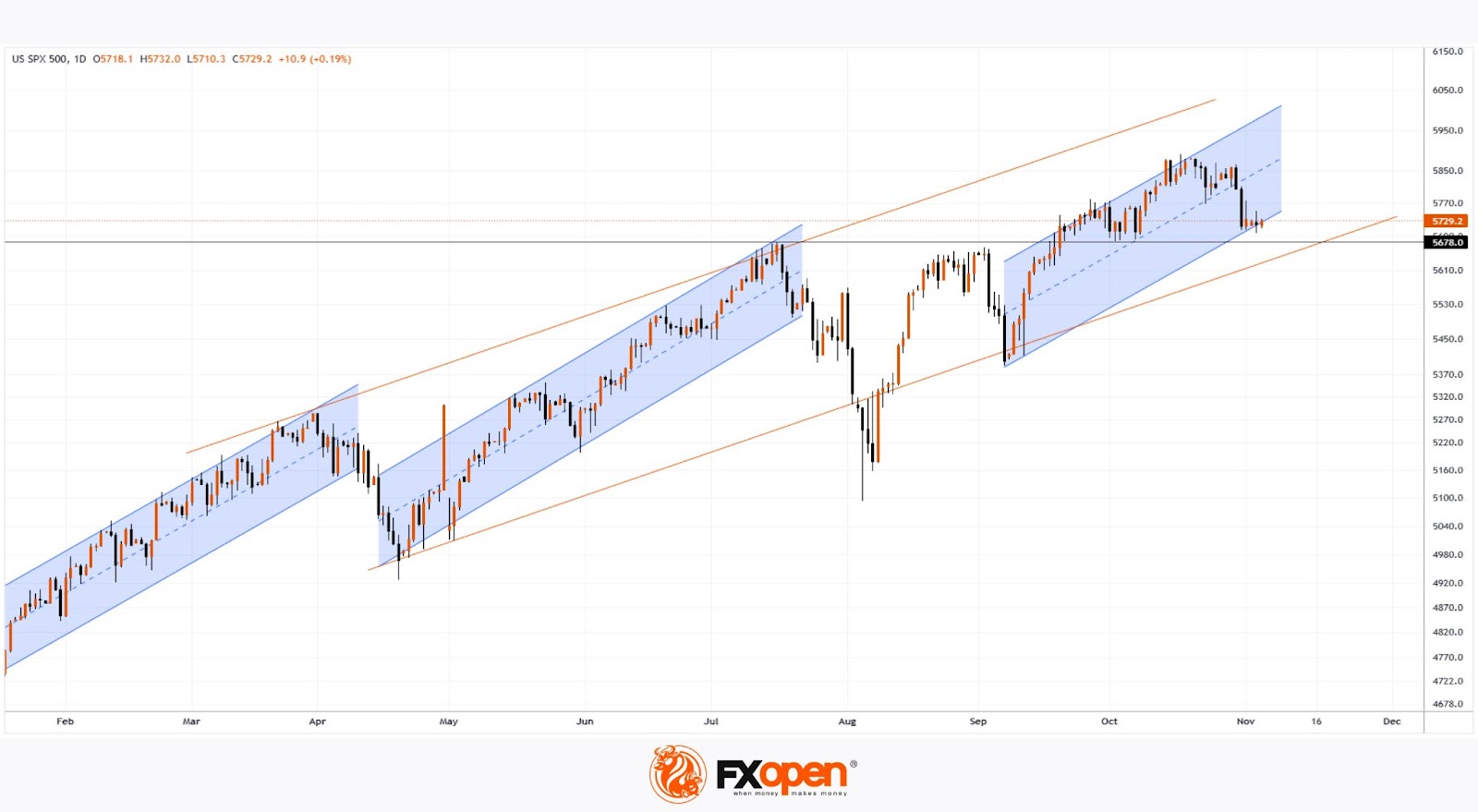
Today’s technical analysis of the S&P 500 (US SPX 500 mini on FXOpen) shows the current index level near the lower edge of the third blue channel, with additional support around:
→ former resistance at $5678;
→ the lower orange boundary.
Election results may trigger a volatility spike, potentially testing or reinforcing these support levels, which could shape future market momentum.
Trade global index CFDs with zero commission and tight spreads (additional fees may apply). Open your FXOpen account now or learn more about trading index CFDs with FXOpen.
This article represents the opinion of the Companies operating under the FXOpen brand only. It is not to be construed as an offer, solicitation, or recommendation with respect to products and services provided by the Companies operating under the FXOpen brand, nor is it to be considered financial advice.
Stay ahead of the market!
Subscribe now to our mailing list and receive the latest market news and insights delivered directly to your inbox.


Latest articles

CAD/JPY: The Yen's Most Historic Move in 30 Years Meets a Fragile Support
Two central banks are heading in genuinely opposite directions this week, and the tension is unmistakable. The Bank of Canada held rates steady at 2.25% on September 2, with a mildly hawkish tilt as policymakers acknowledged a broadening economic

USD/JPY and USD/CAD Await Key Fed Decision
The US dollar is consolidating against the yen and Canadian dollar ahead of the key event of the week — the Federal Reserve meeting. The Fed is widely expected to raise its policy rate by 25 basis points to a range

UnitedHealth: Fundamentals Are Healing, Now the Chart Must Agree
UnitedHealth finds itself in a genuinely split narrative right now, trading near $388, down about 15.9% from its 52-week high, even as the fundamental picture keeps improving. Q2 earnings beat expectations, with revenue of $112.03 billion, and the