


Natural Gas Prices Fell in Late December
FXOpen

On 4 December, while analysing the XNG/USD chart, we highlighted the rally in natural gas prices towards a three-year high and noted that the price had entered a resistance zone formed by:
→ the upper boundary of a broad descending channel (shown in red);
→ the $4.800/MMBtu level, near which a peak was formed in March;
→ the psychological $5.000/MMBtu mark.
As indicated by the arrow:
→ this resistance cluster proved effective, and after an attempt to break above the $5.000 psychological level, the uptrend reached its climax;
→ following the appearance of a bearish gap on 8 December, selling pressure took control, leading to a break below the orange ascending trend line and a decline in US natural gas prices.
From a fundamental perspective, the pullback has been driven by several factors:
→ Seasonality. Weather forecasts for the US holiday period point to above-average temperatures, reducing demand for heating and power generation.
→ Rising production. According to Trading Economics, natural gas output in the continental United States reached 109.7 billion cubic feet per day in December, maintaining the record levels seen in November. In addition, EIA data show that gas inventories remain 0.9% above the current five-year average.
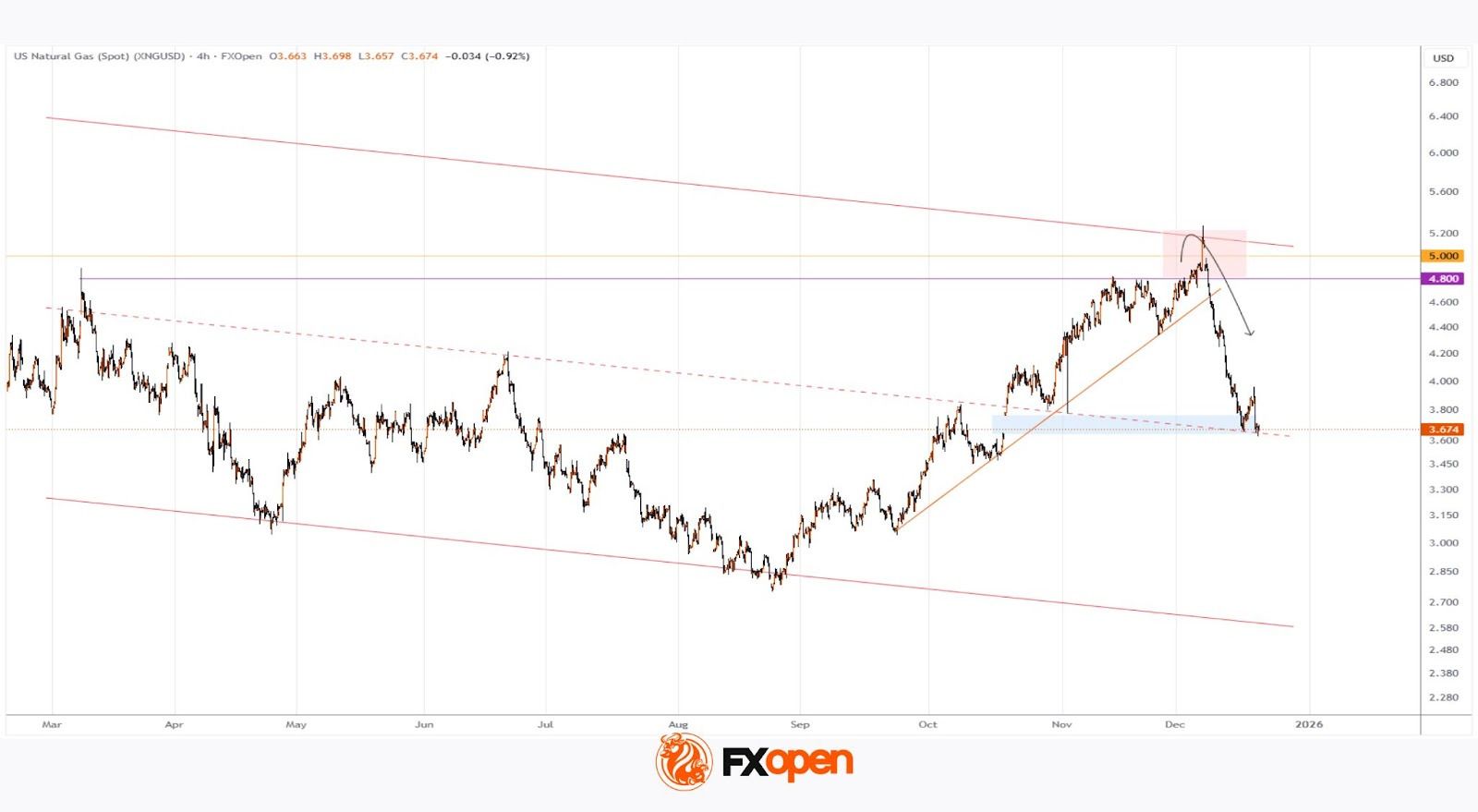
It is worth noting that today natural gas prices are trading:
→ near a support zone created by the bullish gap formed in the second half of October;
→ close to the median of the aforementioned descending channel, an area where supply and demand often come back into balance.
Taking this into account, it is reasonable to assume that:
→ after a sharp drop of around 30% from the early-December peak, sellers may look to lock in profits ahead of the holidays;
→ the market could enter a consolidation phase.
Start trading commodity CFDs with tight spreads (additional fees may apply). Open your trading account now or learn more about trading commodity CFDs with FXOpen.
This article represents the opinion of the Companies operating under the FXOpen brand only. It is not to be construed as an offer, solicitation, or recommendation with respect to products and services provided by the Companies operating under the FXOpen brand, nor is it to be considered financial advice.
Stay ahead of the market!
Subscribe now to our mailing list and receive the latest market news and insights delivered directly to your inbox.


Latest articles

CAD/JPY: The Yen's Most Historic Move in 30 Years Meets a Fragile Support
Two central banks are heading in genuinely opposite directions this week, and the tension is unmistakable. The Bank of Canada held rates steady at 2.25% on September 2, with a mildly hawkish tilt as policymakers acknowledged a broadening economic

USD/JPY and USD/CAD Await Key Fed Decision
The US dollar is consolidating against the yen and Canadian dollar ahead of the key event of the week — the Federal Reserve meeting. The Fed is widely expected to raise its policy rate by 25 basis points to a range

UnitedHealth: Fundamentals Are Healing, Now the Chart Must Agree
UnitedHealth finds itself in a genuinely split narrative right now, trading near $388, down about 15.9% from its 52-week high, even as the fundamental picture keeps improving. Q2 earnings beat expectations, with revenue of $112.03 billion, and the